#Sponsored

Thursday, April 23, 2020

China and North Korea Cheer: Why Are U.S. Bombers Leaving Guam? The U.S. military has sought to make major deployments less predictable. by Peter Suciu


Over the weekend the United States Air Force announced that it would nix its six-month bomber rations at Andersen Air Force Base in Guam in favor of "less predictable" global deployment. Since 2004 bomber patrols from Guam over the East and South China Seas have served as a means of projecting U.S. airpower in the region. 
The USAF base on Guam is 1,800 miles east of China.
Last week five B-52H bombers flew back to their home station at Minot Air Force Base, North Dakota. This came just days after the nuclear-capable bombers took part in an "elephant walk" show of force on the island aimed at China, North Korea and Russia. The B-52s were lined up with six KC-135 Stratotankers, an RQ-4 Global Hawk long-range surveillance drone and a U.S. Navy's MH-60S Knighthawk helicopter.
The "elephant walk" is a procession of military aircraft taxiing in close formation. Last week's walk was widely seen as a demonstration that despite the fact that China had the only aircraft carrier, Liaoning, operating in the region, that the United States still had a significant military presence.
However, with the departure of the bombers, came an end to the Continuous Bomber Presence Mission, which had seen a rotation of B-52s, B-1B "Bone" supersonic bombers and B-2A Spirit stealth bombers for half-year stints. The program ensured that at least one task force of long-range heavy bombers would be ready to respond to any potential issue in the Pacific Region.
In recent months, the Air Force suggested that it wanted to implement shorter duration bomber deployments in the American territory in the Pacific – but the U.S. military has sought to make major deployments less predictable. The goal of Dynamic Force Employment operations is to make potential adversaries such as China and Russia feel more on edge and not be able to predict U.S. military movements. 
"In line with the National Defense Strategy, the United States has transitioned to an approach that enables strategic bombers to operate forward in the Indo-Pacific region from a broader array of overseas locations, when required, and with greater operational resilience, while these bombers are permanently based in the United States," U.S. Air Force Major Kate Atanasoff, a U.S. Strategic Command (STRATCOM) spokesperson, said in a statement as reported by Stars & Stripes. "U.S. strategic bombers will continue to operate in the Indo-Pacific, to include Guam, at the timing and tempo of our choosing."
The U.S. Strategic Command tweeted last week, "Our diverse bomber fleet – B-52, B-1 & B-2 – allows us to respond to global events anytime, anywhere. Whether they’re launched from Louisiana, Guam, or the U.K., long-range strategic bombers have and will remain a bedrock of our deterrence! #DynamicForceEmployment."
The B-52H bombers, along with other aircraft from Guam, have flown patrols in the South China Sea as part of the so-called Freedom of Navigation Operations, or FONOPS, to challenge Chinese claims to the hotly contested island chains in the region.

#Sponsored- Medical/Surgical Mask For Protection Against Covid19 and Pollution

Medical/Surgical Mask 
Book your order now and save time before lockdown is lifted.
Avoid rush and delay.
Contact now email: letongr@gmail.com
WhatsApp: 886955486092
Mobile:+886955486092
Skype:linojo
Mr. John Wang


Could Coronavirus Finish Trump? Here's how the pandemic could hurt his chances. by Paul Whiteley and Harold D Clarke


The US currently has the highest number of coronavirus cases in the world and the highest number of deaths. 
Many commentators claim that President Donald Trump’s reaction to the mounting health crisis has been confused and incoherent. Despite this, the crisis has produced a “rally round the president” effect in public opinion.
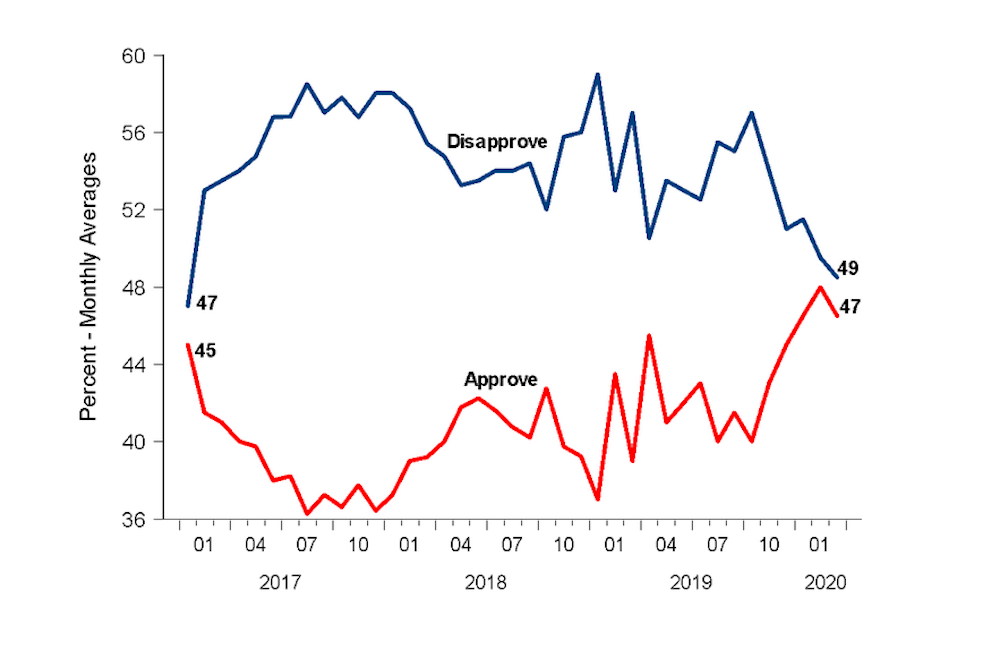
The graph below tracks the average percentage of Americans in monthly Gallup Polls who approve or disapprove of the job Trump has been doing since his inauguration. Presidential approval ratings have rallied in the past when the US has faced significant crises. 9/11 was a good example, with support for President George W Bush, skyrocketing from 56% to 88% between August and October 2001.
Trump’s job approval ratings
Following his inauguration in January 2017, Trump’s job approval ratings fell rapidly, and there was a gap of minus 22% between approval and disapproval by August of that year. His ratings then gradually improved only to crash again following the mid-term Congressional elections in November 2018 when the Republicans lost control of the House of Representatives to the Democrats.
Since the coronavirus pandemic emerged, public opinion has rapidly shifted and more Americans now perceive the virus as a serious threat to public health and the US economy, according to Pew Research Centre data. Despite this, Trump’s job approval ratings have improved in recent weeks with some polls giving him a positive net rating for the first time since his inauguration.
Does this mean that Trump will be re-elected in November on a wave of public endorsements of his handling of the crisis? Our statistical analyses suggest not.
Falling consumer confidence
Efforts to combat the coronavirus have sent the American economy into a tailspin, with 22.2 million people filing for unemployment in the four weeks since March 14. This is the highest number on record, far surpassing the previous high of 6.6 million unemployed in May 2009 during the depths of the great recession.
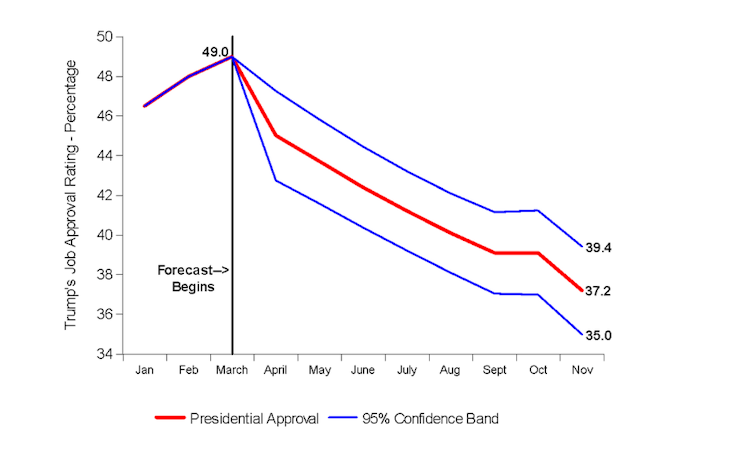
Our forecasting model is known as an error correction time series model which we used to analyse the relationship between the state of the economy and attitudes to Brexit in the UK over more than a decade. If we apply it to the task of modelling the relationship between Trump’s job approval ratings and consumer confidence in the US, his ratings will fall sharply by the time of the election if the economy continues to crash. This is illustrated in the graph below, where the red line is the forecast and the blue lines measure our confidence in it.
The forecast is based on the relationship between presidential approval and consumer confidence over 506 months going back to January 1978. Consumer confidence is measured using the Michigan Index of Consumer Sentiment, a widely used index of public attitudes about the state of the economy. A high score on the index means that Americans are optimistic about the economy and a low score that they are pessimistic.
The consumer confidence index fell sharply from 101 to 89 between February and March 2020. This is the fourth largest one-month decline in nearly half a century and recent Pew survey shows that 65% of Americans expect a recession or even a depression in the months ahead.
In our forecast we assume that a sharp economic downturn will occur, and that the consumer confidence index will fall to 55 in April, as it did in November 2008 during the financial crash. In December 2008, it recovered up to 60, but by February the following year it had fallen again to 56. Overall, the index is fairly volatile but the current sharp decline in the US economy is much more likely to make it fall rather than increase before this year’s election.
Our model assumes that if the index stayed at 55 until the November presidential election, Trump’s job approval would decrease to 37.2%.
Where Trump’s approval ratings could go
Our analysis indicates that when consumer confidence is high, Americans are optimistic and reward the president for his performance, and when it is low they become pessimistic and punish him. This relationship can be disturbed temporarily by events such as international crises and wars (which we take into account), but presidential approval and consumer confidence continue to track each other as the effects of such events gradually dissipate.
Election prospects
If Trump’s job approval rating did fall to 37.2%, this would translate into an electoral disaster for him. Although it is not the only factor at work in any particular election, a president’s job approval rating is always crucial.
In an accompanying analysis we used historical data on the popular vote – which we employ as a proxy for presidential approval – and seats won in the electoral college between 1920 and 2016 to model how many electoral college seats Trump could be expected to win if his job approval rating was at 37.2% in November 2020. If he won this same percentage of the popular vote, our model indicates that he would win only 55 electoral college seats, far below the 270 needed to remain in the White House.
Consumer confidence does not need to be so extremely pessimistic for the president to be in serious trouble. Trump has a strong base of supporters and his approval rating has seldom fallen below 40% during his term in office. If most of these people continue to view his efforts positively and the consumer index falls only half as much (to 73 points rather than 55 until November), we predict Trump would get 43.7% of the popular vote and 181 electoral college votes – again a decisive defeat.
A third scenario underscores how the president’s re-election chances hinge on an economic recovery and the increasingly sanguine consumer confidence it would generate. If we assume that consumer sentiment follows a V-shaped path, falling to 55 in April but then gradually recovering to 101 in October (where it was in February), our model shows that Trump gets a slim majority – 50.9% – of the popular vote. This translates into 320 electoral college votes, and Trump’s re-election.
Taken together, these forecasts emphasise the importance of a healthy economy for Trump’s prospects of a second term. Clearly, he would be in serious trouble if there is a major erosion of consumer confidence. He won in 2016 with 46% of the popular vote, but only with extremely narrow victories in Michigan, Pennsylvania and Wisconsin. These manufacturing states of the so-called rust belt are likely to be hard hit by a protracted recession, so consumer confidence and the presidential approval ratings it generates could be even lower in such places than elsewhere.

This Air Force Unit Is Making U.S. Special Forces Deadlier Than Ever Intelligence is key. by David Axe


Here's What You Need To Remember: Between 2008 and 2012, the Pentagon grew its fleet of spy planes and surveillance drones by 238 percent—until they accounted for half of all Air Force aircraft, according to the ISR Agency history. By 2012 the Defense Department was spending $67 billion a year on intelligence and surveillance. 
A secretive group of U.S. Air Force intelligence specialists flying aboard American spy planes helped U.S. military commandos kill more than a thousand enemy combatants in just a single year back in 2012.
That’s one startling revelation in the official annual history for 2012 of the Air Force’s Intelligence, Surveillance and Reconnaissance Agency, a heavily-redacted copy of which the service released under the provisions of the Freedom of Information Act.
Linguists and analysts from the 361st Intelligence, Surveillance and Reconnaissance Group at Hurlburt Field in Florida flew on at least 31,180 combat sorties in 2012, supporting no fewer than 960 separate operations that resulted in Special Operations Forces detaining more than 3,980 people and killing at least 1,210, according to the history.
That single year’s kill tally probably makes the 361st one of the deadliest individual organizations in the entire U.S. military.
The 361st began as an aerial mapping unit during World War II. In 2008, the Air Force revived the unit as part of a massive expansion of intel units to support counter-terrorism operations and the wars in Iraq and Afghanistan.
Between 2008 and 2012, the Pentagon grew its fleet of spy planes and surveillance drones by 238 percent—until they accounted for half of all Air Force aircraft, according to the ISR Agency history. By 2012 the Defense Department was spending $67 billion a year on intelligence and surveillance.
Many intel flights require specialists to fly aboard the aircraft to quickly analyze the video the plane is shooting or translate the communications between enemy fighters that the aircraft’s receivers pick up.
The intelligence personnel can then pass the information they gather to troops on the ground. The info might include the locations and strength of enemy fighters.
The 361st—which oversees two smaller units of linguists and analysts, the 19th and 25th Intelligence Squadrons—provides the specialists for spy flights supporting Special Operations Forces. The group “is heavily tasked around the world,” the Air Force stated in a fact sheet.
Tech. Sgt. Brandi Fast from the 25th Intelligence Squadron was the Defense Department’s Language Professional of the Year in 2013. That year she deployed twice to Southwest Asia—Afghanistan, presumably—and helped during a mission to rescue 14 crew from a coalition helicopter that crashed.
Fast has a 16,000-word vocabulary in three languages, according to the Air Force.
Lt. Col. John Shirley, the 361st’s commander since April 2014, called his people “the best and brightest America and the Air Force has to offer.”
The planes the 361st’s specialists ride in could include special commando aircraft belonging to the Air Force or the Army. The Air Force’s few public releases concerning the 361st specifically mention U-28 and MC-12W spy planes, which are heavily-modified turboprop transports sporting sophisticated sensors.
The MC-12W was a fixture in Afghanistan from 2010 to 2014. The U-28s spend much of their time in Africa.
The 361st’s intel personnel also support drone flights, presumably by sitting in the robot planes’ command trailers and analyzing video and communications intercepts the drones pipe in. In 2012, 19 percent of the 31,180 sorties the 361st’s people supported were drone flights, according to the ISR Agency history.
Based on the more than 1,200 people the 361st helped to kill in 2012, the group’s work is certainly deadly to America’s enemies. But the unit has also suffered casualties of its own.
On Feb. 18, 2012, a U-28 crashed in Djibouti in East Africa, killing Senior Airman Julian Scholten from the 25th Intelligence SquadronAnd the 361st’s Staff Sgt. Richard Dickson, who operated signals-intercepting gear, died in Afghanistan on April 27, 2013, when his MC-12W went down in hostile territory.

How the Use of Prisoners to Manufacture Coronavirus Supplies Puts Them at High Risk of Illness (Or Even Death) by Carlee Purdum

Reuters
Dependence on incarcerated workers in times of disasters is embedded throughout emergency management policy and practice at the local, state and federal levels.
Under pressure from the coronavirus pandemic, states are turning to prisoners for support. 
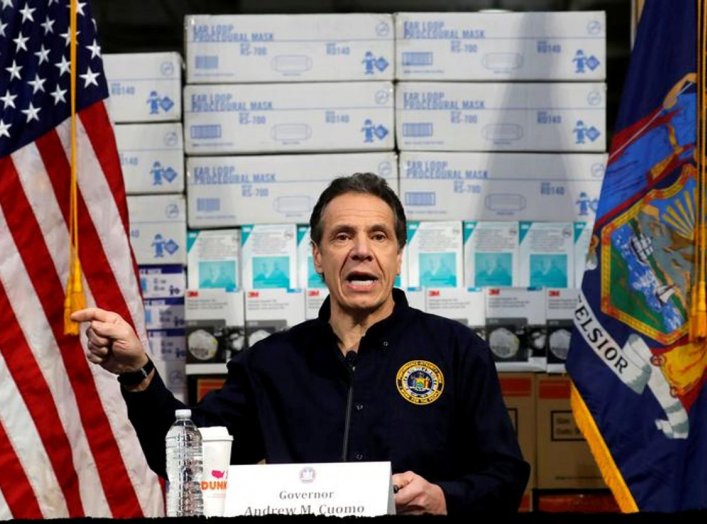
New York Gov. Andrew Cuomo announced on March 9 that the state prison system’s industrial arm, Corcraft, would help produce hand sanitizer.
To date, nearly every state in the U.S. has announced that its incarcerated populations are contributing labor to the pandemic response.
I am a sociologist who studies how emergencies affect correctional institutions. Dependence on incarcerated workers in times of disasters is embedded throughout emergency management policy and practice at the local, state and federal levels.
But that dependence may now be putting these prisoners at risk of illness or even death.
Emergency planning
In the weeks since the coronavirus began to spread across the U.S., every state has declared an emergency, allowing state resources to be directed toward fighting the pandemic.
Incarcerated people in state prisons, representing approximately 1.3 million potential workers, are considered state resources. In my research on state-level emergency operations planning, I’ve found that the majority of states plan to use incarcerated workers to respond to emergencies and disasters.
For example, after disastrous flooding in Cook County, Illinois in 2016, inmate labor was used for sandbagging and debris removal. In the same year, Indiana turned to state prisoners to cull poultry infected with the avian flu.
Federal policy also offers an incentive for using incarcerated workers for emergency-related labor. When President Donald Trump declared a national emergency under the Stafford Act on March 13, the Federal Emergency Management Agency Public Assistance program made money available for states’ COVID response efforts. This program allows local and state government to be reimbursed for costs associated with the management of the emergency or disaster, including the costs of using incarcerated workers.
According to the program guidebook, FEMA pays for prisoner labor costs “based on the rate that the applicant normally pays prisoners,” as well as “prisoner transportation to the worksite and extraordinary costs of security guards, food and lodging.”
Most incarcerated workers are assigned to work within the correctional institution, for local government agencies or for nonprofits. The pay for such work is, on average, between US$0.14 and $0.63 an hour. Certain states, including Alabama, Arkansas, Florida, Georgia and Texas, do not pay wages for such work assignments.
Some states have announced pay increases. In New York, incarcerated workers are reportedly being paid $6 an hour to dig graves, a task assigned to them in the New York City pandemic response plan. In North Dakota, incarcerated workers who clean and disinfect facilities are being offered bonuses for “good work.”
Participation in correctional industries is voluntary and the pay is higher, on average between $0.33 and $1.41. However the conditions under which incarcerated individuals participate can be coercive. The 13th Amendment to the U.S. Constitution was passed to abolish slavery, but an exception was created for persons convicted of a crime.
Incarcerated people do not have the constitutional right to refuse to work. If they don’t volunteer to participate in a certain type of labor, they can be assigned to work in another area that would offer significantly less pay or even no pay, depending upon the state.
Furthermore, they do not have any control over their work conditions, though incarcerated workers have protested against exploitative labor practices by organizing work strikes in prison systems across the U.S., most recently in 2018.
Work conditions
In February, I began to track how state prison systems are adapting their operations and policies in response to the coronavirus, including the decision to use incarcerated workers for response efforts.
Research shows that decision places the workers in danger.
Correctional and detention facilities are particularly vulnerable to the risks of the coronavirus. Incarcerated populations go about their daily routines within a crowded environment. That poses significant challenges to implementing effective social distancing practices.
The Centers for Disease Control and Prevention suggests canceling assignments that take incarcerated workers outside of the facilities and that administrations plan for the need to “implement alternate work arrangements.” The CDC also suggests – but does not mandate – certain safety precautions for incarcerated workers if infections appear within a facility, including social distancing and the distribution of personal protective equipment.
Evidence is emerging that corrections officials may not practice the recommended social distancing.
On April 3, the Arkansas Department of Corrections posted an image of incarcerated workers making masks while sitting next to one another. A video they posted on April 7 showed incarcerated women making masks, at times working only within inches of each other.
In a report from The Marshall Project, one former prisoner says that incarcerated workers within state prison industries do not have access to masks and gloves.
Idaho has shuttered its correctional industries operations out of safety concerns related to the coronavirus.
Meanwhile, in Pennsylvania, as prison manufacturing ramps up, incarcerated people are working longer hours. With the entire state prison system under quarantine, some Pennsylvania prisoners are now working 12 hours a day, six days a week to produce masks, antibacterial soap, medical gowns and disinfectant. (According to the state department of corrections, the standard workday for incarcerated workers is six hours a day, five days a week.)
In Missouri, incarcerated workers are continuing to wash and handle hospital laundry. This arrangement has the potential to introduce the coronavirus to the state’s incarcerated populations.
In early February, the Healthcare Laundry Accreditation Council president issued a statement on the impact of the coronavirus on laundry practices. She described how “all soiled linen should be handled as if it is contaminated.” And the organization states that following their standards only “minimizes” the risks of exposure from contaminated materials.
Exposure to hazards
States and the federal government look to incarcerated populations to supply labor at a reduced cost, even as it may subject them to risk of harm and even death.
The most visible example of this are the incarcerated who volunteer to fight fires. These firefighters in California are more likely to experience certain injuries, including fractures and dislocations, as well as inhalation of smoke and particulates, when compared to civilian firefighters.
The decision to continue to use incarcerated workers for hazardous work that could expose them to the coronavirus or facilitate the spread within the facility lies with corrections authorities and emergency management officials.
Every day, the number of incarcerated persons and prison workers who have tested positive for COVID-19 grows. In my view, corrections and emergency officials should be doing everything in their power to reduce the impact of the coronavirus on a vulnerable population by following recommended health guidelines.

Why Hasn't Anyone Died of Coronavirus In Vietnam? A poster warning about the coronavirus disease (COVID-19) is seen on a street in Hanoi, Vietnam. by Robyn Klingler-Vidra and Ba-Linh Tran

A poster warning about the coronavirus disease (COVID-19) is seen on a street in Hanoi, Vietnam April 20, 2020. REUTERS/Kham
Vietnam – a developing country that has a large land border with China and a population of 97 million people – has not reported a single death from coronavirus. As of April 21, the country had reported 268 cases of COVID-19, the disease associated with the new coronavirus, with more than 140 people making a full recovery. 
The reason why Vietnam has managed to keep patients from death’s door is down to a three-pronged government strategy. While these policy choices may not all be consistent with upholding civil liberties, they are proving essential to keeping the pandemic at bay.
Temperature screening and testing
Starting in February, anyone arriving at an airport in a major Vietnamese city had to go through compulsory body temperature screening and fill in a health self-declaration, stating their contact details and travel and health history. These measures are now mandatory for everyone entering major cities and some provinces by land too, and for everyone entering a government building or hospital.
Anyone with a body temperature of over 38C is taken to the nearest medical facility for more thorough testing. Those who are proven to have lied in their self-declaration, or who resist declaring altogether, can be criminally charged.
Businesses including banks, restaurants and apartment complexes have also implemented their own screening procedures.
There has also been intensive testing across the country. Testing stations have been set up across cities, which all citizens can attend. Communities who live near confirmed cases – sometimes an entire street or village – are swiftly tested and placed in lockdown.
Our own research on the development of affordable test kits found that by March 5, Vietnam had validated three different test kits, each costing less than US$25 (£20) and producing results within 90 minutes. These are all being manufactured in Vietnam. The cost of testing matters everywhere, but is particularly important in emerging economies like Vietnam and these affordable test kits have helped the government’s intensive testing strategy.
Targeted lockdowns
The second prong of Vietnam’s approach is quarantine and lockdowns. Since mid-February, Vietnamese people returning home from abroad have been quarantined for 14 days on arrival and tested for COVID-19. The same quarantine policy has been applied to foreigners coming to Vietnam. Anyone who has come into direct contact with an infected person, the details of whom are publicised, is encouraged to come forward for quarantine. If it’s discovered somebody has come into contact with someone who has tested positive, they will be put into mandatory quarantine.
In March, Vietnam started to lock down whole cities and specific areas in a city. Travelling between cities is now highly restricted. In Danang in central Vietnam, anyone who is not a registered resident of the city but wishes to enter has to submit to a 14-day quarantine at a government-approved facility which they must finance themselves.
Villages of 10,000 people have been fenced off on account of single cases. Bach Mai, a famous hospital of 3,200 people in Hanoi which is also a leading COVID-19 treatment centre, was even locked down in late March after one externally contracted staff member tested positive. Businesses, both state and private, are closed down, and the tourism and airline industries are essentially frozen.
Constant communications
From early January, the Vietnamese government has communicated widely to citizens about the seriousness of the coronavirus. Communications have been clear: COVID-19 is not just a bad flu, but something to be taken extremely seriously, so people are advised not to put themselves or others at risk.
The government has been creative in its communications methods. Each day, different parts of the Vietnamese government – from the prime minister, to the Ministry of Health, Ministry of Information and Communications and provincial governments – text citizens with information. Details on symptoms and protection measures are communicated via text to mobile phones all over the country. The government has also partnered with messaging platforms, such as Zalo, to distribute updates. This is coupled with propaganda art across the country and newly designed stamps that further disseminate public health messages about the virus. Vietnam’s cities are adorned with posters that remind citizens of their role in stopping the spread of the virus.
At the same time, the government is revealing details of those who have COVID-19 or, in rare cases, have escaped quarantine – though the person’s name is not made public. For example, two new reports detailed the travel details of patients 237 and 243.
Even if some cases have not yet been detected by officials, there’s no doubt that the Vietnamese approach has been effective in reducing the spread of the virus. Combined, these measures mean Vietnam has not yet experienced any large scale community outbreak, which would devastate a city like Ho Chi Minh City with a population of 11 million and overwhelm the country’s public healthcare system.

Coronavirus Cases in Africa Could Top 1 Billion Okikiolu Badejo by Nazeem Muhajarine, Ejemai Eboreime, Jacob Albin Korem Alhassan, Okikiolu Badejo

Cheikhou Dembele, 25, Senegalese Red Cross volunteer, waits outside a house during an awareness campaign to prevent the spread of coronavirus disease (COVID-19), in Dakar, Senegal April 18, 2020. REUTERS/Zohra Bensemra
As the SARS-CoV-2 virus sweeps across the globe, African countries are bracing themselves for grave consequences. The projections released on April 17 estimate more than a billion cases and 300,000 deaths due to COVID-19. 
These staggering estimates are a call to urgent action. The time to act in Africa is now, and to apply lessons from its own recent history of battling epidemics such as Ebola and HIV, as well as lessons from countries where COVID-19 outbreaks may now be peaking.
No one knows, though, how Africa is going to come through this pandemic. Compared to the rest of the world, especially Asia, the virus has arrived later, giving opportunity for real-time lessons that can help direct Africa’s battle.
We offer three recommendations in this regard:
● dissemination of accurate information
 a co-ordinated and equitable response from medical and civic communities, and governments
● ramping up testing capacity
1. Disseminate accurate, easy-to-understand information
This is the first epidemic of global scale in the age of the internet. Information, good and bad, spreads rapidly with no regard to national borders. All levels of governments have struggled to keep abreast of the fast-moving pandemic and its implications.
Complicating matters, misinformation — about lines of transmission of the virus, immune-boosting remedies and even probable cures — travels as quickly as science-based information, and is often propagated through social media.
This pandemic requires science-based messaging led by all levels of government. In the best examples, heads of governments, including Canada, give daily briefings and take questions from media. By directly advising people and communities through public service announcements, and enlisting influencers to propagate key messages, governments can create a sense of confidence while confronting misinformation.
Without a steady flow of accurate and clear messages, misinformation and fear take hold. Once this happens it is difficult to undo the damage.
2. Co-ordinate political, medical and civic action with equity in mind
The role of governments does not stop with managing information. Governments need to marshal all the resources and instruments they have to spearhead a co-ordinated response to the pandemic.
Key early steps are to work with medical and public health authorities to co-ordinate and implement a multi-pronged response. This should include data collection and monitoring, protective initiatives for health-care and essential services workers, and containment and mitigation strategies, as well as information dissemination.
Governments, medical and civic leaders must be proactive in dispelling unhelpful public perceptions before they take hold. For example, fears exist that governments are neglecting the most vulnerable members of society — especially the elderly, and those living in poverty and in rural and remote areas. People are also worried that essential services such as food, water, electricity and health care may be disrupted or overwhelmed.
Strikes by health-care workers are already threatening the response capacities in countries such as Zimbabwe, Ghana and Nigeria. Citizens in many countries fear that their personal safety and human rights may be endangered during this crisis.
These fears are real. Governments must address them by detailing the measures they have taken to provide a social safety net for the most vulnerable, by tackling potential artificial price hikes in essential goods and services, and by protecting people from human rights violations that may result from misapplication of enforcement measures.
An unequivocal stance of transparency and accountability can help minimize the loss of lives from COVID-19. More than that, it can foster public confidence and help ensure the resilience of Africa’s economic, political and health systems once the pandemic is over.
3. Ramp up testing capacity with equitable access
In Africa, as in other parts of the world, many countries are currently unable to meet the increasing demands for testing. Consequently, some have established protocols that target people considered most likely to have contracted the virus. But there are concerns that inequitable access to testing and lack of transparency could threaten control efforts. In responding to COVID-19, African health systems will need to pay particular attention to equity.
In South Africa, tests are available at government facilities and private laboratories. However, even in countries where most tests are provided by publicly funded facilities, concerns exist that influential members of society, such as politicians and celebrities, have privileged access.
This inequity may lead to the distribution of positive tests skewing strongly toward wealthier groups. This may create a false sense of immunity among population groups with the fewest resources, who already tend to see COVID-19 as “the rich person’s disease.”
To address this misconception, testing needs to be made available to everyone who needs it and not only those who are well-resourced. Given the public health implications of missed cases, countries must prioritize public funding of COVID-19 testing and treatment, and access to testing must be made equitable and transparent.
In addition to lessons learned from COVID-19’s spread in Asia and Europe, Africa can also learn from its own experiences, including facing earlier health crises. During the 2014 Ebola virus disease epidemic in West Africa over 29,000 people were infected, and about 11,310 of them died. In addition to these deaths, significant socioeconomic and political disruptions occurred.
These experiences have taught African leaders valuable lessons and instilled confidence that they can pull through major catastrophes. As in 2014 when Ebola struck, the world needs to stand with African leaders, medical and public health systems, and civic society to beat back the threat of a billion COVID-19 cases in Africa.
The announcement by G20 countries to suspend the debt service payments by the world’s lower-income countries is a promising first step, but the high-income countries and the development financing institutions (World Bank, IMF) need to do much more.

What Will Happen if the Coronavirus Vaccine Fails? A vaccine could provide a way to end the pandemic, but with no prospect of natural herd immunity we could well be facing the threat of COVID-19 for a long time to come. by Sarah Pitt

  There are  over 175  COVID-19 vaccines in development. Almost all government strategies for dealing with the coronavirus pandemic are base...