#Sponsored

Friday, May 8, 2020

Watch The Army's Futuristic Invictus Attack Helicopter Destroy Russia's Tanks It’s a new generation of Russian equipment that has the dubious honor of being destroyed by the U.S. defense industry. by Michael Peck

It's natural that a defense manufacturer would depict its next-generation helicopter battling next-generation enemy equipment. But it’s also a reminder of how military technology passes on. Just as the Vietnam-era Huey helicopters have faded, so eventually will the B-52s, F-15s, A-10s and all the other equipment that the Cold War baby boomers grew up with.
The call goes over the radio as three T-14 Armatas – Russia’s most advanced tank – explode under a salvo of missiles.
Their killers -- American attack helicopters – swoop away in search of fresh prey. They quickly find it in the form of what looks T-15s – the armored troop carrier version of the Armata. The T-15s are also wiped out.
None of this was real. The battlefield was fictional, the Armata tanks just entering service now, while the Invictus attack helicopters – assuming the U.S. Army even buys them – wouldn’t be in service for another decade.
Nonetheless, this video game-style presentation by Invictus manufacturer Bell (you can see the video here) is interesting. Not because a defense contractor is putting out promotional materials in hopes of winning a lucrative Pentagon contract. That’s a common enough practice.
What’s different here are the enemy weapons. They’re not the traditional Cold War Soviet equipment, the T-72 tanks and BMP troop carriers (or “generic” enemy weapons that happen to look like them) that you might find in a marketing brochure or an entertainment video game.
It’s a new generation of Russian equipment that has the dubious honor of being destroyed by the U.S. defense industry. For example, another Bell video shows an animated Invictus obliterating an enemy air defense battery. But it’s not a battery of Cold War SA-6 missiles or ZSU-23-4 flak guns: the sacrificial weapons are S-400s, Russia’s advanced long-range anti-aircraft missile.
The first Bell video does show a foot soldier firing a shoulder-fired anti-aircraft missile at an Invictus, which successfully deflects it by releasing a salvo of decoys. In real life, the Invictus and other helicopters and aircraft would face a formidable and plentiful array of Russian air defense weapons, including the S-400, the Pantsir and Tunguska self-propelled anti-aircraft missile/gun combos, and even Russian attack helicopters armed with air-to-air missiles. NATO planners worry that even stealth aircraft such as F-35 would have difficulty operating over Eastern Europe.
When queried by the National Interest, a Bell spokesman said that decision to include the Armata and the S-400 in the video probably resulted from a desire to depict the battlefield around 2030, when the U.S. Army plans to field a new generation of scout helicopters.
And those helicopters will be formidable. The Invictus (Latin for “unconquered”) is Bell’s contender for the Army’s Future Attack Reconnaissance Aircraft (FARA) program, which seeks to replace the 1960s Bell OH-58 Kiowa scout helicopter with a modern design. The Army has been searching for a replacement for the Kiowas since the 1980s,  including several abortive projects such as the RAH-66 Comanche, canceled in 2004 after $7 billion had been spent on the project.
There are now five contenders for the FARA contract, which seeks to replace the Kiowa by 2028, including AVX, Bell, Boeing, Karem and Sikorsky. They must meet certain FARA requirements, including being armed with a 20-mm cannon and an integrated munitions launcher, as well as Improved Turbine Engine Program propulsion.
Bell’s Invictus is a sleek design (though not stealthy, which the Army isn’t looking for) based on Bell’s 525 Relentless medium-lift helicopter. The Invictus cruises at 180 knots, has a payload of 1,400 pounds and a combat radius of 135 nautical miles that includes 90 minutes of loiter time on station.
It's natural that a defense manufacturer would depict its next-generation helicopter battling next-generation enemy equipment. But it’s also a reminder of how military technology passes on. Just as the Vietnam-era Huey helicopters have faded, so eventually will the B-52s, F-15s, A-10s and all the other equipment that the Cold War baby boomers grew up with.
Time marches on.

Sanders Advisor: Investigate China for Coronavirus, but Don’t "Incite Hostility" Progressives are taking a more cautious tone about the growing U.S.-Chinese tensions. by Matthew Petti

https://www.reutersconnect.com/all?id=tag%3Areuters.com%2C2020%3Anewsml_RC21BG92O7RW&share=true
Democrats are lining up behind calls to investigate the Chinese government over a potential coronavirus coverup, but the progressive wing of the party is warning against turning calls for transparency into a pandemic-driven cold war with China. 
Secretary of State Mike Pompeo doubled down Wednesday on controversial claims the novel coronavirus disease could have originated in a lab accident covered up by the Chinese government. The accusations come as American public opinion on Beijing sours, U.S.-China tensions ramp up, and lawmakers on both sides of the aisle call for a harder line.
Leading progressive lawmakers Sen. Bernie Sanders (I-Vt.) and Rep. Ro Khanna (D-Calif.) both agreed that China’s role needs to be investigated, but called for restraint and cooperation with U.S. allies in the face of a global crisis.
“There are very serious questions that we need to answer regarding how this virus emerged, and about Chinese government’s failure to contain its spread,” said Sanders foreign policy advisor Matt Duss. “We need to work with our international partners and allies to press the Chinese government to cooperate with an investigation and to stop spreading misinformation about the virus’s origin.”
“At this moment, the United States should be doing everything possible to build a coordinated, collaborative response with countries around the world to defeat this unprecedented economic and public-health crisis,” he told the National Interest by email, expressing skepticism that the virus was “man-made.”
Khanna, who served as Sanders’s presidential campaign co-chair, said that there are “conflicting” reports about the origins of the virus, but “China hasn’t been transparent about this pandemic” either way.
“We need to hold China accountable and shape multilateral institutions to prevent that kind of behavior in the future,” he told the National Interest in a statement. “The United States must work with the entire world to end this crisis, and that will require working constructively with China, as well as reasserting U.S. diplomatic leadership on the world stage.”
Khanna said he supports the “exact opposite approach” as the Trump administration, which has accused the World Health Organization (WHO) of abetting a Chinese coverup and cut its funding.
Republican firebrand Sen. Tom Cotton (R-Ark.) has gone even further than the Trump administration, arguing at the beginning of the crisis that the United States should “exact a very steep price” from China and referring to the present situation as “Cold War Two.”
Democrats have not shied away from competing with Republicans over who can take a harder line on China.
South Bend mayor and former Democratic presidential candidate Pete Buttigieg wrote an article last week blasting President Donald Trump as weak because Trump had earlier sung “praise for the ‘transparency’ of China’s pandemic response.”
Democratic presidential nominee Joe Biden ran an attack ad several weeks before calling Trump soft on China.
But the progressive camp has been more reluctant to join the war of words, seeing it as a distraction from major domestic issues.
“Unfortunately, Trump and Pompeo have repeatedly lied about issue after issue, and are clearly trying to incite hostility against China to distract attention from their own disastrous incompetence in responding to this pandemic,” Duss said, warning against a potential uptick in anti-Chinese racism as a result.
Kate Kizer, policy director at the progressive foreign think tank Win Without War, agreed.
“Even if it was the case that somehow there was an accident where the virus got leaked, which is highly unlikely, the reality is that blaming another country for that happening is not really useful for Americans or people in other countries,” she said.
“While you have folks calling for China to pay, I’m not sure what that actually means, because if this scenario were true—which I don’t think it is—the way to prevent things like that in the future is to have more safeguards in place and increase U.S.-China and other countries’ scientific cooperation,” Kizer concluded.

People in Canada Might be Attacking Cell Towers in Canada Thinking 5G Causes Coronavirus Ever since the coronavirus pandemic began, a bizarre conspiracy theory has been making the rounds that the towers that emit the fledgling 5G technology are somehow connected to the virus' spread. This has led to a trend, mostly in the U.K., of vandals attacking 5G towers themselves. Now, the trend might have hit North America. by Stephen Silver


Ever since the coronavirus pandemic began, a bizarre conspiracy theory has been making the rounds that the towers that emit the fledgling 5G technology are somehow connected to the virus' spread. This has led to a trend, mostly in the U.K., of vandals attacking 5G towers themselves. 
Per Business Insider, more than 75 towers had been set fire to throughout the U.K. as of earlier this week. Not all of the towers actually had anything to do with 5G signals, although those setting the fires believed they were, industry group Mobile UK told the site last month. There was even one report of a 5G engineer being stabbed, and others of workers being physically assaulted in the act of maintaining the technology.
There have also been reports, per Vice, of similar incidents everywhere from Ireland to The Netherlands to New Zealand.
Now, the 5G tower attack phenomenon appears to have reached North America.
The Toronto Globe and Mail reported this week that multiple "suspicious fires" have been reported at cell towers throughout Quebec. Police in that province did say that it's too early to say whether anti-5G protesters are responsible.
It was, however, enough for the prime minister of Canada to weigh in.
"Vandalizing cellphone towers does nothing but threaten emergency services and impact the daily lives of Canadians across the country," Prime Minister Justin Trudeau tweeted Wednesday. "These recent acts are serious criminal offences and carry severe penalties."
The 5G conspiracy theories are a successor of long-spread tales about cellular towers from previous generations of technology. This year, such celebrities as actor Woody Harrelson and John Cusack and musician M.I.A. have spread the 5G theories on social media, while the theory is also a staple of conspiracy videos on YouTube.
It should perhaps go without saying that there is zero evidence of any connection between 5G networks and the spread of coronavirus. Dr. Simon Clarke, a British scientist, described the theories as "complete rubbish," and stated that waves from 5G towers are "nowhere near strong enough to affect the immune system." The CEO of Verizon has also denounced the theories as “fake news.”
There do not appear to have any reports, at least thus far, of such 5G tower fires taking place in the United States.

How China Is Slow Conquering the South China Sea The Chinese government has consistently built-up false assurance by presenting a façade of commitment to peace, harmony and moral principle. Additionally, the dependence of regional countries on Chinese trade and investment puts Beijing in a position to dictate compliance. by Denny Roy

Reuters
Beijing is making gradual progress toward achieving its objective of gaining international assent to China’s territorial claims in the South China Sea. With each decade, more of Beijing’s agenda is realized. During the 1970s, China limited its attempted enforcement of Chinese claims mostly to the Paracels Islands, which lies in the northern part of the South China Sea, closer to China. Beijing’s violent seizure of Johnson South Reef from Vietnam in 1988 was jarring but unusual. More typical of the era was the “creeping invasion” of the 1990s, exemplified by the rickety makeshift structures built on Mischief Reef in the more southerly Spratly Group. In 1999 Beijing began attempting to impose bans on fishing in the South China Sea during the summer months, making the case that China has administrative control. 
The trend is culminating in the Xi Jinping era, wherein China embraces unabashed great-power behavior. Chinese harassment of non-Chinese vessels engaged in fishing or resource extraction, sometimes by ramming them, has become commonplace up to the southernmost edge of the infamous nine-dashed line. And, of course, Xi has overseen the building of three sizable Chinese bases on man-made sandbars that give the People’s Liberation Army (PLA) a permanent presence in the distant southern half of the South China Sea. Countervailing moves by the international community—including complaints by Southeast Asian countries, the 2016 Permanent Court of Arbitration ruling against China, and numerous “freedom of navigation” operations by the U.S. Navy—have failed to stop China’s march toward consolidating its claims.
Achieving its objectives in the South China Sea would endow China with economic, political and strategic benefits. Beijing would have first rights to the resources in the sea, such as fish, and the resources in the seabed, such as oil, natural gas, and minerals. The Chinese Communist Party (CCP) could bolster its legitimacy by boasting to the Chinese public that it had defeated foreign attempts to steal “Chinese” territory. And China would significantly improve its strategic position in the region.
China’s claim is intentionally vague. Beijing refuses to specify its position within the terms set out by the UN’s Law of the Sea Treaty (of which China is a signatory). Instead it points to the nine-dashed line and repeats the mantra of “indisputable sovereignty over the islands of the South China Sea and their adjacent waters.” Based on the actual behavior of Chinese government personnel and commandeered Chinese fishing fleets in the South China Sea, Beijing seems to consider the great majority of the South China Sea (as demarcated by the nine-dashed line) to be Chinese territorial waters—i.e., an ownership level equivalent to that of land within mainland China’s borders. The Law of the Sea allows for “innocent passage” of foreign warships through territorial waters, but China also routinely condemns transits of U.S. warships through the South China Sea that Washington characterizes as an innocent passage. Chinese actions indicate Beijing believes it has the right to set regulations over the South China Sea, owns the resources in and under the sea, and is entitled to exclude foreign military vessels and aircraft.
China’s success stems largely from three features of its South China Sea policy. 
The first is leverage. To achieve its political objectives, Beijing exploits imbalances where China is larger, stronger or weightier than opponents. China harnesses its industrial might, particularly its shipbuilding capacity, to dispatch into the South China Sea larger numbers of military and coast guard vessels and aircraft than the other claimants can match. Moreover, Beijing regularly calls on its civilian fishing fleet, the largest in the South China Sea, to fulfill missions in support of national strategic goals. Beijing’s position that negotiations to settle the South China Sea dispute must be bilateral--i.e., between China and each one of the other claimants separately—is based on China’s superior leverage. China is much larger and more powerful than any of its rival claimants, which would give China an advantage in each of these negotiations. Beijing strongly opposes any suggestion of multilateral talks, which would allow for the possibility of two or more other governments coordinating their positions to offset China’s heft.
The dependence of regional countries on Chinese trade and investment puts Beijing in a position to dictate compliance. Chinese influence is apparent in Cambodia’s moves to block criticism of China’s South China Sea activities. Beijing carried out economic coercion against the Philippines before Duterte demonstrated a willingness to trade away his ability to defend his country’s territorial claims in order to gain additional Chinese economic assistance. Although Vietnam has been the feistiest of China’s rival claimants, its own heavy economic dependence on China creates a conflicting interest. 
A second feature contributing to China’s success is false assurance. Even as its operatives have engaged in hooliganism in the South China Sea, the Chinese government has consistently presented a façade of commitment to peace, harmony and moral principle. At the general level, Beijing has always claimed that CCP-led China is a uniquely peace-loving, non-aggressive and non-bullying country, even as a great power. More specific to this case, Beijing has appeared supportive of calming tensions, signing the Declaration on the Conduct of the Parties in the South China Sea (DoC) in 2002, and participating in discussions about a possible Code of Conduct (CoC) among the claimants. 
This posturing serves to obfuscate China’s intentions and to create unfounded optimism among foreigners that apparent instances of aggressive Chinese behavior are anomalies, are strictly limited to particular circumstances, or are carried out by rogue actors not authorized by Beijing. Seeing the issue this way increases the disagreement among regional governments over how to deal with China, creating openings for Beijing to divide and conquer.
The more compelling alternative explanation, however, has two parts. First, Beijing has an obvious interest in shrouding its actions in a cloud of benevolence so as to limit security cooperation against China among other countries that feel threatened. Second, due to both traditional Chinese political culture and its own determination to rule in perpetuity, the CCP regime feels compelled to maintain the image of righteous and mistake-free leadership to uphold its domestic legitimacy. This leads to the Chinese government’s insistence that the world has nothing to fear from Chinese foreign policy—even as the CCP’s domestic insecurity drives Beijing to take nationalistic positions that increase tensions with other countries. 
Thus, the assurances Beijing offers are ultimately unsubstantial. The DoC includes commitments not to “inhabit presently uninhabited” features and not to engage in “activities that would complicate or escalate disputes,” which China obviously flouted when it piled sand onto reefs to build military bases covering over three thousand acres of reclaimed land. Meanwhile, negotiations over a CoC have dragged on for twenty-four years, and Beijing has opposed wording that would invalidate Chinese claims while promoting a provision that would restrict U.S. military operations in the South China Sea.
Chinese vessels have also egregiously violated universally-accepted standards of safe and professional conduct such as are contained in the 1972 Convention on the International Regulations for Preventing Collisions at Sea and the 2014 Code for Unplanned Encounters at Sea. Typically Chinese officials have denied any wrongdoing in the South China Sea even when confronted with contrary facts, such as when Chinese personnel cut the cables of non-Chinese survey vessels in 2011.
A third feature contributing to China’s success is modulated aggressiveness. China persistently pushes forward its interests in the South China Sea to the detriment of other countries’ interests. But Beijing has carefully chosen the amounts, places, times and methods of pressure so as to minimize the consequent backlash. The Chinese government correctly assessed that the United States would not go to war with China to stop the construction of military bases on reclaimed land. Vietnam is the South China Sea claimant that has suffered the most from violent Chinese attacks. The country has no cooperative security agreement with the United States. Beijing chose the height of the pandemic in April 2020 as the time to declare what the Chinese media called the “major administrative move” of declaring two new “districts” in the South China Sea, including one over the “Zhongsha islands,” which is actually a sunken atoll under nine to eighteen meters of water.
The Chinese government has three levels of physical force to call upon to implement policy in the South China Sea: PLA Navy ships, Chinese Coast Guard (Haijing) vessels, and deputized civilian fishing boats. Generally the Chinese will use the lowest level that is sufficient to accomplish the mission to reduce the appearance of bullying. In recent months, for example, scores of Chinese fishing boats, not engaging in fishing and with their transponders turned off, have surrounded Philippine-occupied Thitu / Pag-Asa Island in an apparent attempt to intimidate Manila to withdraw. 
The now-common Chinese tactic of ramming is far less provocative than gunfire, but often as effective in winning sea battles. Chinese vessels have repeatedly used the threat of collision to drive away even U.S. Navy ships. 
The Chinese use of lasers to harass other countries’ aircraft is a newer manifestation of the same pattern. Lasers are a problem for aircraft but not directly lethal. The Chinese government’s current policy is employ-and-deny. After the US Navy said a Chinese destroyer had fired a laser at P-8 in February 2020 over international waters in the Philippine Sea, the Chinese Ministry of Defense said this was a “baseless accusation.” A few days later the CCP-owned Global Times carried an article in which “Chinese military experts” advocated the use of lasers to “expel” U.S. warships from “intruding into the South China Sea.” 
These same features are visible in Chinese foreign policy outside of the South China Sea: assurances that China is committed to peace and justice; official Chinese denial of criminal behavior or policies that harm other countries; swarming tactics and laser attacks on and above the East China Sea; and Chinese economic coercion to punish other countries for challenging Beijing’s positions on issues such as Taiwan, CCP governance, China’s privileges as a big country, and the arrest of Huawei executive Meng Wanzhou.  
Changing the trajectory of the trend in the South China Sea would require more of the region to decide that the long-term risk of de facto Chinese ownership of this important waterway outweighs the short-term risk—both military and economic—of taking a stronger stand against Chinese encroachment. If it chose to, the United States could play a uniquely constructive role: First, by taking the lead in opposing Chinese actions that contravene the Law of the Sea and the 2016 Permanent Court of Arbitration decision; and second, by championing an effort to formulate a comprehensive settlement of the South China Sea disputes that would at a minimum call out and isolate China rather than allowing Beijing to prevail by skillfully exploiting international inattention. Otherwise, the region is betting that China will not use its control of the South China Sea to promote its self-interest and punish its opponents. 

The JH-XX Stealth Bomber Is China's Worst Kept Military Secret But we actually don’t know much about it. by Peter Suciu

China's H-20 and JH-XX Stealth Bombers: Beijing's Very Own Deadly ...
Why build one stealth bomber when two would be better? That is likely the thinking behind China’s People’s Liberation Army Air Force’s current strategy. It has released a bit of information on its Xian H-20 stealth bomber, which seems to be similar to the U.S. Air Force’s B-2 Spirit in form and function—and resembles the iconic “flying wing” that one almost expects with stealth aircraft.  
This has included a viral marketing campaign that almost resembles a sizzle reel for an upcoming Hollywood blockbuster. It is also likely that the PLAAF could officially debut the aircraft at its Zhuhai Airshow. Putting a stealth aircraft in such a spotlight would seem in stark contrast to its mission of not being seen, but perhaps that is why so little is known about the “other” stealth aircraft that could be in the works. 
This is the JH-XX, a rival stealth bomber concept proposed by Shenyang Aircraft Corporation, which may have been passed over in favor of the longer-range H-20. However, as recent reports have suggested the H-20 may not completely live up to the expectations so it may make sense that Beijing would want to hedge its bet with a second stealth aircraft. 
From what little has been seen of the JH-XX stealth fighter/bomber, it seems that unlike the flying wing concept this would be a more traditional looking aircraft that could be an evolution of the Russian Flanker and Chinese J-31 stealth fighter; aircraft for which Shenyang currently produces. Hence it could be more of an evolutionary approach to a stealth aircraft rather than a truly revolutionary one. 
As The National Interest has previously reported, this could be a balance of low-detectability features against speed and limited dogfighting abilities. That could be a fair trade-off given that if detected, the aircraft might need to defend itself in potentially hostile skies especially as the aircraft could be more “regionally-focused” than a long-range aircraft.
While China certainly may have global power aspirations, the fact can’t be denied that it also has many regional rivals that include Japan, Taiwan, Vietnam, Malaysia, Thailand and the Philippines—a few of which are U.S. aerospace customers. Thus, China doesn’t so much need aircraft that can strike across the Pacific, but rather fast fighter/bombers that can reach targets in the South China Sea—a region contested by several of those regional rivals. 
The development of this more regionally-focused aircraft may be progressing, even if the new aircraft isn’t getting the spotlight. 
As The Drive reported last year, a Chinese annex report explained, “The PLAAF [People’s Liberation Army Air Force] is developing new medium- and long-range stealth bombers to strike regional and global targets. Stealth technology continues to play a key role in the development of these new bombers, which probably will reach initial operational capability no sooner than 2025.” 
The Chinese are thus building stealth aircraft for particular needs. The H-20 may trade speed in exchange for a greater payload and range, but it would need to penetrate enemy airspace without being detected. Meanwhile, JH-XX would have a shorter range and smaller payload, but would be much faster. If detected it could have the ability to sprint away or, if necessary, even hold its own. 

Study: Coronavirus Crisis Could Have Started as Early as October 6, 2019 “Phylogenetic estimates support that the COVID-2 pandemic started sometime around Oct. 6, 2019 to Dec. 11, 2019, which corresponds to the time of the host jump into humans,” the research team, co-led by Francois Balloux, wrote in a study published in the journal Infection, Genetics and Evolution. by Ethen Kim Lieser


A new genetic study out of England suggests that the novel coronavirus spread rapidly around the globe late last year. 
Scientists at University College London’s Genetics Institute examined samples from more than 7,500 people infected with COVID-19. The study also identified nearly 200 recurrent genetic mutations of the new coronavirus, SARS-CoV-2, which researchers said showed how the contagion is adapting to its human hosts as it spreads.
“Phylogenetic estimates support that the COVID-2 pandemic started sometime around Oct. 6, 2019 to Dec. 11, 2019, which corresponds to the time of the host jump into humans,” the research team, co-led by Francois Balloux, wrote in a study published in the journal Infection, Genetics and Evolution.
A recently published study by French scientists discovered a man in France was infected with COVID-19 as early as Dec. 27, which was close to a month before authorities confirmed the first cases there. The World Health Organization responded by saying that this finding was “not surprising.”
Novel coronavirus cases have been reported in more than 210 countries and territories since they were first identified in Wuhan, China, in December 2019.
The analysis also discovered that the virus was and is currently mutating—as what normally occurs with these types of contagions. In addition, a large proportion of the worldwide genetic diversity of the virus causing COVID-19 was found in all of the countries with the largest outbreaks.
“All viruses naturally mutate,” Balloux said in a statement. “Mutations in themselves are not a bad thing and there is nothing to suggest SARS-CoV-2 is mutating faster or slower than expected. So far, we cannot say whether SARS-CoV-2 is becoming more or less lethal and contagious.”
In another study conducted by scientists at Britain’s University of Glasgow, it showed that previous assertions that there are two different strains were, in fact, inaccurate.
A preliminary study in March by scientists in China suggested there could be two strains of the new coronavirus, but this particular study, published in the journal Virus Evolution, revealed that only one type of the virus was circulating.
More than 3.75 million people worldwide have been reported to be infected by COVID-19 and about 263,000 have died, according to the latest data by Johns Hopkins University.

Thursday, May 7, 2020

Coronavirus: What Makes Meatpacking Plants so Dangerous? History tells all. by Michael Haedicke

Reuters
Large meatpacking plants have become hotspots for coronavirus infection, along with jails and nursing homes. As of May 1, nearly 5,000 packing plant workers in 19 states had fallen ill, and 20 had died.
Packing plants from Washington state to Iowa to Georgia have temporarily suspended operations, although President Trump has invoked the Defense Production Act in an effort to quickly restart these facilities.
As Iowa Gov. Kim Reynolds put it in a press conference, virus outbreaks in packing plants are “very difficult to contain.” But what makes these plants so dangerous? As a sociologist who has studied food system labor issues, I see two answers.
First, working conditions experienced in meatpacking plants, which are shaped by the pressures of efficient production, contribute to the spread of COVID-19. Second, this industry has evolved since the mid-20th century in ways that make it hard for workers to advocate for safe conditions even in good times, let alone during a pandemic.
Together, these factors help to explain why U.S. meatpacking plants are so dangerous now – and why this problem will be difficult to solve.
The meatpacking industry is an important job source for thousands of people. In 2019 it employed nearly 200,000 people in direct meat processing jobs at wages averaging US$14.13 per hour or $29,400 yearly.
Even in normal conditions, meatpacking plants are risky places to work. The job requires using knives, saws and other cutting tools, as well as operating industrial meat grinders and other heavy machinery.
Traumatic injuries due to workplace accidents are common, and mistakes can have gruesome consequences. Government researchers have also documented chronic injuries, such as repetitive motion strains, among packing plant workers.
The same conditions that lead to these accidents and injuries during normal times also contribute to the spread of coronavirus. To understand this connection, it is first important to know that meatpacking is a volume industry. The higher a plant’s daily throughput – that is, the more animals it turns into meat – the more lucrative it is.
For instance, one Smithfield plant in Sioux Falls, South Dakota, which shut down indefinitely in April after hundreds of workers tested positive for COVID-19, employed 3,700 people and produced 18 million servings of pork daily.
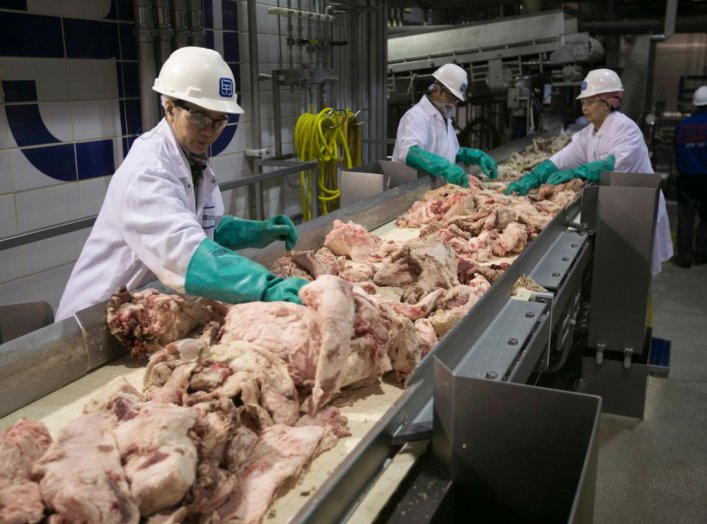
To maximize efficiency, production takes place on an assembly line – or more accurately, a disassembly line. Workers stand close together and perform simple, repetitive tasks on animal parts as the parts stream by.
Production lines move quickly, with industry averages ranging from 1,000 animals per hour in pork processing to over 8,000 per hour in chicken plants. In October 2019 the Trump administration eliminated limits on production line speed in pork processing plants, and it has also waived limits for individual chicken processing plants.
The speed and organization of meatpacking both promote the spread of coronavirus. Employees labor alongside one another, working at a rate that makes it difficult, if not impossible, to practice protective behaviors such as covering sneezes and coughs.
The Centers for Disease Control and Prevention has issued guidelines to allow meatpacking workers to continue working during the pandemic. They include spacing workers at least six feet apart and installing barriers between them. Some plants have adopted these controls, but the pressures of rapid production may well limit their effectiveness.
Unionizing the industry
Understanding why meatpacking workers tolerate these difficult and dangerous conditions requires a look at the industry’s history.
Many people assume that jobs in packing plants have always been as difficult and dangerous as those depicted in journalist Upton Sinclair’s famed 1906 novel “The Jungle.” That book described meatpacking workers in early 20th-century Chicago facing similar conditions to those in the modern industry.
But this assumption conceals an important story. For several decades after World War II, conditions in meatpacking plants steadily improved as a result of pressure from workers themselves.
Starting in 1943, the United Packinghouse Workers of America, a labor union, organized meatpacking employees in major cities. At the height of its influence, this union secured “master agreements” with the largest firms, such as Armour and Swift, ensuring standard wages and working conditions across the industry.
One source of the UPWA’s influence was its ability to build interracial alliances. Racial antagonism between black and white workers, linked to job discrimination and the use of black workers to break strikes in the early 20th century, had historically undermined union efforts in meatpacking plants.
UPWA District Area 5 Members Parade float, circa 1960, Chicago. Source: Chicago Public Library, CC BY-ND
The union’s logo, which depicted clasped black and white hands, symbolized its ability to bridge these differences. Its support for the civil rights movement in the 1960s also revealed its commitment to racial equality.
A changing labor force
But by the 1970s, the union was in decline. A key factor was industry leaders’ decision to shift production from cities with a strong union tradition, like Chicago and Kansas City, to small towns scattered across the Great Plains and the southeastern United States.
Rural work forces are more difficult to organize than their urban counterparts for many reasons. Most small towns do not have a history of union activity, and anti-union sentiment is often strong – as shown by the prevalence of right-to-work laws in many rural states.
Moreover, packing plants are often small towns’ only major employers. Workers and municipal authorities alike depend on plants for jobs and tax revenue. This relationship creates enormous pressure to treat meat processing companies with deference.
Additionally, meatpacking consolidated in the late 20th century. Plants grew larger, and a relative handful of firms such as Cargill and Tyson came to dominate processing of beef, poultry and other meats. Consolidation gives these firms greater ability to control working conditions and wages.
Finally, today’s plants often recruit workers from Mexico and Central America, some of whom may lack legal authorization to work in the U.S. They also hire refugees who may be unfamiliar with U.S. labor protections and have few other employment possibilities.
These workers’ precarious legal and economic standing makes it hard for them to challenge employers. Cultural differences, language gaps and racial prejudice can also pose obstacles to collective action.
The challenge of coronavirus
Workers’ organizations have not disappeared. The United Food and Commercial Workers Union has called on the Trump administration to ensure safety during the pandemic, but it is fighting an uphill battle.
Despite President Trump’s reassurances that closed plants will reopen safely, I expect that the pressures of efficiency and limits on workers’ ability to advocate for themselves will cause infections to persist.
In meatpacking as in other industries, the pandemic has revealed how people who do “essential” work for Americans can be treated as if they are expendable.

What Will Happen if the Coronavirus Vaccine Fails? A vaccine could provide a way to end the pandemic, but with no prospect of natural herd immunity we could well be facing the threat of COVID-19 for a long time to come. by Sarah Pitt

  There are  over 175  COVID-19 vaccines in development. Almost all government strategies for dealing with the coronavirus pandemic are base...