A new genetic study out of England suggests that the novel coronavirus spread rapidly around the globe late last year.
Scientists at University College London’s Genetics Institute examined samples from more than 7,500 people infected with COVID-19. The study also identified nearly 200 recurrent genetic mutations of the new coronavirus, SARS-CoV-2, which researchers said showed how the contagion is adapting to its human hosts as it spreads.
“Phylogenetic estimates support that the COVID-2 pandemic started sometime around Oct. 6, 2019 to Dec. 11, 2019, which corresponds to the time of the host jump into humans,” the research team, co-led by Francois Balloux, wrote in a study published in the journal Infection, Genetics and Evolution.
A recently published study by French scientists discovered a man in France was infected with COVID-19 as early as Dec. 27, which was close to a month before authorities confirmed the first cases there. The World Health Organization responded by saying that this finding was “not surprising.”
Novel coronavirus cases have been reported in more than 210 countries and territories since they were first identified in Wuhan, China, in December 2019.
The analysis also discovered that the virus was and is currently mutating—as what normally occurs with these types of contagions. In addition, a large proportion of the worldwide genetic diversity of the virus causing COVID-19 was found in all of the countries with the largest outbreaks.
“All viruses naturally mutate,” Balloux said in a statement. “Mutations in themselves are not a bad thing and there is nothing to suggest SARS-CoV-2 is mutating faster or slower than expected. So far, we cannot say whether SARS-CoV-2 is becoming more or less lethal and contagious.”
In another study conducted by scientists at Britain’s University of Glasgow, it showed that previous assertions that there are two different strains were, in fact, inaccurate.
A preliminary study in March by scientists in China suggested there could be two strains of the new coronavirus, but this particular study, published in the journal Virus Evolution, revealed that only one type of the virus was circulating.
More than 3.75 million people worldwide have been reported to be infected by COVID-19 and about 263,000 have died, according to the latest data by Johns Hopkins University.
As Iowa Gov. Kim Reynolds put it in a press conference, virus outbreaks in packing plants are “very difficult to contain.” But what makes these plants so dangerous? As a sociologist who has studied food system labor issues, I see two answers.
First, working conditions experienced in meatpacking plants, which are shaped by the pressures of efficient production, contribute to the spread of COVID-19. Second, this industry has evolved since the mid-20th century in ways that make it hard for workers to advocate for safe conditions even in good times, let alone during a pandemic.
Together, these factors help to explain why U.S. meatpacking plants are so dangerous now – and why this problem will be difficult to solve.
The meatpacking industry is an important job source for thousands of people. In 2019 it employed nearly 200,000 people in direct meat processing jobs at wages averaging US$14.13 per hour or $29,400 yearly.
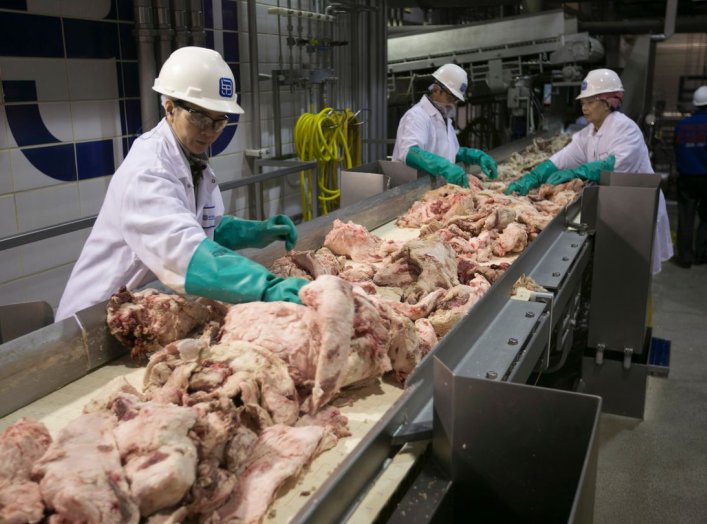
Even in normal conditions, meatpacking plants are risky places to work. The job requires using knives, saws and other cutting tools, as well as operating industrial meat grinders and other heavy machinery.
Traumatic injuries due to workplace accidents are common, and mistakes can have gruesome consequences. Government researchers have also documented chronic injuries, such as repetitive motion strains, among packing plant workers.
The same conditions that lead to these accidents and injuries during normal times also contribute to the spread of coronavirus. To understand this connection, it is first important to know that meatpacking is a volume industry. The higher a plant’s daily throughput – that is, the more animals it turns into meat – the more lucrative it is.
For instance, one Smithfield plant in Sioux Falls, South Dakota, which shut down indefinitely in April after hundreds of workers tested positive for COVID-19, employed 3,700 people and produced 18 million servings of pork daily.
To maximize efficiency, production takes place on an assembly line – or more accurately, a disassembly line. Workers stand close together and perform simple, repetitive tasks on animal parts as the parts stream by.
Production lines move quickly, with industry averages ranging from 1,000 animals per hour in pork processing to over 8,000 per hour in chicken plants. In October 2019 the Trump administration eliminated limits on production line speed in pork processing plants, and it has also waived limits for individual chicken processing plants.
The speed and organization of meatpacking both promote the spread of coronavirus. Employees labor alongside one another, working at a rate that makes it difficult, if not impossible, to practice protective behaviors such as covering sneezes and coughs.
The Centers for Disease Control and Prevention has issued guidelines to allow meatpacking workers to continue working during the pandemic. They include spacing workers at least six feet apart and installing barriers between them. Some plants have adopted these controls, but the pressures of rapid production may well limit their effectiveness.
Unionizing the industry
Understanding why meatpacking workers tolerate these difficult and dangerous conditions requires a look at the industry’s history.
Many people assume that jobs in packing plants have always been as difficult and dangerous as those depicted in journalist Upton Sinclair’s famed 1906 novel “The Jungle.” That book described meatpacking workers in early 20th-century Chicago facing similar conditions to those in the modern industry.
But this assumption conceals an important story. For several decades after World War II, conditions in meatpacking plants steadily improved as a result of pressure from workers themselves.
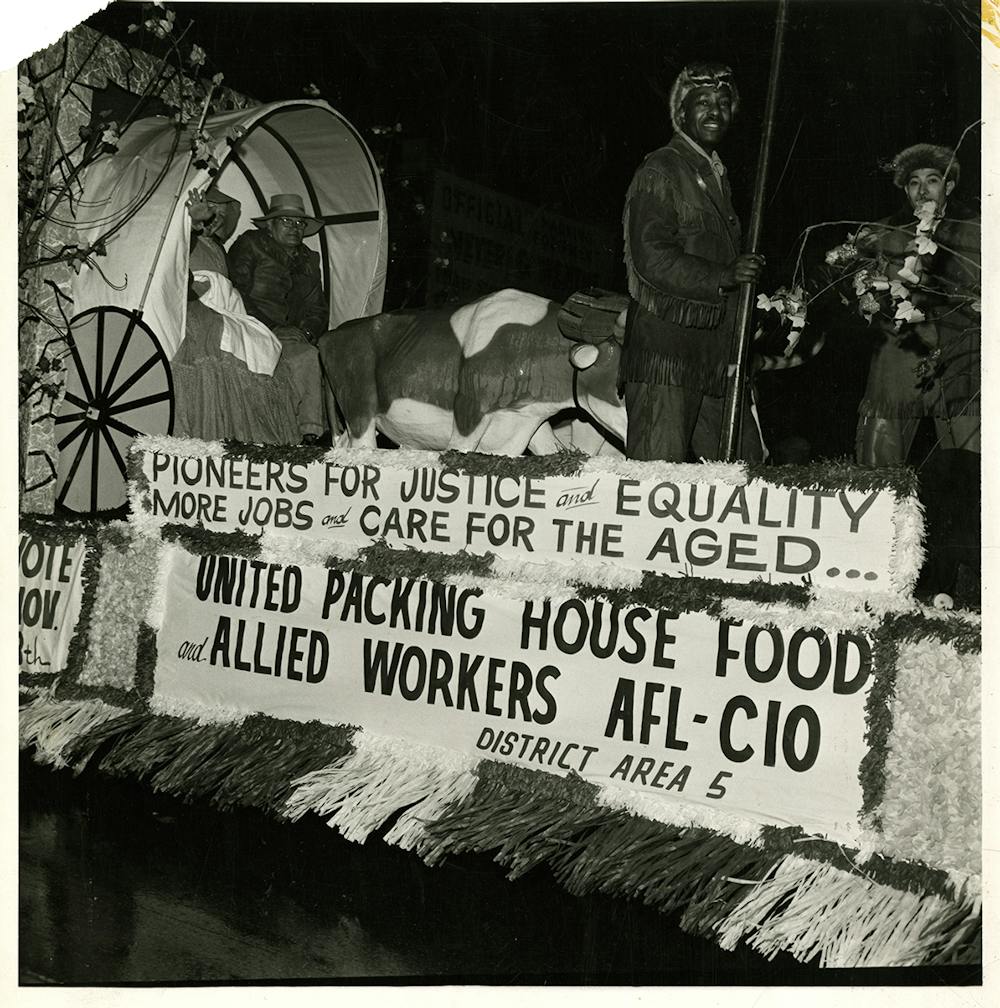
Starting in 1943, the United Packinghouse Workers of America, a labor union, organized meatpacking employees in major cities. At the height of its influence, this union secured “master agreements” with the largest firms, such as Armour and Swift, ensuring standard wages and working conditions across the industry.
One source of the UPWA’s influence was its ability to build interracial alliances. Racial antagonism between black and white workers, linked to job discrimination and the use of black workers to break strikes in the early 20th century, had historically undermined union efforts in meatpacking plants.
UPWA District Area 5 Members Parade float, circa 1960, Chicago.Source: Chicago Public Library, CC BY-ND
The union’s logo, which depicted clasped black and white hands, symbolized its ability to bridge these differences. Its support for the civil rights movement in the 1960s also revealed its commitment to racial equality.
A changing labor force
But by the 1970s, the union was in decline. A key factor was industry leaders’ decision to shift production from cities with a strong union tradition, like Chicago and Kansas City, to small towns scattered across the Great Plains and the southeastern United States.
Rural work forces are more difficult to organize than their urban counterparts for many reasons. Most small towns do not have a history of union activity, and anti-union sentiment is often strong – as shown by the prevalence of right-to-work laws in many rural states.
Moreover, packing plants are often small towns’ only major employers. Workers and municipal authorities alike depend on plants for jobs and tax revenue. This relationship creates enormous pressure to treat meat processing companies with deference.
Additionally, meatpacking consolidated in the late 20th century. Plants grew larger, and a relative handful of firms such as Cargill and Tyson came to dominate processing of beef, poultry and other meats. Consolidation gives these firms greater ability to control working conditions and wages.
Finally, today’s plants often recruit workers from Mexico and Central America, some of whom may lack legal authorization to work in the U.S. They also hire refugees who may be unfamiliar with U.S. labor protections and have few other employment possibilities.
These workers’ precarious legal and economic standing makes it hard for them to challenge employers. Cultural differences, language gaps and racial prejudice can also pose obstacles to collective action.
The challenge of coronavirus
Workers’ organizations have not disappeared. The United Food and Commercial Workers Union has called on the Trump administration to ensure safety during the pandemic, but it is fighting an uphill battle.
Despite President Trump’s reassurances that closed plants will reopen safely, I expect that the pressures of efficiency and limits on workers’ ability to advocate for themselves will cause infections to persist.
In meatpacking as in other industries, the pandemic has revealed how people who do “essential” work for Americans can be treated as if they are expendable.
Secretary of State Mike Pompeo said that “there was no U.S. government direct involvement” in a failed attempt to overthrow Venezuelan president Nicolás Maduro by force earlier this week.
Venezuelan forces killed six and captured a few dozen armed men who launched a bizarre amphibious raid on a beach in northern Venezuela on Sunday. Maduro has accused the Trump administration of orchestrating the incident as part of an attempted coup d’etat.
Two of the prisoners appear to be U.S. Army veterans. An eccentric special forces veteran named Jordan Goudreau, who once served as private security for a Donald Trump campaign rally, claimed that his private security company SilverCorp was responsible for the attack.
“If we had been involved, it would have gone differently,” Pompeo said. “As for who bankrolled it, we’re not prepared to share any more information about what we know took place.”
He added that “we’ll use every tool that we have available” to secure the release of the American prisoners “if in fact these are Americans that are there.”
Goudreau claims that Venezuelan parliament leader Juan Guaidó had originally promised to finance the operation but failed to pay up, a claim that Guaidó denies.
A report by the Associated Press released a few days before the failed raid also suggests that Roen Kraft, heir to the Kraft Foods fortune, also played a role in bankrolling Goudreau.
The Trump administration had put a $55 million bounty on Maduro in late March after the U.S. Department of Justice indicted Maduro on drug trafficking charges.
Goudreau was encouraged by Maj. Gen. Cliver Alcalá, a Venezuelan military defector who has also been indicted for drug trafficking by U.S. authorities, according to the Associated Press.
The United States and several other countries do not consider Maduro to be the president of Venezuela. Instead, they recognize Guaidó, who was declared acting president by the Venezuelan parliament in January 2019 amidst a constitutional crisis.
Maduro, however, has continued to control most parts of the Venezuelan state, despite numerous uprisings and mutinies.
Venezuela is currently holding several other U.S. citizens, including the CITGO Six, a group of oil executives who worked for Venezuela’s state-run oil company.
The Trump administration has pursued an economic pressure campaign aimed at forcing Maduro to step down.
Elliot Abrams, the State Department official in charge of Venezuelan affairs, had laid out a “framework for a democratic transition” during a March 31 press briefing.
“It’s obvious that Maduro is going to resist any plan that calls for him to leave power,” he told reporters. “What’s important is the conversations that take place privately within the military and within the regime and within the party and within Venezuela, in labor unions, in the business community.”
Speaking to a Russian television station on Sunday, the Russian Minister of Industry and Trade Denis Manturov said that Russia’s newest, and possibly most capable tank ever, has undergone field testing in Syria. “Yes, that’s right. They [the Armata tanks] were used in Syria,” he said to Russia’s Rossiya-1 television channel. “They were used in field conditions, in Syria, so, we took into account all the nuances,” Tass reported.
This would be a first for the platform, which despite some early hiccups, is at least on paper perhaps one of the more capable tanks in any country’s inventories. It was first shown to the public on May 9, 2015, during Russia’s annual Red Square Victory Day parade which commemorates the Soviet Union’s victory over Nazi Germany during the Second World War.
Tass also reported that the T-14 would finally enter serial production sometime in 2021. “It [the T-14 Armata tank] is expensive because it is still undergoing extra trials and modernization after the defense ministry requested additional technical solutions in order to begin serial supplies starting from the next year under the existing contract,” said Manturov.
The T-14 platform has experienced delays before. The Russian producer of the T-14, Uralvagonzavod, had previously given 2020 as the T-14’s serial production entry date, so it would appear that that date has been pushed back.
As I previously explained, the T-14 is remarkable for its armor (both active and passive systems), and its drivetrain. If reports are to be believed, the T-14 may very well be one of the nimblest tanks in existence.
When in dire situations, the tank can “boost” its engine from an output of 1,500 horsepower to an unheard of 2,000 horsepower, though this comes at a price. Engine longevity is significantly decreased after “boost” operation.
Import Export
Technologically decisive platforms like the F-22 Raptor or the M60A2 tank are sometimes barred from being sold abroad. Apparently not so with the T-14.
In a somewhat surprising move, Manturov announced that several foreign buyers had expressed interest in acquiring the T-14 platform. “Next year, when serial supplies of these tanks to the defense ministry are launched and an exports certificate is obtained, we will begin to work with foreign clients,” he said, though he did end his statement with a rather weasel-word statement. “Preliminarily, bearing in mind that we cannot provide all the documentation to our foreign clients, well, we do have preliminary orders.”
Well, we’ll see about that.
Questions remain about what the T-14 in Syria were actually up to. It is possible that the T-14s in Syria did nothing more than collect dust—but hard to say definitively. Perhaps more information will come to light in the future.
Armed speedboats belonging to the Iranian Revolutionary Guard Corps Navy habitually harass U.S. Navy and allied vessels in the Persian Gulf, in particular in the strategic Strait of Hormuz that connects the Gulf to the open ocean.
Now those boats have farther-flying missiles, the militia claimed.
The IRGCN now possesses ship-launched anti-ship missiles with a range as far as 430 miles, naval militia leader Adm. Ali Reza Tangsiri told Iranian state media.
As recently as September 2020, the militia said its best anti-ship missile could travel just 180 miles, Defense Newsnoted.
The missile claim could have implications for tensions in the Gulf region.
The IRGCN’s boats in mid-April 2020 sailed dangerously close to a group of U.S. Navy and U.S. Coast Guard vessels practicing helicopter operations.
Eleven Iranian fast attack craft “repeatedly conducted dangerous and harassing approaches of the USS Lewis B. Puller, USS Paul Hamilton, USS Firebolt, USS Sirocco, USCGC Wrangell and USCGC Maui while the U.S. vessels were conducting joint integration operations with U.S. Army AH-64E Apache attack helicopters in the international waters of the North Arabian Gulf,” the Navy stated.
Puller is a sea-base ship with a large flight deck. Hamilton is a guided-missile destroyer. Firebolt and Sirocco are patrol boats. Wrangell and Maui are Coast Guard cutters. Puller’s battle group had been practicing deploying Apaches for strikes on small craft just like the type that harassed the group.
“The IRGCN vessels repeatedly crossed the bows and sterns of the U.S. vessels at extremely close range and high speeds, including multiple crossings of the Puller with a 50 yard closest point of approach and within 10 yards of Maui‘s bow,” the Navy stated.
On April 22, 2020, U.S. president Donald Trump wrote on Twitter that he was authorizing the Navy to “shoot down and destroy” Iranian boats that harass American vessels.
Trump however did not formally instruct the Navy to change its rules of engagement. The Navy periodically fires warning shots near Iranian boats but as a matter of policy does not attack the boats for the mere act of operating unprofessionally. It’s worth noting that U.S. forces also have operated in close, even dangerous, proximity to Iranian forces.
“What he was emphasizing is all of our ships retain the right of self-defense, and people need to be very careful in their interactions to understand the inherent right of self-defense,” Deputy U.S. Defense Secretary David Norquist told NBC News.
The back-and-forth claims and threats mark another month of escalating tensions between the United States and Iran.
Trump in 2018 unilaterally withdrew the United States from the deal that limited Iran’s nuclear-weapons program. Iranian missileers in June 2019 shot down a U.S. Navy Global Hawk spy drone flying near the Strait of Hormuz. In January 2020 U.S. forces assassinated IRGC leader Gen. Qasem Soleimani in Iraq. Iran retaliated with barrages of rockets targeting American facilities in the region.
Longer-range missiles could make the IRGCN more dangerous in wartime. It’s not clear whether or how the new munitions might alter the militia’s tactics during peacetime.
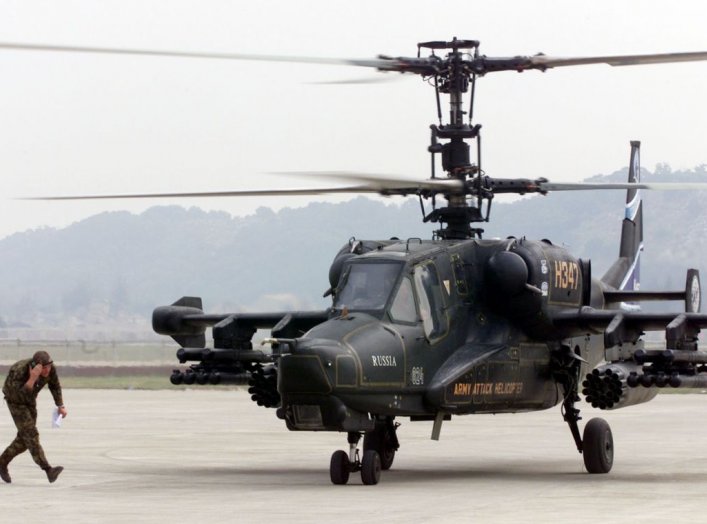
The KA-50 helicopter is heavily armed and heavily armored. It’s also incredibly maneuverable.
Two is Better than One
Rather than a main blade rotor and a tail rotor assembly, the KA-50 forgoes the tail rotor for another main rotor. These two main rotors spin in opposite directions and give the KA-50 a very high degree of maneuverability and performance when compared to typical tail-rotor helicopters.
The KA-50 is also one of the few helicopters with a pilot ejection system. Like most jets, the KA-50 has rocket or explosive-assisted seats. Prior to ejection, the helicopter’s rotors blades are destroyed and thrown away from the KA-50 frame by integrated explosives. The helicopter’s canopy is then hurled outward and the pilot or pilots are ejected to safety.
In addition to relatively large winglets that can carry a variety of air-to-surface missiles, the KA-50 also has a large 30 millimeter cannon affixed to its right wing. Though the cannon is not free-turning, as on other attack helicopters, it benefits from improved accuracy.
Substantial armor protects the KA-50 from ground fire. The pilot canopy is designed to withstand 12.7 millimeter hits, and the cockpit provides protection from 23 millimeter rounds. The rotor blades are made of a composite material, and can withstand several hits from automatic weapons fire.
A naval variant of the KA-50 was intended to fly on the Mistral-class amphibious assault ships Russia ordered from France. This variant is a two-seater, and has anti-corrosion properties and inwardly-folding rotor blades for compact storage.
In response to the 2014 Russian annexation of Crimea, the tender was canceled and the Mistrals were never delivered. The Mistral-class can carry around 16, possibly as many as 30 helicopters, depending on the airframe’s size and weight.
Following the failed bid, France sold the Russian-intended Mistrals to Egypt. Ironically, Egypt will likely equip its Mistrals with a KA-52 naval variant from Russia.
Zapad 2017
In 2017, a KA-50 variant, the KA-52, was involved in a live-fire accident during Russia and Belarus’ massive 2017 Zapad military drills, which included 12,000 personnel and hundreds of aircraft, tanks, and other vehicles.
Video footage from an onlooker’s cell phone showed two KA-52s approaching a group of people and mix of civilian cars and military trucks. In the video, one of the KA-52s fired what appears to be two rockets towards the group, striking the foreground in front of the people.
While there were no fatalities, several people were reportedly injured and the military-style truck lost at least one wheel and appears to sustain damage to its suspension.
Another video surfaced online which appeared to be a recording of the pilot’s helmet-mounted display. In the video, a targeting reticle appeared to target the military-style truck. After firing, the pilot appeared to quickly lift the nose of the KA-52, possibly confirming the incident’s accidental nature.
Action!
Depending on how Egypt plans to employ their Mistrals, the KA-50 may end up seeing some action in the Middle East. We’ll see.
According to two new studies, those who have died from COVID-19 could have expected to live for another 10 years.
The findings from the studies show that the novel coronavirus isn’t only killing seniors and those with underlying health conditions who may have had only months to live prior to infection.
“Some people think that these people dying would have died this year anyway,” author of one study Andrew Briggs, a professor of health economics at the London School of Hygiene & Tropical Medical, told The Wall Street Journal. “That’s simply not the case.”
Some scientists have said this new data is proof that social distancing and shelter-in-place directives should remain in place to curb the further spread of the virus.
The other study was a paper by Scotland-based researchers that was published online by the Wellcome Trust, a London-based foundation that funds scientific research.
This particular study discovered that the average number of years cut due to COVID-19 for healthy adults was 14 for men and 12 for women. Briggs’ data put the U.S. average at 14 years and U.K. average at 11.
The two studies, which were published separately, looked at mortality data in several badly affected countries. The figures were then used to compare the age at which COVID-19 victims are dying with the region’s life expectancy. Also taken into account were the differences in life expectancy connected to common ailments, such as heart disease, diabetes and dementia.
An assortment of key data from Italy and the U.K. were used to gauge the long-term conditions often witnessed in COVID-19 victims and the general population. After accounting for years lost due to common chronic illnesses and cancer, the victims on average died about a decade sooner than expected. For the sickest patients, they lost between one and six years, depending on their age.
According to the Centers for Disease Control and Prevention, of the 37,000 people who died in the U.S. due to COVID-19 between Feb. 1 and April 25, 31% were over the age of 85. But 40% of the individuals were between 45 and 75 years old.
There have been more than 3.5 million confirmed COVID-19 cases worldwide and about 250,000 deaths due to the virus. Disease experts, though, have said such numbers likely underestimate the real toll.
Estimates regarding the fatality rate of those infected by COVID-19 can vary. According to a March paper published in the British medical journal Lancet, the percentage of Chinese citizens infected by the virus and later dying came in between 0.4% and 1.3%, while other figures have it closer to 3% to 6%.