#Sponsored

Tuesday, May 19, 2020

How Coronavirus Exacerbates the Drug Shortages in Canada Drug shortages cause all sorts of problems. by Lorian Hardcastle and Reed F Beall

Reuters

COVID-19 has exposed and magnified weaknesses within health-care systems. Drug shortages, which are a growing problem in Canada, may be one example of this.

Shortages hinder patients’ ability to effectively manage chronic diseases, leading to unnecessary harm. They also complicate the work of health-care providers, such as pharmacists, who must spend considerable time trying to find difficult-to-obtain drugs, and physicians, who have to prescribe alternative drugs to replace those that are unavailable. Shortages may also increase costs if alternative treatments are more expensive.

Potential contributors to shortages

Disruptions in the supply chain due to COVID-19 may cause shortages because many drugs and the raw ingredients used to produce them come from India and China. India has started to ban some drug exports due to shortages in its own country.

Supply-side pressures are also caused by increasing consolidation in the pharmaceutical industry, which means fewer suppliers and manufacturing facilities and thus fewer alternative sources for drugs. Given that most shortages are of less expensive generic drugs, some speculate that manufacturers intentionally limit the production of less profitable products to drive up sales of expensive brand name drugs.

COVID-19 may also produce demand-side shortages. Manufacturers are struggling to keep up with demand for the sedatives required by patients on ventilators. Large volumes of these drugs will also be necessary when Canadian hospitals catch-up on elective surgeries cancelled due to COVID-19. For example, two manufacturers of one such sedative, propofol, have reported recent shortages.

Hydroxychloroquine and azithromycin, which were touted as treatments for COVID-19, are in sufficiently high demand that professional regulatory bodies have issued warnings about inappropriately prescribing these products. Since March 15, six azithromycin products and one hydroxychloroquine manufacturer have reported shortages in Canada. The latter of these affects patients who take hydroxychloroquine to treat arthritis and lupus.

Prevalence of shortages

In order to enhance tracking of and responsiveness to drug shortages, Health Canada has required manufacturers to report shortages since 2017. Shortages have been steadily increasing over the past two years, with 2,023 products in shortage as of April 2020.

Some of this effect may be attributable to the increasing number of products that are added to the pharmaceutical market each year. This suggests that Health Canada must continue to increase its capacity to monitor and address shortages to correspond with the growing number of products in active use. In its role as federal drug regulator, Health Canada may help drug manufacturers address shortages by reviewing alternative suppliers, processes, facilities and production locations.
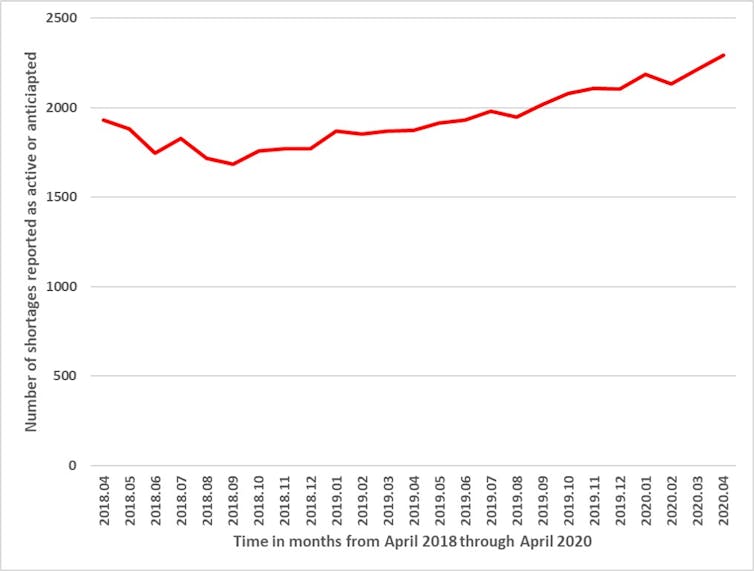
Anticipated or actual shortages, April 2018-April 2020. (Lorian Hardcastle and Reed Beall), Author provided

Although the full effects of COVID-19 on drug shortages are not yet known, it is notable that manufacturers reported 221 new shortages in April 2020, compared to 148 in March, 59 in February and 104 in January. In other words, a recent increase in shortages, which could be attributable to COVID-19, may worsen existing problems with shortages.

Response to shortages

Pharmacists reported a rush to fill prescriptions when physical distancing measures took effect, with some patients requesting a six-month supply. In response, Health Canada discouraged drug stockpiling and the Canadian Pharmacists Association and provincial governments strongly encouraged pharmacists to limit patients to a 30-day supply of their prescriptions.

Although this may help to address shortages by moderating demand, it increases the cost of drugs for individuals who may incur additional dispensing fees with each visit. This disproportionately affects those who are unemployed and who have lower incomes. It may also require more frequent visits to pharmacies, which can be dangerous for seniors who are at increased risk for COVID-19 and tend to use more prescriptions. When this 30-day restriction is lifted, the elevated demand may further contribute to shortages.

The federal government has implemented several measures to address COVID-related shortages. On March 25, it authorized the passage of regulations necessary for “preventing shortages … or alleviating those shortages or their effects, in order to protect human health.”

This legislation also allows the government to grant a manufacturer a license to produce a drug, even if another manufacturer holds the patent for that product. Although these licences could theoretically increase supply, practical challenges may limit their utility. For example, alternative suppliers may similarly be unable to obtain raw ingredients from the same foreign suppliers.

A more practicable solution may be the import and sale of drugs that have not yet met all Canadian regulatory requirements, which is permissible following an order by the minister of health. However, this exceptional process is only available for particular drugs that meet certain manufacturing standards.

While the federal government’s efforts may help to mitigate shortages during COVID-19, it should also seize this opportunity to develop long-term solutions to shortages, which have affected the Canadian drug market for years. Due to the globalization of pharmaceutical manufacturing, the government must work with both industry and other countries to rapidly identify and respond to disruptions in the supply chain, so that Canadians have uninterrupted and reliable access to safe drugs. Given the pressures caused by COVID-19, now is a pivotal time for the government to act.

The Reconstruction of Brazilian Foreign Policy Reconstructing Brazilian foreign policy is urgent and indispensable. By leaving behind this shameful page of subservience and irrationality, let us once again place at the center of diplomatic action the defense of our independence, sovereignty, dignity, and national interests. Let us embody once more all the values, including solidarity and the search for dialogue, that have helped build the heritage and boost the pride of the Brazilian people. by Fernando Henrique Cardoso, Aloysio Nunes Ferreira, Celso Amorim, Celso Lafer, Francisco Rezek, José Serra, Rubens Ricupero and Hussein Kalout

Despite our distinct political trajectories and opinions, we, who have all held high positions in the sphere of international relations in various governments of the New Republic, express our concern with the way in which the country’s foreign policy has systematically violated the guiding principles of Brazil's international relations as defined in Article 4 of the 1988 Constitution. 

An innovative document in this sense, the constitution states that Brazil “is governed in its international relations by the following principles: I, national independence; II, respect for human rights; III, self-determination of peoples; IV, non-intervention; V, equality between States; VI, defense of peace; VII, peaceful resolution of conflicts; VIII, repudiation of terrorism and racism; IX,  cooperation between peoples for the progress of humanity;  and X, granting of political asylum.”

It furthermore states that “The Federative Republic of Brazil will seek the economic, political, social and cultural integration of the peoples of Latin America with a view to forming a Latin American community of nations.”

Comparing the principles of Brazil’s constitution with the government’s actions in the realm of foreign policy reveals that the latter contradict the former in both letter and spirit. True national independence cannot be reconciled with subordination to a foreign government whose explicit political strategy is to promote its own self-interest above all other considerations. A government that declares itself a steadfast ally of that country relinquishes its own independence. In doing so, the current administration embraces an agenda that threatens to drag Brazil into conflicts with nations with which we maintain relations of friendship and mutual interest. Furthermore, it departs from the universalist principle of Brazilian foreign policy and its ability to open dialogue and build bridges with different countries, developed and developing ones, for our own sake.

Some other examples of recent contradictions with the provisions of the Constitution include the following: support for coercive measures in neighboring countries, a violation of the principles of self-determination and non-intervention; vote in the United Nations for the imposition of a unilateral embargo in violation of the rules of international law, equality of states, and peaceful resolution of conflicts; endorsement of use of force against sovereign states without authorization from the UN Security Council; official approval of political assassination and vote against resolutions by the Human Rights Council in Geneva to condemn the violation of such rights; defense of the policy of denying indigenous peoples the rights guaranteed to them in the Constitution; disregard for issues such as discrimination on grounds of race and gender.

In addition to contravening the Federal constitution, the current strain/breed of foreign policy has imposed serious costs on the country, such as the collapse of external credibility, loss of markets, and capital flight. This damage will undoubtedly prove difficult to repair.

Admired in the realm of environmentalism since Rio-92 and long viewed as a leader in sustainable development, Brazil now figures as a threat to itself and others due to the ongoing destruction of the Amazon and the worsening of global warming. Brazilian diplomacy, traditionally recognized as a force for moderation and balance at the service of consensus building, has become a subordinate player to an aggressive and dangerous unilateralism.

In Latin America, the nation has shifted from an advocate for regional integration to a supporter of interventionist adventures, giving way to extra-regional powers. We have given up the ability to stand up our interests by collaborating to deport Brazilian workers from the United States in inhumane conditions. We have done so once more by deciding to withdraw all Brazilian diplomatic and consular personnel from the neighboring country of Venezuela for purely ideological reasons, leaving behind helpless Brazilian nationals residing there.

In Western Europe, we now antagonize important partners, such as France and Germany, in practically all fields. The current course of anti-diplomatic action distances Brazil from its strategic objectives by alienating nations that are essential to the implementation of the government's economic agenda.

The grave health crisis posed by coronavirus further revealed the ineffectiveness of the current Ministry of Foreign Affairs and its counterproductive role in helping the nation gain access to medical products and equipment. The sectarianism fueling otherwise inexplicable attacks on China and the World Health Organization, coupled with the disrespect for science and the insensitivity to human lives demonstrated by the president, has made the government an object of international derision and disgust. At the same time, it has also jeopardized the efforts of governors seeking to import products that are desperately needed to save the lives of thousands of Brazilians.

Rescuing Brazil's foreign policy will require a return to constitutional principles, rationality, pragmatism, a sense of balance, moderation and constructive realism. In this process of reconstruction, it will be incumbent on the Judiciary—guardian of the constitution and the National Congress, representative of the people's will—to fulfill their role by ensuring that diplomatic actions truly abide by the principles laid out in the constitution.

In order to respond to the yearnings of our people and the real needs of Brazil, foreign policy needs to elicit broad support in terms of opinion. It must be collaborative, with respect and consideration for all sectors of society. It also requires the engagement of our diplomatic corps at service of the country toward a State policy rather than partisan actions aimed at arousing spirits and exacerbating the prejudices of a reactionary minority. We offer our sympathy and decisive support for diplomats who have been humiliated and embarrassed by positions that clash with the best traditions of the Foreign Ministry.

Reconstructing Brazilian foreign policy is urgent and indispensable. By leaving behind this shameful page of subservience and irrationality, let us once again place at the center of diplomatic action the defense of our independence, sovereignty, dignity, and national interests. Let us embody once more all the values, including solidarity and the search for dialogue, that have helped build the heritage and boost the pride of the Brazilian people.

How China's History Explains The Coming Chinese Empire China is an old civilization. by Akhilesh Pillalamarri

Here's What You Need To Remember: The Qing could have done better at focusing on threats from the sea—first the West, and then Japan. On the whole, however, the Qing managed to lay the basis of China’s continued control into the modern era of the resources of much of inner Asia, the Chinese equivalent of America’s wild west.

Chinese civilization is one of the world’s oldest continuous civilizations. Indeed, unlike Western, Islamic, and Indian civilizations, China has managed to remain politically unified for much of its history.

Contrary to the common perception of China being historically isolated and weak, many Chinese dynasties were very powerful and have had a profound impact on global history. Yes, it is true that during the Ming Dynasty, China ships conducted multiple voyages of exploration (1405-1433) before abruptly stopping. But this hardly dented the enormous economic and political influence China wielded for most of its history in East, Southeast, and Central Asia. Although the people of these regions pursued their own interests as best as they could, China was always the major power to be dealt with.

Nonetheless, not all Chinese dynasties were created, and these three stood above the rest.

The Han Dynasty ruled China for a solid four centuries, from 206 B.C.E. to 220 C.E. Although the preceding Qin Dynasty unified China, it was the Han Dynasty that kept it together and developed the institutions that characterized most of Chinese history since.

The Han Dynasty was able to maintain its bureaucracy and military through a more efficient and thorough system of taxation than many contemporary empires. Additionally, to gain increased revenue, the Han created monopolies on iron and salt. The salt monopoly has been a traditional source of revenue for Chinese states since, one that apparently lasted until 2014.

The Han’s large coffers allowed it to expand China’s boundaries outwards from its traditional heartland in the Yellow River valley toward what is today southern China. Southern China would prove to be very important to China in the future since it can support a large population through the rice crop. Thanks in part to southern China’s wealth, China’s sociopolitical development was usually greater than its neighbors, allowing China to easily incorporate or defeat them.

One exception to this, however, was China’s perennial problem— namely, nomads to its north. During the Han, these were the Xiongnu. Constant harassment and raids by these nomads necessitated the first construction of the Great Wall during the Qin Dynasty. During the Han, China attempted to outflank its enemies, which led to an expedition westward into today’s Xinjiang and Central Asia.

This process is generally thought to have informed China for the first time of other civilizations, a shocking development for a people who until then believed themselves to be the only state society. Indeed, during this time China became aware of the civilizations of India, the Bactrians, the Sogdians, the Persians, and many more, This event is thought to have stimulated the development of trade routes that would later be called the Silk Road.

To control trade routes and outflank their enemies, Chinese forces occupied much of Xinjiang for many decades, allowing them to project their influence deep to the west. Buddhism also entered China through this route at this time.

Tang

After the Han Dynasty collapsed due to civil war, China entered a period of disunity until being reunited by the Sui Dynasty, which was subsequently succeeded by the Tang Dynasty, which ruled China from 618-907 C.E. The Tang Dynasty was one of China’s most cosmopolitan and urbane dynasties, opening China up to a period of foreign influences. The Tang Dynasty was also likely China’s largest and most powerful dynasty in history and is considered the golden age of imperial China.

The population base of the Tang Dynasty was estimated to have been around 80 million people, enabling it to completely dominate its neighbors. During this time, China continued to expand northeast and south, incorporating much of Manchuria and Vietnam. It was also during this period that many other state societies developed under Chinese influence, including Korea, Japan, and Tibet. This period thus saw the establishment of the tributary state system to a greater extent than under the Han. Although they did not rule Tibet, the Tang were the first Chinese dynasty to exert influence over the previously foreboding plateau to the southeast.

The Tang military was successful because it had learned to fight like the steppe nomads in many ways. The Tang were crazy about horses, which had previously been relatively rare in China, and imported and breed many different breeds, negating the main advantage of the nomads to their north. The Tang also promoted and used talented Central Asian generals (a decision which would later come back to haunt them).

The Tang’s grip on Xinjiang was firm during this time (the region had slipped from Chinese rule after the Han) and garrisons were established in the “Western Region,” an area that was expanding rapidly to dominate all of Central Asia up to the border of the Persian Empire. Until the Arabs defeated the Chinese in the Battle of Talas (751), it looked as though Central Asia’s future was with China. Numerous states near this region such as Kabul and Kashmir became direct tributaries to China. The Chinese also intervened in the affairs of their steppe neighbors and even in the northern heartland of India.

The Tang Dynasty never recovered from the An Lushan Rebellion, when An Lushan, a Tang general of Central Asian origin, revolted and named himself emperor. Up to half of the empire’s population is said to have perished in the resulting fighting, famines, and diseases in what has been called one of history’s largest man-made disasters.

The Tang Dynasty managed to limp on due to support from Tibetan and Turkish soldiers but eventually collapsed.

Qing

The dynasties that followed the Tang’s collapse were all very weak. It wasn’t until the Ming Dynasty (1368–1644) hundreds of years later that another dynasty  rule over the Chinese heartland without major threats or issues. However, the Ming is considered to be one of the worst Chinese dynasties, as China suffered a period of intellectual, political, and economic sterility under its rule.

The Ming were followed by the Qing, China’s last and one of its greatest dynasties, ruling from 1644 to 1911. This may seem puzzling since the Qing are often blamed for allowing the Chinese system to collapse and for the country to be humiliated by the West. These things did happen during Qing but it doesn’t diminish from their achievements. Indeed, China today maintains borders far beyond its traditional heartland, losing comparatively little territory compared to other empires and their modern successor states (like Turkey and Iran) and this feat can be attributed to the policies and conquests of the Qing.

The Qing Dynasty was actually not Chinese in origin. They were Manchus who after establishing a state in Manchuria, were let into China through the Great Wall by a dissident Ming general. They then proceeded to conquer or co-opt the rest of the country. Unlike the Mongols, the Qing established a lasting Chinese-style state. The introduction of new crops from the Americas also helped China’s population grow to around 400 million.

The Qing were the first Chinese state to effectively control regions like Tibet, Xinjiang, Manchuria, and Mongolia, peripheral regions that were inhabited by people that had always harassed China. They were able to do this because of their dual nature as both a Chinese imperial bureaucratic state able to draw on agrarian revenue, and as the leaders of a large northern tribal confederacy that was able to assimilate Mongol tribes into their system. Gunpowder also aided the Qing’s cause, allowing them to negate the power of the steppe tribes.

The Qing’s masterful diplomacy was also part of its success. For example, the Qing ably played Russia and Great Britain off one another during the Great Game. Neither of those two powers wanted the other to gain more territory in Central Asia and were thus happy to led China keep most of its extensive empire as a buffer. Chinese influence also increased in Southeast Asia and Himalayan Asia to a greater degree than before during the Qing Empire, as many states like Myanmar, Nepal, Chitral Valley (in Pakistan today), and Siam became part of the Chinese system.

The Qing could have done better at focusing on threats from the sea—first the West, and then Japan. On the whole, however, the Qing managed to lay the basis of China’s continued control into the modern era of the resources of much of inner Asia, the Chinese equivalent of America’s wild west.

Monday, May 18, 2020

Why Home Advantage Disappears in Empty Football Stadiums Here's what 4 graphs tell us. by Carl Singleton, Dominik Schreyer and James Reade

Reuters

For millions of football fans, we’ve had nothing but repeats to watch to get our fix in recent months. But starting from May 16, elite European football kicks off, courtesy of the German Bundesliga. But there will be a few differences.

Given that there will be a packed schedule of matches to finish before the end of July, teams can make five substitutions rather than the normal three. But the most obvious difference will be that these matches will take place without spectators. Games will be held in empty, cavernous stadiums. These will not be neutral venues, as has been proposed for completing the English Premier League, but research shows empty grounds can effectively mean a removal of “home” advantage.

A few studies show that home fans can influence the outcome of football matches through the pressure they put on the referee. There is evidence, for example, that referees award more injury time when the home team is losing and less when the home team is winning, systematically shortening or lengthening the game to favour the home team, and this is affected by how many fans are present.

Most results on the effects of fans are based on changes in a few hundred or thousand fans from one match to the next. We are among a few sports economists to have studied the effect of playing in closed stadiums.

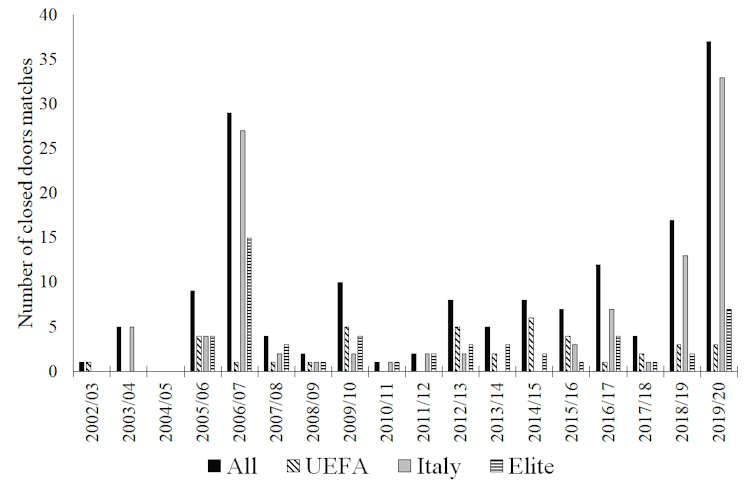
Historically, most closed doors matches have been imposed on clubs and their fans as a punishment – for violence, racist abuse and corruption. Studying the history of European football since the second world war, we found 191 closed doors matches across the top Italian and French leagues, and in European club competitions. We found none in the English and German top leagues, and only one in Spain’s La Liga. Most of these matches were after 2002.

The number of closed door matches in European football by competition and season since 2002/03. Carl Singleton, Author provided

We have found that the considerable home advantage in football is on average almost entirely wiped out in closed doors matches. Historically, home teams win 46% of the time in matches with fans, but only 36% of the time when there are no fans. The away team wins 26% of the time with fans, and 34% without fans.

These differences are primarily because the home team scores fewer goals when there aren’t any fans. The chart below shows the average differences between matches with fans and without them since 2002, with negative values implying that an outcome was smaller or happened less often in closed doors matches, and vice versa for a positive value.


The outcomes in closed doors matches vs in all others since the beginning of the 2002-03 European football season. Bands show 95% confidence intervals. Carl Singleton, Author provided

Reasons for the difference

The data suggests at least two reasons for the loss of home advantage. The first is that away teams get punished differently by the referee. Small changes in the number of fans in the stadium normally have small effects. But as the graph below shows, we estimate that an away team would receive 0.5 fewer yellow cards when playing behind closed doors (the X on the diagram), whereas the effect of reducing a specific stadium’s 25,000 crowd down to a 6,000 one is a mere 0.05 of a card (black line on diagram). Closed door matches have a disproportionate and strong effect on yellow cards.

The estimated effects on how many yellow cards are awarded to the away team, depending on how many fans are present. Carl Singleton, Author provided

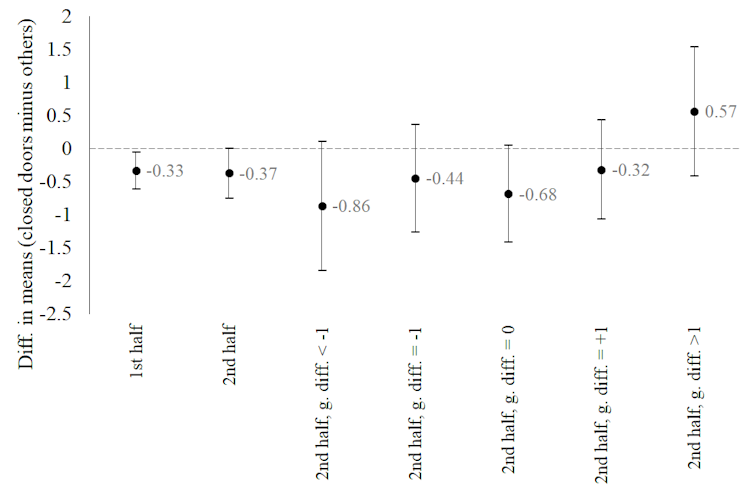
The second possible reason is that less injury time is awarded in matches played behind closed doors. Though, in the small sample of matches without fans we have studied so far, this difference is generally not statistically significant.

Second half injury time awarded in closed doors matches vs in all others since the beginning of the 2002-03 European football season. Bands show 95% confidence intervals. Carl Singleton, Author provided

To be clear, we are not accusing professional football referees of being consciously biased. Indeed research has shown that some of the biases they exhibit are subconscious, reflecting the highly pressurised environment that they must make tight calls in. Hence, the introduction of technology like the infamous VAR is an attempt to make the game more fair.

Fans turn up hoping to see their team win, and so, whatever causes it, there is an argument that some amount of home advantage is a good thing. It draws higher crowds and maintains their interest - only the diehards pay to watch their team lose every week.

A different game

Ultimately, our research suggests that professional football over the coming months is likely to be substantially different – not just the echoes of empty stadiums but in measurable outcomes as well. We can expect home teams to win less often. Teams with more home matches than away matches remaining in the current season might not do as well as they otherwise would have done, affecting championships, promotion and relegation.

The evidence also suggests that the current wrangling among the English Premier League’s clubs, about playing their remaining matches at neutral venues, is based on a mistaken notion that home advantage wouldn’t disappear if they play some of their remaining matches in their own empty stadiums.

Why Refugees Will Struggle to Combat the Coronavirus Instead of allowing the pandemic to exacerbate the harmful impacts of a broken refugee system, this could be an opportunity to remake it. by Shelly Culbertson and Gary Edson

Reuters

At a time when the pandemic is forcing people to stay at home and practice social-distancing, that is not possible for one of the most vulnerable populations—the world’s seventy-one million refugees, internally displaced persons, and asylum seekers. Having escaped conflict and persecution, they now risk illness and death from the coronavirus. That risk is heightened by a policy regime that focuses largely on refugees in camps, not the almost two-thirds that live in urban areas. But the crisis could provide an opportunity to reform a broken system for the benefit of refugees and host countries alike.  

The word refugee has become synonymous with images of Syrians, Afghanis, Sudanese, Central Americans, and other groups huddled in makeshift camps that have become way stations between the homes they left behind and the safe havens they hope one day to find. Supported by the UN system and international nongovernmental organizations, these camps pose a heightened risk for the coronavirus, with a density of living conditions and lack of water and sanitation that makes social distancing and adequate hygiene impossible.

But the 61 percent of refugees who live in urban areas are also at risk, precisely because their situation is so fundamentally different from those in the camps. While these refugees receive some limited assistance from UN agencies and other multilaterals, they largely rely on work to pay their rent, buy food, and support their families. Indeed, a RAND survey of Syrian refugees in Turkey, Jordan, and Lebanon found that 65 to 85 percent relied on income from work as their main source of support. Refugees often work on the lowest rungs of the employment ladder, informally, below minimum wage, and without access to a social safety net if they lose their jobs.  

Social-distancing measures during the coronavirus pandemic mean that many of these refugees can no longer work. This has put them in a dire situation because of food insecurity and the need to pay for rent and other expenses. Worse, when they cannot work, they resort to negative coping mechanisms, including reducing the quantity or quality of food, forgoing healthcare, selling personal goods, relying on child labor for additional family income, or having daughters enter into early marriage. 

Refugees in urban areas also depend on local public and private healthcare providers, to whom they often have limited access. For example, the over one million Syrian refugees in Lebanon’s urban areas often cannot afford the fees to access Lebanon’s mainly private health-care system. The majority of the 1.6 million Venezuelans in Colombia lack regular immigration status and therefore have access only to emergency medical care. If refugees in urban areas do not have access to testing, treatment, and, ultimately, a vaccine during the coronavirus pandemic, then they could become vectors for transmission, posing risks to themselves and their host nations.

What is needed is a new framework for helping refugees and host countries—both during and after this crisis—that reflects the different circumstances of refugees in camps and urban areas.  In light of the epidemiological, economic, and humanitarian realities, this framework could be based on the fundamental principle that all people within a country’s borders facing the same health crisis should be treated the same, regardless of where they live or their citizenship status. This framework could also reflect the new 2018 Global Compact on Refugees, which urges that host countries should be supported in their efforts to help the refugees within their borders.

Because many refugees, particularly those in camps, are dependent on support from UN agencies, donor governments could help by responding to appeals by the UN High Commissioner for Refugees for an additional $255 million to improve the coronavirus preparedness and response for refugees. 

But given that host countries are the main source of both employment and health care for the majority of refugees, bilateral and multilateral donors could also help by providing additional financial and technical assistance directly to host governments. Such assistance, however, might best be conditioned on host countries providing refugees with access to the coronavirus testing, treatment, and healthcare on a par with their own citizens. This would be in the host countries’ self-interest, since denying access to quality healthcare for one group could threaten everyone.

Bilateral and multilateral donors could also provide additional funding to the World Food Program for food assistance to refugees who are unable to work. Since refugees contribute to national economies through both their labor and consumption, improved access to a social safety net—and to work once social distancing is relaxed—would be in host countries’ best interests as well.

Finally, to ensure that refugees have access to a vaccine once it becomes available, GAVI, the global Vaccine Alliance, could ensure that eligible countries, the world’s poorest, include refugees in their requests. GAVI could also consider using its policy flexibility to provide assistance to middle-income host countries, like Lebanon and Colombia if they include refugees in national pandemic plans. 

These reforms could be crucial—not only to address this crisis, but also the next one. Conflict and persecution have led to an ever-growing number of displaced people. The impact of climate change, drought, famine, and economic dislocation will only add to their ranks.  

Instead of a post-pandemic world characterized by swelling camps, refugees could benefit from equitable access to work, health care and a social safety net. This could not only make their lives safer and better but could also benefit the host countries. In short, instead of allowing the current crisis to exacerbate the harmful impacts of a broken system, this could be an opportunity to remake it.

What Are the Pros and Cons of Conducting Mass Testing for Coronavirus? We tend to take for granted that the results of medical tests are accurate – but no test is perfect and all carry a risk of harm of some kind. by Jennifer MacLachlan and Benjamin Cowle

Reuters

Many jurisdictions around the world are now testing people without symptoms as part of efforts to manage COVID-19. In Victoria, asymptomatic health-care workers have been part of the recent “testing blitz”.

We tend to take for granted that the results of medical tests are accurate – but no test is perfect and all carry a risk of harm of some kind. Although there has been a drive to increase testing, we must recognise this is also true for coronavirus.

All tests have limitations

Among the shortfalls of diagnostic testing is the possibility of false negatives (failing to detect a condition when it’s present) and false positives (detecting a condition when it’s absent).

It’s easy to see why false negatives can be a problem – we lose the benefits of early intervention.

But false positives can also cause harm, including unnecessary treatment. This is why positive screening tests are often followed up with a second, different test to confirm a diagnosis.

Examples include further imaging and possibly biopsy following a positive mammogram for breast cancer, or colonoscopy following positive screening for colon cancer.

Why do we get false positives?

False positives can occur for many reasons, including normal human and system errors (for example mislabelling, data entry errors or sample mishandling).

Sometimes false positive test results could be due to a cross-reaction with something else in the sample, such as a different virus.

For COVID-19, the only routinely available option to confirm a positive result is to retest using the same method. This can address the false positives generated through sample contamination or human error.

Even so, some authorities recommend isolation for any person who returns a positive test, regardless of subsequent results.

Testing more widely could mean more false positives

The proportion of false positives among all positive results depends not just on the characteristics of the test, but on how common the condition being tested for is among those being tested.

This is because even a highly specific test – one that generates hardly any false positives – may still generate more false positive results than there are actual cases of the condition in those being tested (true positives).

Let’s work through an example.

Say we have a very good test which is 99.9% specific – that is, only one in 1,000 tests give a false positive. And imagine we’re testing 20,000 people for condition X. Condition X has a very low prevalence – we estimate it affects 0.01%, or one in 10,000 people in the population.

At this level we could expect two people in our sample to have condition X, so we might get two true positive results. But we would also expect around 20 false positive results, given the error rate of our test.

So the proportion of people testing positive who actually have condition X would be only two out of 22, or 9.1%.

This is called the positive predictive value of a test. The lower the prevalence of a condition in the population, the lower the positive predictive value.

What about COVID-19?

In Australia, control measures have been very successful in reducing the number of people currently infected with COVID-19. We estimate the likelihood of a positive test to be very low right now (although of course this may change as restrictions ease).

The current reported number of active COVID-19 cases in Australia is about 600. And even if we’ve only diagnosed one in every ten people currently infected, this still represents less than 0.03% of the population.

While we’re still establishing the specificity of tests for SARS-CoV-2 (the coronavirus that causes COVID-19), early evidence suggests an estimate of 99% or greater is reasonable.

However, following the same calculations as in the example above, at a prevalence of 0.03%, even a test with 99.9% specificity would mean only 30% of people who test positive actually have the condition. This means more than two-thirds of positive results would actually be false positives if we were testing asymptomatic people with no increased risk.

This is why testing criteria are often applied. If testing is offered only to those with symptoms consistent with COVID-19, the condition is almost certainly more common in those being tested than in the general (asymptomatic) population, and therefore the rate of true positives is going to be higher.

But if we start testing more broadly, the likelihood of false positives becomes a greater concern.

Why are false positives a problem?

Clearly we need tests to be as sensitive as possible – it’s easy to see why a false negative COVID-19 result could be a serious issue. But it’s important to recognise a false positive result can also cause significant problems for an individual and the community.

Consider, for example, the impact of asymptomatic health worker screening if a false positive test result leads to isolation of the person falsely diagnosed, and quarantining of their clinical co-workers identified (incorrectly) as close contacts of a case of COVID-19.

Further, a person who has had a false positive result may feel they are not at risk of future infection as they believe they are immune, leading to potential consequences for the individual and their contacts.

Even from an epidemiologicial perspective, a high proportion of false positives could distort our understanding of the spread of COVID-19 in the community.

Testing for COVID-19 in Australia is highly regulated and uses the best possible tests and highly qualified staff.

But asymptomatic screening when the prevalence of a condition is as low as that of COVID-19 in Australia currently must carefully weigh the benefits of such testing against the potential harms.

How the Coronavirus Is Harming Children's Vaccination Rates against Other Diseases This isn't good. by Jeffrey A. Singer

https://www.reutersconnect.com/all?id=tag%3Areuters.com%2C2019%3Anewsml_RC1C4F6DB800&share=true

Key point:Lower vaccination rates means more older (and deadly) diseases.

As I recently wrote here, and spoke about here, bans on elective surgery invoked by governors across the country in response to the COVID-19 pandemic have caused many people to suffer and even possibly face fatal consequences due to delays in necessary medical care. But there are other reasons why the public health emergency has the potential to generate secondary public health crises.

In some cases people are avoiding doctors’ offices and emergency rooms because they worry about handling the expense at a time they have seen their income, and perhaps their savings, vanish during the current economic shutdown. In other cases, people–particularly those with vulnerabilities–avoid medical care out of fear they might get exposed to the virus in the process.

Fear among vulnerable patients that they may contract and succumb to a COVID-19 infection is completely understandable. It is less understandable, however, when this fear makes parents forgo taking their children to the doctor’s office for routine vaccinations against diseases which are far more deadly and contagious, as the Wall Street Journal reported May 8. The timing of certain immunizations in children can be crucial. Forgoing or even just postponing them can have serious consequences.

Despite the fact that family practice and pediatrics offices have employed social distancing strategies to minimize the risk of COVID exposure to parents and their children if they come in for their scheduled vaccinations, the Journal reported:

The immunization rate for all recommended childhood vaccines declined about 40% in the U.S. from late February through mid‐​April, according to Physician’s Computer Co., a provider of electronic health‐​record systems. The data are based on vaccines administered by more than 1,000 pediatricians in 40 states who use PCC’s record system.

Concerns about a drop in the vaccination rate in association with the pandemic were also published by the Centers for Disease Control and Prevention. 

This is particularly unfortunate considering that children appear relatively spared by the COVID pandemic. According to the CDC, as of May 3 less than two percent of confirmed COVID-19 cases were among patients under age 18. The cases are almost always mild. The CDC report states, “In the U.S., as of April 2, 2020, there have been three deaths among children with laboratory‐​confirmed SARS‐​CoV‐​2 infection that have been reported to CDC, but the contribution of SARS‐​CoV‐​2 infection to the cause of death in these cases is unclear.” The fatality rate among adults under age 50 is likewise extremely low.

Meanwhile, diseases like measles and polio are much more deadly and contagious. Measles can lead to pneumonia, along with brain swelling and secondary permanent neurologic sequelae, such as vision and hearing loss and cognitive impairment. Measles can also be fatal. Complications of polio include paralysis. Parents must consider risks such as these when they fail to get their children vaccinated.

The World Health Organization reported 140,000 deaths from measles occurred globally in 2018, most under the age of five. Even polio virus, thought to be largely eradicated, is showing traces of a comeback, with worldwide reported cases increasing from 28 in 2018 to 163 in 2019.

It’s not only measles that poses a threat. Rotavirus, which can cause severe gastrointestinal illness in children is also a part of the standard vaccination package, as is immunization against Bordetella pertussis, the cause of “whooping cough.” Some vaccinations may protect against problems that can develop down the road. An example is the immunization for human papilloma virus (HPV), which can be a cause of cervical, anal, penile, and throat cancers in adults.

The Wall Street Journal article quoted one pediatrician as saying, “The numbers will tell you it’s guaranteed that some American kid today is going to die in 10 to 20 years of HPV as a result of Covid.”

It would be a great tragedy to see new pandemics, from pathogens previously believed to have been defeated, arise from the ashes of the current pandemic.

Public health experts should inform political leaders as well as the public about the dangers of COVID-19 and the best ways to avoid them. But policymakers and the public should also be told about trade‐​offs, as well as the relative risks faced by different demographic groups. Policies and personal decisions should be based on reason, not fear.

What Will Happen if the Coronavirus Vaccine Fails? A vaccine could provide a way to end the pandemic, but with no prospect of natural herd immunity we could well be facing the threat of COVID-19 for a long time to come. by Sarah Pitt

  There are  over 175  COVID-19 vaccines in development. Almost all government strategies for dealing with the coronavirus pandemic are base...