#Sponsored

Monday, July 27, 2020

North Korea declares emergency over suspected Covid-19 case Kim Jong-un imposes lockdown on Kaesong, calling it a ‘critical situation’

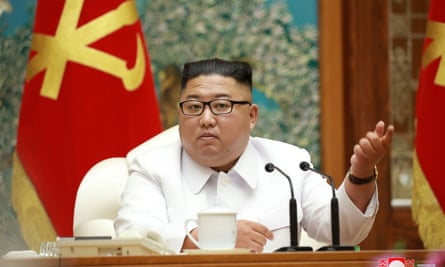
North Korean leader Kim Jong-un

North Korea has declared an emergency and a lockdown in a border town after a person suspected of having coronavirus returned from South Korea after illegally crossing the border, state media has said.

If confirmed, it would be the first case officially acknowledged by North Korean authorities.

Kim Jong-un convened an emergency politburo meeting in response to what he called a “critical situation in which the vicious virus could be said to have entered the country”, the North’s KCNA state news reported.

A person who defected to South Korea three years ago returned across the fortified border that divides the two Koreas to the town of Kaesong this month with symptoms of Covid-19, according to KCNA.

“An emergency event happened in Kaesong city where a runaway who went to the south three years ago, a person who is suspected to have been infected with the vicious virus, returned on 19 July after illegally crossing the demarcation line,” KCNA said.

The agency did not say if the person had been tested, but said an “uncertain result was made from several medical checkups of the secretion of that person’s upper respiratory organ and blood”, prompting officials to quarantine the person and investigate anyone he may have been in contact with.

One analyst said the announcement was important, not only because North Korea was for the first time reporting a suspected coronavirus case but also because it suggested it was appealing for help.

“It’s an ice-breaking moment for North Korea to admit a case,” said Choo Jae-woo, a professor at Kyung Hee University in Seoul. “It could be reaching out to the world for help. Perhaps for humanitarian assistance.”

North Korea is under economic pressure because of international sanctions over its nuclear programme. Cho Han-bum, a senior fellow at the Korea Institute for National Unification in Seoul, said it was significant that North Korea was reporting that its first suspected coronavirus case was imported.

“North Korea is in such a dire situation, where they can’t even finish building the Pyongyang general hospital on time. Pointing the blame at an ‘imported case’ from South Korea, the North can use this as a way to openly accept aid from the South,” Cho said.

KCNA did not elaborate on how the unidentified “runaway” had crossed one of the world’s most heavily guarded borders but said the incident was being investigated and the military unit responsible would face “severe punishment”.

The South’s joint chiefs of staff (JCS) said there was a “high chance” that someone had indeed crossed and the military was checking surveillance footage. It suggested it might be able to identify the person.

“Our military has specified some people and is verifying facts in close collaboration with related agencies,” the JCS said.

North Korea has received thousands of coronavirus testing kits from Russia and other countries and imposed strict border closures. Thousands of people were quarantined as it took precautions to prevent a coronavirus outbreak, but restrictions had recently been eased.

US-China relations: Washington confirms suspension of Fulbright programme for Hong Kong, mainland

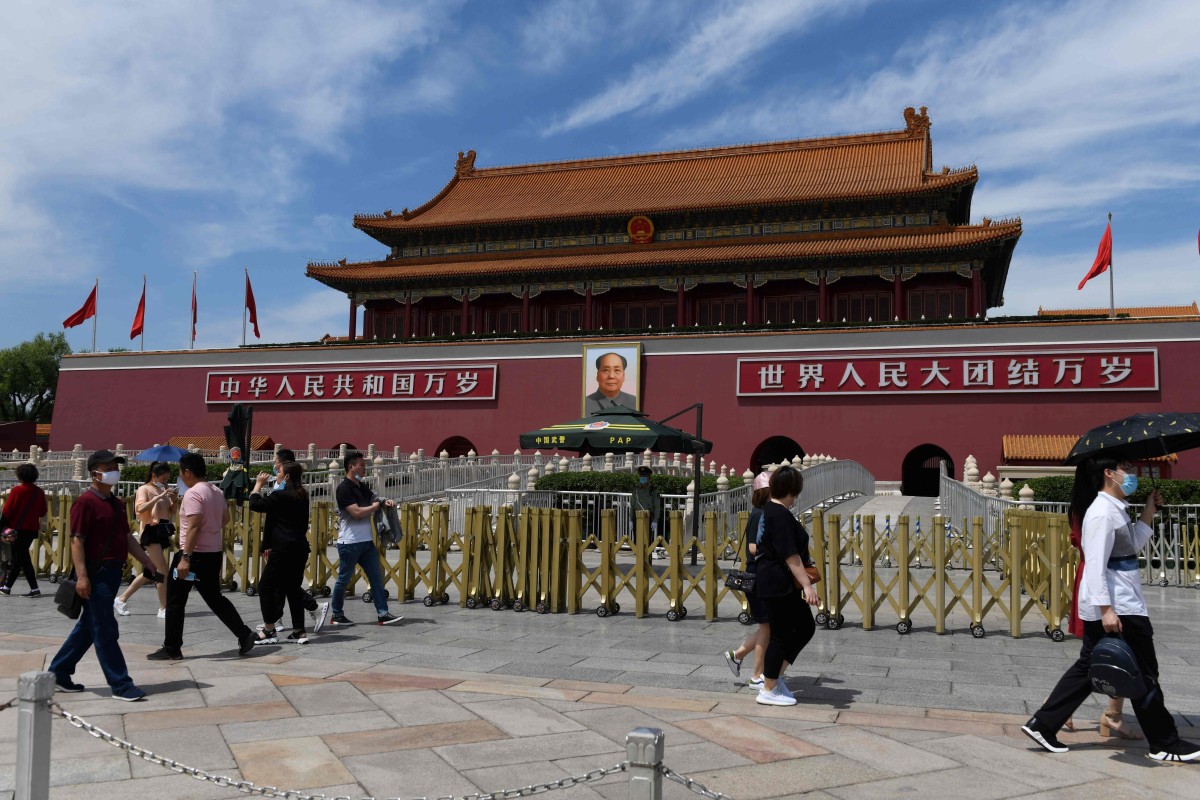
China was America’s first partner in the Fulbright programme, which was set up by the US in 1946 and now covers more than 160 countries. Photo: AFP
  • Would-be participants told after US President Donald Trump signed an executive order this month in retaliation for Beijing’s imposition of a national security law in Hong Kong
  • Programme, set up in 1946, allows American and foreign academics to teach, research and study in each other’s countries.
  • The United States has confirmed the suspension of its Fulbright programme in mainland China and Hong Kong, after 
    President Donald Trump
     pulled the plug on the fellowship earlier this month in response to Beijing’s introduction of a national security law in the former British colony.

    In an email sent to US scholars preparing to take part in the programme, the US state department said the 2020-21 exchange “will not operate”, though participants would be allowed to apply to take part in different countries.

    The Fulbright programme was established by the US in 1946 and allows American and foreign academics to teach, research and study in each other’s countries. The first agreement was signed with China, but it now covers more than 160 countries.

    Trump announced the termination of the exchanges in an executive order on July 14. It was part of a series of actions to remove the preferential treatment afforded Hong Kong.

    The confirmation comes as ties between China and the United States continue to sour over a broad range of issues, including trade, technology, Hong Kong, Xinjiang and the South China Sea. The rising tensions also saw the Peace Corps end its China programme, which sent American volunteers to teach English in Chinese universities, in January.

  • Hundreds of Fulbright participants, past and present, criticised the suspension, saying it was counterproductive at a time of heightened US-China tensions and would hurt mutual understanding between the countries. More than 1,500 people signed a petition, organised by Fulbright members and alumni, arguing it was “because of the state of US-China relations today that Fulbright’s work is more needed, not less”.

    Rachel Wong, a board member of Fulbright Lotus, an affinity group supporting Asian and Asian-American members of the programme, said the move was a “huge blow” to US, mainland Chinese and Hong Kong students and scholars alike.

  • “Fulbright’s entire mission revolves around cultural diplomacy and intercultural exchange, and this executive order goes against that,” said Wong, who received a Fulbright to teach English in Taiwan this year.

    “This will have consequences in our societies as well: we don’t get to reap the benefits of breakthrough collaborative research.”

  • Canaan Morse, a doctoral student at Harvard University and 2020 Fulbright awardee who planned to research Chinese traditional storytelling in Beijing, said the suspension of the programme left him “frustrated, infuriated and deeply, deeply saddened”.

    He said he had already lined up interviews with artists in Beijing, but would now have to submit a new proposal to conduct his research on the ethnography of “pingshu” performance in Taiwan instead.

    “I have no truly satisfactory alternatives because those of us who study folk performance must go to the locus of performance – we can’t just simply substitute one thing for another,” he said.

    “I can think of nothing more counterproductive to the improvement of the US-China relationship than the cancellation of this programme.

    “We live in a world in which everyone is yelling, and no one is being persuaded … But what does help is when a cultural outsider can say, I see what you have and I love it too. That’s what brings people together, and that’s how minds are changed.”

  • About 140 China scholars signed a separate open letter against the move, after the board for the Michigan-based non-profit organisation Association for Asian Studies released a statement on July 16 that called the termination “extremely short-sighted” with “long-lasting implications for US foreign affairs.”

    James Millward, a professor of Chinese history at Georgetown University in Washington who signed the letter, said he was awarded a Fulbright grant in 1989, which later partially funded foundational research for his career he conducted in Beijing and through trips to Xinjiang.

    Millward, whose research helped expose the mass internment camps Beijing uses to imprison Uygurs and other ethnic minorities in Xinjiang, said the cancellation of the exchanges would hurt the US more than China, and cut off an important channel between American and Hong Kong scholars.

    “I don’t know if this was simply an ignorant, money-saving measure on the part of the administration, or whether this was deliberately meant as part of a decoupling strategy, but it really is a case of the administration shooting itself in the foot,” he said.

    “It’s literally blinding us to China at a time when we need to know and understand China more.

    “Sending somebody to teach in Hong Kong, or welcoming a scholar from Hong Kong – it has nothing at all to do with what the Chinese Communist Party’s trying to do, in fact it’s enabling it because it is cutting Hong Kong off in significant ways from the academic world in the United States.”

  • Yang Wang, an assistant professor of art history at the University of Colorado Denver, said the programme had shaped the careers of many scholars, diplomats, journalists and business professionals, including her own after Fulbright funded her art history research in 2011 in Xian.

    Wang, who sits on the campus committee for her university’s Fulbright student programmes, said the China and Hong Kong programmes currently supported 50 to 60 researchers.

    “It would be a major loss to our national base of expertise on Greater China. It not only sends Americans abroad but also brings to the US many international students and professionals, who through Fulbright gain a deeper understanding of American culture that they, in turn, share with their networks back in their home countries,” she said.

    “The programme has been a successful component of American diplomacy, a relatively economical one at that, and should be prioritised rather than dismantled.”


US has 10 more ways to defeat China: Taiwanese economist Closing consulates only the beginning of heated conflict between two nations

FedEx employee removes box from China's consulate in Houston on July 23, 2020.

Taiwanese economist Wu Chia-lung (吳嘉隆) stated on Friday (July 24) that the U.S. has at least 10 additional ways to counteract China's aggressive global expansion as tensions between the two countries ratchet up to the highest point in decades following consulate closures in Houston and Chengdu.

1. Jointly demand compensation

The U.S. can team up with other countries to hold China accountable for its responsibility for the global COVID-19 pandemic.

2. Cancel China's sovereign immunity

Once the U.S. takes away China's sovereign immunity, the Americans can then sue the Chinese government for the economic losses inflicted by the pandemic. However, some have pointed out that this approach could lead to the U.S. facing future lawsuits itself after establishing a precedent.

3. Tear down China's Great Firewall

China blocks domestic access to information from the outside world through its Great Firewall on the internet. The U.S. can leverage Starlink — the 42,000-satellite web that the U.S. aerospace company SpaceX plans to establish in the coming years — to allow more Chinese netizens to learn the truth about their country.

4. Destroy the linked exchange rate system in Hong Kong

Once the U.S. cuts the supply of U.S. dollars to Hong Kong, the latter's foreign exchange reserves will dry up to the point that its linked exchange rate system can no longer function, causing the Hong Kong dollar to depreciate as well as the Renminbi. When this happens, foreign companies will withdraw from the Special Administrative Region along with their capital.

5. Exclude Hong Kong and China from the U.S dollar-based financial system

As the U.S. dollar is still the most traded currency in the world, America can ban Chinese and Hong Kong banks from transferring U.S. dollars for their clients, which will put China's trade with other countries in jeopardy.

6. Increase military operations in the South China Sea

China's largest nuclear submarine base is in Hainan's Yalong Bay. The depths of the South China Sea offers natural protection for China's submarines and encourages the communist country to build artificial islands in order to claim sovereignty over surrounding areas. The U.S. reaction is crucial to halting China's attempted expansion and continuing intimidation of other coastal states.

7. Place an oil embargo

The U.S. can implement an oil embargo in the South China Sea or across the Malacca Strait.

8. Sanction Chinese officials

Based on the existing regulations, such as the Hong Kong Autonomy Act and the Magnitsky Act, the U.S. should continue imposing sanctions on senior Chinese officials who violate human rights and threaten Hong Kong's autonomy. Banning the members of the Chinese Communist Party (CCP) from entering the U.S. will also be an option.

9. Abandon the "one China policy"

The U.S. can restore diplomatic relations with Taiwan and recognize it as a country, which would be a tremendous blow to the CCP.

10. Establish a new liberal world order

The U.S. should continue rallying its allies to build a "new liberal world order" that prevents war and achieves greater prosperity for all. The country can leave current international institutions, such as the World Health Organization, and reconstruct new ones that exclude China.

Australia declares 'there is no legal basis' to Beijing’s claims in South China Sea Australia says China’s claims to disputed islands are ‘invalid’ and are not consistent with UN convention on law of the sea

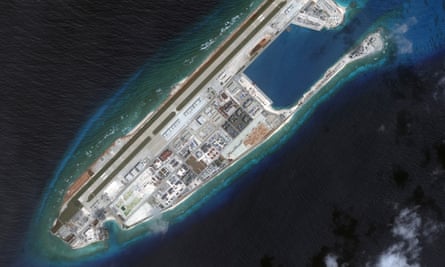
Fiery Cross reef in the Spratly Islands chain in the South China Sea. Australia says ‘there is no legal basis’ for Beijing’s disputed territorial claims in the South China Sea

Australia has declared “there is no legal basis” to China’s territorial and maritime claims in the South China Sea, marking an escalation of recent tensions with Beijing and bringing Canberra further in line with Washington.

The declaration, made in a submission to the United Nations on Thursday, comes after the United States hardened its position earlier this month, accusing Beijing of a “completely unlawful … campaign of bullying” to control the sea.

Australia’s shift in position comes as Australia’s foreign affairs minister, Marise Payne, and the defence minister, Linda Reynolds, prepare to travel to Washington next week to meet with the US secretary of state, Mike Pompeo, and the secretary of defence, Mark Esper, for the 2020 Australia-United States Ministerial Consultations (Ausmin).

The declaration to the UN said: “Australia rejects China’s claim to ‘historic rights’ or ‘maritime rights and interests’ as established in the ‘long course of historical practice’ in the South China Sea.”

Australia’s declaration mentioned the objections and complaints held by the Philippines, Vietnam and Malaysia in regards to Beijing’s actions in the South China Sea, and “rejects” the validity of “land building activities” used to create artificial islands.

The declaration said Australia does not accept China’s claim of sovereignty over the Paracel Islands and Spratly Islands, after Australian warships encountered China’s navy near the Spratly Islands earlier this month when taking part in drills with Japan and the United States in the Philippine Sea.

It notes “the Tribunal in the 2016 South China Sea Arbitral Award found these claims to be inconsistent with UNCLOS (United Nations Convention on the Law of the Sea) and, to the extent of that inconsistency, invalid”.

“There is no legal basis for China to draw straight baselines connecting the outermost points of maritime features or ‘island groups’ in the South China Sea, including around the ‘Four Sha’ or ‘continental’ or ‘outlying’ archipelagos,” it said.

“Australia rejects any claims to internal waters, territorial sea, exclusive economic zone and continental shelf based on such straight baselines.

“Australia also rejects China’s claims to maritime zones generated by submerged features, or low-tide elevations in a manner inconsistent with UNCLOS. Land building activities or other forms of artificial transformation cannot change the classification of a feature under UNCLOS … the Australian government does not accept that artificially transformed features can ever acquire the status of an island.”

Earlier on Saturday, Payne and Reynolds said “discussions at Ausmin 2020 will centre on our shared efforts towards a stable, resilient, open, secure and prosperous Indo-Pacific, particularly in the context of the impact of Covid-19”.

“Our relationship is built on our shared values, and a shared understanding of the importance of maintaining presence and leadership in our region.

“In the face of an increasingly complex and contested regional environment, it is vital we continue working together across the breadth of our relationship.”

The joint statement also reiterated that “the United States remains by far Australia’s largest source of foreign investment”.

The ministers also wrote an opinion piece in Saturday’s the Australian newspaper noting “coercive actions in the South China Sea, such as the escalation of disputes and militarisation of disputed features, continue to create tensions that destabilises the region”.

The opposition leader, Anthony Albanese, said Australia needed to defend the “national interest” when asked about the change in position on Saturday morning.

“We also need to stand up for international law,” he said. “And the international law of the sea provides for freedom of navigation which is absolutely critical to international trade.”

Tensions between Australia and China escalated earlier this year as Canberra pushed for an inquiry into Beijing’s initial handling of the Covid-19 outbreak, with Australia’s trade minister, Simon Birmingham, complaining his Chinese counterpart would not answer his calls in May.

Since then, China has issued a warning to its citizens, and lucrative international student market, not to travel to Australia out of fears of racism. In June, Chinese foreign ministry spokesman Zhao Lijian accused Australia of mass espionage and of “stoking confrontation”.

Rising tensions have prompted Australian business leaders, who are worried further hostilities could damage exports to China, to call for a “separation of powers” between Australia’s foreign relations and trade ties.

Singapore man admits being Chinese spy in US

Flags of China (left) and the US. File photo

A Singaporean man has pleaded guilty in the US to working as an agent of China, the latest incident in a growing stand-off between Washington and Beijing.

Jun Wei Yeo was charged with using his political consultancy in America as a front to collect information for Chinese intelligence, US officials say.

Separately, the US said a Chinese researcher accused of hiding her ties to China's military was detained.

China earlier ordered the closure of the US consulate in Chengdu.

The move to shut down the diplomatic mission in the south-western city was in response to the US closing China's consulate in Houston.

US Secretary of State Mike Pompeo said the decision was taken because China was "stealing" intellectual property.

Chinese Foreign Ministry spokesman Wang Wenbin responded by saying that the US move was based on "a hodgepodge of anti-Chinese lies".

After a 72-hour deadline for Chinese diplomats to leave the Houston consulate expired on Friday at 16:00 (21:00 GMT) reporters saw men who appeared to be US officials force open a door to enter the premises. Uniformed staff from the US State Department's Bureau of Diplomatic Security took up position to guard the entrance.

Tensions have been rising between the two nuclear powers over several key issues.

President Donald Trump's administration has clashed repeatedly with Beijing over trade and the coronavirus pandemic, as well as China's imposition of a controversial new security law in Hong Kong.

What is known about the Singaporean national?

Jun Wei Yeo, also known as Dickson Yeo, on Friday pleaded guilty in a federal court to working as an illegal agent of the Chinese government in 2015-19, the US Department of Justice said in a statement.

He was earlier charged with using his political consultancy in the country as a front to collect valuable, non-public information for Chinese intelligence.

In his guilty plea, he admitted to scouting for Americans with high-level security clearance and getting them to write reports for fake clients. According to court documents he was recruited by Chinese intelligence in 2015 after giving a presentation in Beijing.

At the time he was a PhD student at a prestigious Singaporean university.

According to the guilty plea, Mr Yeo used a professional networking website - assumed to be LinkedIn - to contact potential targets likely to have access to sensitive information.

Mr Yeo was arrested as he flew in to the US in 2019.

And what about the arrested Chinese researcher?

The researcher was named by US officials as Juan Tang, aged 37.

She was among four Chinese nationals charged earlier this week with visa fraud for allegedly lying about serving in China's People's Liberation Army.

Juan Tang was the last of the four to be detained in California, after the US had accused the Chinese consulate in San Francisco of harbouring her.

It was not immediately clear how she was arrested.

FBI agents have found pictures of Juan Tang dressed in military uniform and reviewed articles in China identifying her military affiliation, the Associated Press reports.

It is quoting the University of California Davis as saying that she left her job as a visiting researcher in the Department of Radiation Oncology in June.

Why is there tension between China and the US?

There are a number of factors in play. US officials have blamed China for the global spread of Covid-19. More specifically, President Donald Trump has alleged, without presenting evidence, that the virus originated from a Chinese laboratory in Wuhan.

And, in unsubstantiated remarks, a Chinese foreign ministry spokesman said in March that the US military might have brought the virus to Wuhan.

The US and China have also been locked in a tariff war since 2018.

Mr Trump has long accused China of unfair trading practices and intellectual property theft, but in Beijing there is a perception that the US is trying to curb its rise as a global economic power.

The US has also imposed sanctions on Chinese politicians who it says are responsible for human rights violations against Muslim minorities in Xinjiang. China is accused of mass detentions, religious persecution and forced sterilisation of Uighurs and others.

Beijing denies the allegations and has accused the US of "gross interference" in its domestic affairs.

What about Hong Kong?

China's imposition of a sweeping security law there is also a source of tension in relations with the US and the UK, which administered the territory until 1997.

In response, the US last week revoked Hong Kong's special trading status, which allowed it to avoid tariffs imposed on Chinese goods by the US.

The US and UK see the security law as a threat to the freedoms Hong Kong has enjoyed under a 1984 agreement between China and the UK - before sovereignty reverted to Beijing.

The UK has angered China by outlining a route to UK citizenship for nearly three million Hong Kong residents.

China responded by threatening to stop recognising a type of British passport - BNO - held by many of those living in Hong Kong.

What Will Happen if the Coronavirus Vaccine Fails? A vaccine could provide a way to end the pandemic, but with no prospect of natural herd immunity we could well be facing the threat of COVID-19 for a long time to come. by Sarah Pitt

  There are  over 175  COVID-19 vaccines in development. Almost all government strategies for dealing with the coronavirus pandemic are base...