#Sponsored

Monday, August 3, 2020

The U.S. Army's New Assault Rifle Shoots Bullets With the Force of a Tank? The Next Generation Squad Automatic Rifle (NGSAR) will pack a punch. by Jared Keller

 The service is working overtime to get the muscular system operational.

The Army claims its new assault rifle will unleash a hailstorm of specially-designed shells with as much chamber pressure as a battle tank to tear through even the most advanced body armor — and if all goes according to plan, the soldiers will get them to play with sooner than they thought.

The service plans on fielding a Next Generation Squad Automatic Rifle (NGSAR) — the first version in the Army’s Next-Generation Weapons System that chambers a round between 6.5mm and 6.8mm —  as a potential replacement for its 80,000 M249 SAWs starting in fiscal 2022 rather than the original target date of fiscal 2025, Col. Geoffrey A. Norman, force development division chief at Army HQ, told Task & Purpose back in 2018, with two per nine-man infantry squad.

While the service still hasn’t set official requirements for the system, the NGSAR will weigh less, shoot farther, and pack more punch than the service’s existing infantry weapons, Norman told Task & Purpose. And more importantly, the platform will incorporate a chamber pressure superior to the current system in soldiers’ arsenals to ensure that the rounds can still blast through enhanced enemy body armor at up to 600 meters.

The goal, as Norman put it, is to equip infantry soldiers with an automatic rifle “that fires a small bullet at the pressure equivalent to what a tank would fire.”

“The chamber pressure for the standard assault rifle is around 45 KSI [kilopound per square inch], but we’re looking for between 60 and 80 KSI … the chamber pressure when an M1 Abrams tank fires is on that order,” Norman told Task & Purpose. “We’re looking to reach out around 600 meters and have lethal effects even if the target is protected by body armor.”

The NGSW program currently consists of the NGSAR, a Next Generation Squad Carbine (NGSC), and a squad designated marksman rifle, along with specialized ammunition and fire control system. But while the Army had previously focused on fielding an improved carbine with a range and accuracy superior to the standard M4 that would also chamber a round between 6.5mm and 6.8mm, the service recently changed gears to prioritize the muscular automatic NGSAR.

The reason, according to Norman, is the Pentagon’s current shift from the close quarters of urban warfare in Iraq and Syria to the mountains and open terrain of Afghanistan. While the carbine may be well-suited for a knock-down, drag-out brawl while moving house to house in cities like Mosul and Raqqa, it lacks the range to take out Taliban and ISIS fighters in open stretches.

“For the past 10 or 15 years, we’ve been really focused on the requirement of lethal effects against unprotected targets,” Norman said. “Now we’re looking at near-peer threats like Russia and others. We need to have lethal effects against protected targets and we need to have requirements for long-range lethality in places like Afghanistan, where you’re fighting from mountaintop to mountaintop over extended ranges.”

The service is certainly working overtime to get the muscular system turning militants into pink mist downrange. Gordon told Task & Purpose that the NGSW systems currently undergoing testing and evaluation by the Soldier Lethality Cross-Functional Team at Fort Benning, Georgia will initially head downrange with the 7.62mm XM11158 Advanced Armor Piercing (ADVAP) round while the service hacks away at a specialized round built to achieve the proper balance between range and lethality.

“The challenge of the 5.56mm is that it doesn’t have enough mass [to defeat enemy body armor],” Norman said, referring to Chief of Staff Gen. Mark A. Milley’s April 2017 testimony before lawmakers on the Army’s growing ammo problem downrange. “But the challenge with 7.62mm ammo is that it has too much mass and not enough propellant. The right solution is somewhere between the two, where you have enough mass to penetrate but you’re still moving fast enough.”

But the real heart of the NGSW program is the fire control system, developed independently from the receiver and chamber. While the Army has spent years evaluating off-the-shelf options for soldiers’ next assault rifle — see the Interim Combat Service Rifle program aborted in November due to weight concerns rather than budget jousting — Norman characterized the proprietary fire-control system as a miniaturized version of the systems utilized by ground vehicles and aviation platforms.

“We’re exploring several options to ensure that what the gun aims at, it actually hits,” Norman told Task & Purpose. “The system will adjust and potentially only fire when the muzzle will line up with its target. It will take into account atmospheric conditions, even automatically center the weapon using an internal system. We’re looking to get these capabilities ready as soon as possible.”

The Army’s hard target of a 2022 fielding may seem ambitious, especially given the maddening nature of defense acquisition. But the service isn’t the only one putting the NGSW in the crosshairs: According to Norman, the Corps is also interested in adopting the NGSAR alongside the M27 and M1101 CSASS sniper rifle the Army has eyed in recent years. And with the campaign against ISIS in close-quarters environs like Iraq and Syria winding down, soldiers and infantry Marines could use the range and the punch of the system sooner rather than later.

“We’ve got support from Congress and the Secretary of Defense as part of our close combat strategic portfolio review,” Norman told Task & Purpose. “We’re not going to replace all 80,000 SAWs right away — but the intent is to get this AR variant out to infantry squads as soon as possible.”

Russia's New Heavy Flamethrower Battalion May Violate International Law Calling these weapons “flamethrowers” seems a bit of a misnomer. by Michael Peck

One complication with using thermobaric weapons is international law. While these weapons are not expressly prohibited, Human Rights Watch argues that they are so indiscriminate that they would kill not just soldiers, but any civilians in the target zone.

Heavy flamethrower battalions are coming to the Russian army.

The goal is to use incendiary weapons – devastating physically and psychologically – to clear enemy troops from cities, bunkers and tunnels.

Calling these weapons “flamethrowers” seems a bit of a misnomer. Rather than the backpack-and-nozzle units carried by foot soldiers in World War II, Russia will be using the new TOS-1A Solntsepek (“burning sun”) a multiple rocket launcher – mounted on a T-72 tank chassis – that fires thermobaric rockets. These weapons mix mix fuel and  air in a cloud that, when detonated, creates massive heat and pressure effects. Russia has reportedly used the older TOS-1 Buratino in Syria.

“Solntsepek heavy flamethrowers will clear the road for Armata tanks and motorized riflemen,” according to Russian newspaper Izvestia. “They will form battalions, which are armed with those powerful systems, in each military district, Their primary mission is to dislodge the enemy from fortifications.”

Viktor Murakhovsky, a Russian defense expert, boasted to Izvestia that the new thermobaric weapons will so devastate the enemy that the infantry will have a cakewalk occupying the terrain. “‘Solntsepek’ systems provide complete destruction on a large area,” he said. “They are good during the breach of heavily defended fortified areas. Ordinary tube or rocket-propelled artillery will require much more time and ammunition to accomplish a similar mission. Moreover, the result will not be ensured in the end. But the heavy flamethrowers using fuel-air explosive munitions will destroy that defense with one salvo. Later, tanks and motorized riflemen should enter the engagement and, essentially, there will already be no one to offer resistance to them.”

The U.S. military has moved away from the flamethrowers and napalm bombs used during World War, Korea and Vietnam, though there are reports that the M202A1 FLASH – a handheld bazooka-like incendiary rocket launcher – has been used in Afghanistan. However, flame weapons are an integral part of the Russian arsenal.

“In the current structure of the Russian Ground Forces, shoulder-fired flamethrower squads and platoons may be found in the NBC Defense companies of Russian maneuver brigades. Company-sized flamethrower units can only be found in the flamethrower battalions in the NBC Defense regiments of the Combined Arms Armies, Tank Army, and Army Corps,” according to the U.S. Army’s Foreign Military Studies Office. “The typical Russian flamethrower battalion consists of two companies of shoulder-launched flamethrowers, and one company of vehicle-launched ‘heavy’ flamethrowers. The typical shoulder-fired flamethrower company has 71 personnel and nine BMO-T ‘Terminators’ (the BMO-T is a modified T-72 chassis for the transportation of 20-30 of the highly volatile shoulder-fired disposable RPO-A Shmel series flamethrowers). The typical vehicle-launched ‘heavy’ flamethrower company has 35 personnel, three TOS-1A ‘Solntsepek’ heavy flamethrowers, each with 24 220-mm thermobaric rockets mounted on a T-72 chassis, and six TZM-T transporter/loader vehicles that are also mounted on a T-72 chassis.”

One complication with using thermobaric weapons is international law. While these weapons are not expressly prohibited, Human Rights Watch argues that they are so indiscriminate that they would kill not just soldiers, but any civilians in the target zone. Fuel-air explosive also inflict horrific injuries, crushing their victims or crushing their internal organs.

Interestingly, Izvestia noted that “for a long time, the Russian military could not decide on a concept of using these systems, although they have been exported for several years.” Also interesting is that the incendiary and flamethrower weapons are operated by the Russian military’s Nuclear, Biological, and Chemical (NBC) units, which also is responsible for protecting troops from weapons of mass destruction.

Russian military newspaper Red Star asserts that thermobaric weapons reflect Russia’s willingness  to conduct assault operations such as storming fortified towns, in contrast to the Western approach of using precision weapons for mobile battles. “The Americans assumed that wars will become contactless - light mobile infantry will conduct in-depth raids under the cover of aircraft,” Red Star said. “They considered assault operations to have receded into the past. As a result, in Viktor Murakhovsky’s words, they spent a year for the seizure of Iraq’s Mosul and the storming of Syria’s Raqqa was dragged out for four months. In the process, the cities were completely destroyed by aircraft.”

Whether razing cities – and wiping out their inhabitants -- with fuel-air explosives is any more efficient or humane remains to be seen. “We had to burn the city to save it” seems a dubious assertion at best.

China Is Now Working On a Deadly Kamikaze Drone Army Like drones in general, loitering munitions can be hard to detect and shoot down, especially the smaller models. by Michael Peck

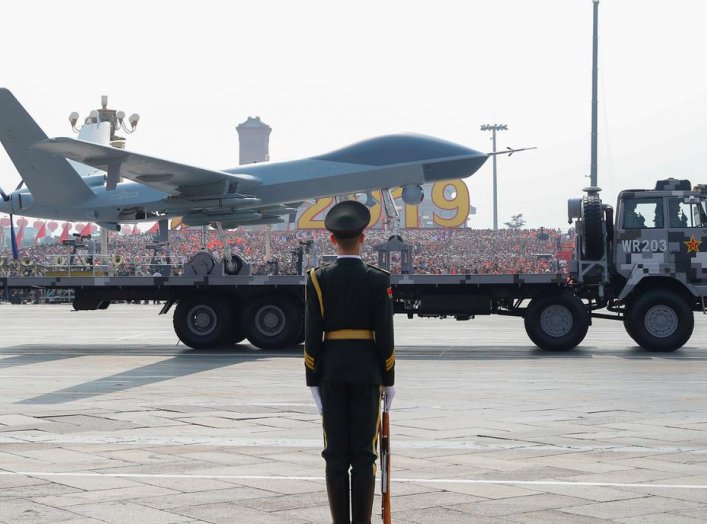
A military vehicle carrying an unmanned aerial vehicle (UVA) travels past Tiananmen Square during the military parade marking the 70th founding anniversary of People's Republic of China, on its National Day in Beijing, China October 1, 2019. REUTERS/Thoma
U.S. ally Israel first taught China about suicide drones. Now Beijing is looking for its own.

China’s military is looking to buy suicide drones.

The military wants two types of suicide drones, according to an announcement posted on a Chinese military procurement Web site. The desired technical specifications of the drones, or the number to be purchased, is classified.

But Chinese drone manufacturers do have products that might satisfy the demands of the People’s Liberation Army. In 2018, China Aerospace unveiled the CH-901, which Chinese media described as being 4 feet long and weighing 20 pounds, with a speed of 150 kilometers (93 miles) per hour, a range of 15 kilometers (9 miles) and an endurance of two hours. The larger WS-43 is a 500-pound weapon with a range of 60 kilometers (37 miles) and an endurance of 30 minutes.

Either expendable attack drones or flying artillery shells, depending on how you look at them, suicide drones are lethal newcomers to the 21st Century battlefield. Called “loitering munitions” by military customers who are understandably reluctant to refer to them as suicidal, these weapons seek to bridge the gap between artillery shells – which can’t stay up in the air – and strike drones like America’s Reaper and Predator, which are big and expensive unmanned aircraft

Loitering munitions feature a propeller, wings, a warhead and a camera. They orbit an area, scanning it with their cameras to identify targets and transmitting the images back to the operator. When the operator sees a worthwhile target, he can command the drone to perform a death-dive on the target.

The potential uses of these weapons are numerous. Aerovision’s Switchblade, which the U.S. Marine Corps ordered in 2018, is a handheld 6-pound weapon that fits inside a soldier’s backpack. Switchblade is designed for situations such as troops encountering a mortar on the reverse slope of a hill that can’t be hit by direct-fire weapons. Instead of waiting for artillery or airstrikes, a rifleman can pluck a Switchblade from his backpack and destroy the target. Or, if hitting a sniper in a building risks collateral damage to civilians, a Switchblade can be flown through the window. Its warhead is no more powerful than that of a grenade, but that’s still powerful enough to take out a mortar or sniper.

Israel’s Harpy, designed to knock out enemy radar sites, is a much larger weapon. Introduced in 1990 as probably the world’s first suicide drone, the 300-pound Harpy has a range of up to 250 miles and an endurance of two hours. It is similar to a traditional anti-radiation missile that homes in on signals from a radar station. However, unlike a missile, it can stalk an area for hours, waiting for an unwary operator to switch on a radar before it autonomously flies toward the target.

Ironically, China got its first taste of suicide drones when Israel sold it the Harpy in the 1990s, to the displeasure of the U.S. government. Meanwhile, Russia is also developing its own kamikaze drones.

For the U.S. military and other potential Chinese adversaries, this is one more advanced weapon that they may encounter in battle. Like drones in general, loitering munitions can be hard to detect and shoot down, especially the smaller models.

Even worse, those Chinese loitering munitions may be popping up outside of China. Beijing may have become the world’s No. 2 arms exporter, whose aircraft, tanks and rifles can be found across the globe. This means that American soldiers could face Chinese-made suicide drones in hotspots such as Africa and the Middle East.

When the Lasers Strike: How the U.S. Military Wants to Protect Its Planes and Bases A lot of high-tech advances will be needed to clear an airspace or defend fixed locations alike airfields and ports. by Kris Osborn

By US Air Force - usaf.mil, Public Domain, https://commons.wikimedia.org/w/index.php?curid=70220960
The U.S. Air Force is looking at innovative ways to counter a new generation of enemy weapons such as lasers, anti-satellite systems, long-range missiles and advanced air defenses. One way the Pentagon hopes to deal with these weapons is by sharpening its focus on emerging methods of networking, sensor detection and countermeasures. 

Air Force General James Holmes, Commander, Air Combat Command, explained that countering these types of new threats will require the service to rely upon new technologies such as the now-in-development Advanced Battle Management System (ABMS). 

“We are trying to find and destroy mobile, agile, intelligent hard to find targets such as mobile anti satellite systems, mobile directed energy systems, mobile long range fires and mobile integrated air defenses [that] in many cases they are shooting at ports and airfields which are easy to find,” Holmes told Retired Lieutenant General David Deptula, Dean of the Mitchell Institute for Aerospace Studies in a special interview series. 

Holmes explained the dynamic in terms of a “battle of long range fires” requiring Air Force war commanders to help “close that kill chain.” He cited ABMS as the key conceptual and technical foundation upon which this kind of combat effectiveness can be achieved. 

ABMS is a future-oriented program immersed in leveraging, networking, innovating and uncovering a meshed web of warzone surveillance “nodes” able to find enemy targets with great accuracy at long ranges. Of greatest significance, the program is understood in terms of mission objectives, meaning that it may ultimately evolve into a series of specific platforms capable of performing the operations. The program initially emerged out of a need to replace the Air Force’s highly effective, yet aging E-8 Joint Surveillance Target Attack Radar System (JSTARS) surveillance planes. What is needed now is a new platform or series of nodes able to operate at greater distances and operate in austere, high-risk environments. 

The JSTARS planes were highly effective at reconnaissance and intelligence-gathering in areas such as Afghanistan, where the U.S. operates in what’s called “uncontested airspace.” However, they would, of course, face challenges when confronting advanced air and ground weapons developed by sophisticated adversaries. 

As a large “unstealthy” surveillance aircraft, a JSTARS would be vulnerable in contested airspace to advanced air defenses, lasers, ground-fired missiles and air-to-air attacks. The mission scope and effectiveness of the JTARS does, however, need to be replicated, yet adjusted to a much higher-threat, contested environment. 

This may mean the development and use of stealthy, forward-operating networked drones able to sense key targets and transmit signals to a flying “mothership” flying at safer standoff distances. 

The JSTARS mission is, after all, nuanced and quite complex. Synthetic Aperture Radar, which paints an image or rendering of the terrain below, is able to connect with on-board computers, electro-optical sensors and additional detection technologies such as Ground Moving Target Indicator to find enemy ground vehicles.

The JSTARS can cover wide swaths of terrain, identify areas of relevance, perform on-board analytics in many respects, and pass vital information along to drones able to offer more of a pinpointed view at target areas. 

It makes sense to place all of this in the context of Holmes’ reference to a “kill chain.” After all, what use is a surveillance network if it does not speed up, improve and expedite the process of “destroying” an enemy’s advanced weapons threat. 

This means countermeasures, electronic warfare (EW), interceptor missiles and straight forward offensive attacks upon enemy weapons systems once discovered, may be employed. Perhaps a cutting-edge EW system can block, jam or re-direct incoming enemy laser fire or guided ballistic missiles? Perhaps a network of manned-unmanned platforms can detect the launch of an anti-satellite system or find the electronic signature of an enemy air defense system and pinpoint the necessary targets for attack in a matter of seconds. 

Such a technical ability would indeed be necessary to accomplish the kinds of missions articulated by Holmes, such as defending findable, and potentially vulnerable, targets such as “ports and airfields.” 

Air Force war planners in the Pacific have a particular interest in questions pertaining to the importance of targeting and surveillance networks, given the dispersed geographical expanse of the region. This interest also often explains the importance of long-range attack and “standoff” forces. 

“The Standoff force (in the Pacific) will have to rely upon intelligence, surveillance and reconnaissance assets. They attack targets they do not see,” Brigadier General Mike Winkler, Pacific Air Force Director, Strategic Plans, Requirements and Programs, told Deptula in a separate, but related discussion. 

Holmes explained these efforts within a specific major-power threat context, explaining that much of the innovation in the U.S. Air Force is zeroed in on finding new ways to destroy, respond to or thwart enemy attempts to “counter” successful U.S. weapons. 

“We have watched China and Russia spend the time since Desert Storm watching what we do coming up with ways to counter our strengths and take advantage of our weaknesses,” Holmes told Deptula. 

China and Iran are about to Become Allies—Here’s What We Should Do about It The United States should undertake a global strategic review, with all of its allies and partners in the democratic world as well as those that play by the rules, to develop a more effective collective strategy for dealing with China in the post-coronavirus era. by Barry Pavel

Reuters
Two ancient Asian cultures, two partners in the sectors of trade, economy, politics, culture and security with a similar outlook and many mutual bilateral and multilateral interests will consider one another strategic partners.” So begins a new secret bilateral agreement reportedly in its final stages between Chinese Communist Party leader Xi Jinping’s China and Supreme Leader Ayatollah Ali Khamenei’s Iran. On the assumption that this agreement is implemented, it should cause U.S., European, and Asian strategic planners great alarm. Ultimately, it will require the United States to develop a vision for how to organize its allies and partners to work together on a global strategy for dealing with China. 

What are the first-order implications of this new agreement, in many ways an alliance between two of the world’s leading authoritarian systems that share and promote values that are entirely antithetical to the democratic world?

First, this is a new strategic challenge not just for the United States and its regional partners in the Gulf and Israel but for Asian and European democracies everywhere. It is the first major comprehensive bilateral agreement between China and another major country in a long time. It has been reported that the agreement has been in development for many months, but the geopolitical significance is that China gains a new and very significant foothold in one of the most geostrategic locations in the world, at the mouth of the Straits of Hormuz from where most of the world’s oil flows to keep the global economy humming. It also gives the Iranian regime and economy a major lifeline in the form of tens of billions of dollars of Chinese investment and trade, which will significantly weaken the U.S.-led sanctions against Iran. These are only two of the many reasons why this agreement should stimulate new consultations among the United States, its global democratic partners and allies, and its regional Gulf partners. 

This Chinese-Iranian initiative also makes clear to the Gulf and Israel that they cannot really have it both ways, and that China has chosen to formally ally with their arch-enemy, Iran. Thus, this is an opportunity for the United States to draw the Gulf and Israel closer to the United States and away from China. 

The second major implication is that China is intent on projecting its military power on a routine and sustained basis to the Middle East and to Europe. Thus, in essence, this is the beginning of the reset of the global military postures of the top two great-power competitors of our new era. While China will sustain its investments in and massive continuing improvements of its military capabilities and posture in the western Pacific, this new move into Southwest Asia is part of the continuing advance of China’s military posture, access, and operations into the areas of operation that the Defense Department calls U.S. Central Command and U.S. European Command. It portends much more significant Chinese military advances into those two theaters in the near term, something that most observers in the United States, Europe, and elsewhere greatly underappreciate. 

In 2017, China established a major military base in the geostrategic location of Djibouti only a few miles from a U.S. base there. While that Chinese base ostensibly was built only for counter-piracy operations and other routine reasons according to the Chinese, all of China’s growing points of access and bases across southern Eurasia in the Indian Ocean (e.g., Sri Lanka and Pakistan), the Middle East, and into Europe in the Mediterranean will be used for classic great-power nationalist geopolitical and military purposes, including political influence and a wide range of military objectives such as Intelligence, Surveillance, and Reconnaissance (ISR); Command and Control (C2) of military forces in exercises, in shows of force to deter U.S., European, and Gulf military action, and, in the event of crisis and conflict, to target U.S., Gulf, and European forces. 

This new Chinese political-military-economic foothold provides China with new points of leverage for coercion. China already wields vast economic, technological, military, and informational levers for coercion and has used them wantonly and as it sees fit to punish other countries who take actions that it doesn’t like (such as when South Korea deployed a single missile defense battery to counter North Korean ballistic missiles and China shut down Korean department stores in China and shut off Chinese tourism into South Korea). 

One only needs to remember the several joint Chinese-Russian exercises in Europe including the Baltics in recent years, China’s joint incursions with Russian air forces into Korean airspace on July 23, 2019, as well as China’s continuing advances into the Arctic, to see where all of this is headed. The Chinese People’s Liberation Army increasingly will become a major security actor across the Middle East and Europe (with Russian support and coordination). Indeed, it appears increasingly obvious that a China-Russia-Iran axis is forming and could be a sustained strategic alignment. North American, European, Middle Eastern, and Asian policymakers would do well to get ahead of this curve and begin intensifying and integrating their consultations about China, with Russia and Iran as important but secondary factors. In addition, the United States will have to respond, over time, and view its military posture in the Middle East and Europe as at least in part driven by the changing and growing Chinese military posture.

In addition, it is quite likely that somewhere in this secret agreement, the two dictatorships also have included provisions for Chinese assistance with the Iranian ballistic missile program, space launch and related space capabilities, and cyberspace capabilities including advanced techniques for throttling the Internet in Iran.

Third, and perhaps most dangerously, its timing suggests that Xi Jinping sees the United States in its current viral, economic, racial, and electoral throes as completely distracted at the minimum and more likely, simply weak. Such a perception alone would be dangerous enough, as it means that the Chinese Communist Party leader is willing to take greater risks to continue China’s march toward achieving its stated goal of global domination and sees now as the time to act to displace the United States and erect a new global order that reflects Chinese Communist Party values. That global order, or what I call a “China First” global system, would set the conditions for the expansion worldwide of Chinese authoritarianism as a model, which includes suppression of freedom of speech, the elimination of privacy through technological means, the dictatorship of the party, internment and reeducation camps, the elimination of the rule of law, and much more. That is not a world that most of us will want to live in. 

How should we in the democratic world respond to this new strategic context? There are at least four major endeavors upon which we need to act. 

First and most broadly, the United States should undertake a global strategic review, with all of its allies and partners in the democratic world as well as those that play by the rules, to develop a more effective collective strategy for dealing with China in the post-coronavirus era. That integrated strategy should cut across regions and domains, including public health, governance, defense, and the economy, and seek not just recovery from the virus but a rejuvenation of the democratic world and a new, rules-based order which would leverage the inherent advantages of democracies over autocracies. That strategy also should seek deep cooperation with China in areas of agreed mutual interest, while also collecting democracies together to counter China in other areas where it is pursuing hostile activities. 

Second, leading democratic powers from across Asia, Europe, and North America should start consulting more structurally and routinely—perhaps in the “D-10 Plus” format as soon as possible at the foreign and defense minister level. While the United States’ planned expansion of the G-7 meeting this fall would move in this direction, the D-10 Plus format should become more routinized. 

Third, and consistent with the NATO Secretary General’s recently outlined vision of the future of the Alliance, NATO and its core Asian partners such as Japan, Australia, and Korea should strengthen their interrelationships. If in the future a major crisis or conflict between the United States and China occurred, then Japanese and Korean interests in the Middle East and Europe will be as much at risk as French and German interests in Asia and Europe. In addition, NATO also now needs to reinvigorate its linkages with key partners in the Gulf and the Middle East. The point is that these U.S.-led alliances and partnerships, borne in a different era, now need to be integrated across regions and domains to counter the China challenge.

Finally, as I have proposed before, with Chinese influence and military forces encroaching into and across the European continent, it’s well past time for the establishment of a NATO-China Council for the alliance and China to engage in a dialogue, avoid misunderstandings and accidents, and seek cooperation in areas of common interest.

The headlines about this new China-Iran agreement will suggest that it is important, but not geopolitical. Those headlines underestimate the significance of this new alliance—it is a milestone in history. It constitutes a major new element in our new era’s shifting geopolitical dynamics, setting the stage for a long-term confrontation between the democratic world and the authoritarians. We now need to wake up to this reality and, patiently and strategically, make the necessary arrangements in order to win the competition.

How a War in the South China Sea Between China and America Could Start Could a small “clash,” incident, or brief exchange of fire between American and Chinese forces in the South China Sea quickly lead to a dangerous “all-out war? by Kris Osborn

https://www.reutersconnect.com/all?id=tag%3Areuters.com%2C2020%3Anewsml_RC2F0I90TY37&share=true
Could a small “clash,” incident, or brief exchange of fire between American and Chinese forces in the South China Sea quickly lead to a dangerous “all-out war?”

Many experts, observers and officials seem to share the concern, given the rapid escalation of hostility between the two major superpowers. 

Speaking to this topic, the Chinese-government backed Global Times heated up the rhetoric a bit when stating, “if Washington launches military provocations to challenge the bottom line of China’s national security and sovereignty, China will make immediate and effective retaliations.” 

While this may, in some respects, seem like somewhat of an obvious statement, it does introduce the prospect of a major war, perhaps beginning with only a small incident. 

“The possibility of small and medium-sized clashes, which could involve ship collisions and occasional firing incidents, is rising,” the Global Times writes. 

How could a small clash occur? The paper suggests the highly unlikely possibility that the U.S. might attack some of China’s claimed “phony island” territory in the South China Sea. While unlikely, Chinese moves to place weapons in sensitive areas of the South China Sea island chain might make that kind of consideration somewhat realistic, given the proximity of the threat they would introduce. 

However, some kind of intercept, false move or misinterpreted training exercise could easily spark some kind of exchange of fire. Both the America and China have been massively ratcheting up surveillance plane operations, aircraft carrier attack drills, training operations and bomber patrols in close proximity to one another. This increases the likelihood of actions being misunderstood or intentions being misread. 

Perhaps Chinese fighter jets and surveillance drones operating near or over Taiwan might appear to be closing in for an attack, therefore prompting ground commanders to fire air defenses? Where is the boundary between peaceful training operations, harmless patrols and severe military provocation? Should that line be tenuous in any way, major catastrophic war could erupt. 

On the flip side, what if a U.S. Navy destroyer conducts a Freedom of Navigation exercise in the South China Sea and sails within the twelve-mile territorial boundary of island areas claimed by China and China fires missiles at the U.S. ship? If the shots fired are even warning shots, they could lead to disproportionate retaliation. 

In terms of pure statistics, increasing the number of patrols, surveillance operations and attack drills near one another simply raises the probability of some kind of hostile encounter. The big question is this: would either major power exercise the much-needed restraint necessary to stop a war in the event of small engagement? One would think the price of major warfare would simply be far too high for both countries, but that does not mean it could not happen.

The U.S. Navy Is Getting a New Robot Anti-Mine Submarine The Knifefish will be paired with the Littoral Combat Ship. by Caleb Larson

https://www.reutersconnect.com/all?id=tag%3Areuters.com%2C2010%3Anewsml_GM1E61601XF02&share=true

The program aims to keep U.S. Navy ships safe from mines by replacing mammals with machines.

The Knifefish is a “medium-class Mine Countermeasure (MCM) Unmanned Undersea Vehicle (UUV) designed for deployment off the Littoral Combat Ship (LCS),” and is essentially an anti-naval mine drone. According to General Dynamics, the Knifefish “provides the mine warfare commander with enhanced mine-hunting capability by detecting, classifying and identifying both buried mines and mines in high clutter environments.”

Unlike some other underwater autonomous vehicles, the Knifefish does not tow a sonar, but has a sonar built into its body, significantly streamlining the design and increasing range and endurance. 

The Knifefish system uses low-frequency sonar in tandem with target recognition software to identify underwater targets. The Knifefish system is designed to essentially act as a sensor extension of its mother ship, allowing the ship to stay behind the Knifefish, away from minefields and out of harm’s way.

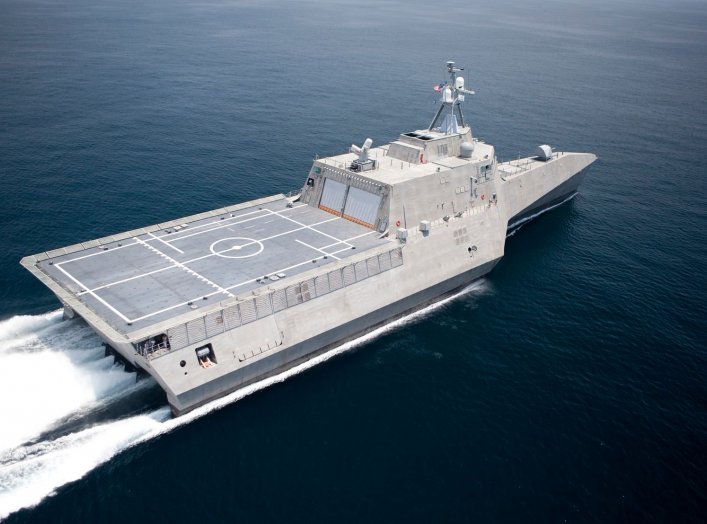
The Knifefish is intended to operate alongside the Navy’s Littoral Combat Ship system. Though facing many woes, among them early retirement, the LCS ships would gain a potentially powerful new arrow in their mission profile quiver with the addition of the Knifefish anti-mine program.

The Navy lauds the program’s modularity. They state, “Knifefish’s common open systems architecture design and modularity allow for platform flexibility and quick reconfiguration of the mission package to respond to evolving and dynamic mission requirements.” The platform can essentially be “retrained” by updating its software to identify new mine threats as they arise. “Planned block upgrades will improve its sensors and automated target recognition software to keep pace with mine threats.”

Marine Mammal Program

You don’t have to catch it, you don’t have to train it, and you don’t have to feed it—unlike the animals in the Navy’s Marine Mammal Program.

Although the Marine Mammal Program has used a wide range of animals at different times—including various seals, species of dolphins, and small whales—the two animals that are primarily trained are California sea lions and bottlenose dolphins.

The animals are primarily used for identifying and marking underwater naval mines, but they’ve also been trained for use in recovery operations and as underwater harbor sentries. These missions could also be done by robots—robots who need only an occasional battery refill.

Money, Money, Money


What Will Happen if the Coronavirus Vaccine Fails? A vaccine could provide a way to end the pandemic, but with no prospect of natural herd immunity we could well be facing the threat of COVID-19 for a long time to come. by Sarah Pitt

  There are  over 175  COVID-19 vaccines in development. Almost all government strategies for dealing with the coronavirus pandemic are base...