#Sponsored

Monday, August 3, 2020

India Scrutinizing Russian SU-57 Stealth Jets As Makers Struggle To Fulfill Orders Earlier, Russian Minister of Industry had confirmed on June 27 that a contract for the procurement of 76 Sukhoi Su-57 aircraft, Russia’s first indigenously designed and built fifth-generation stealth fighter jet, has been concluded between the Moscow and United Aircraft Corporation.

Sukhoi Su-57 - Wikipedia

Russian Sukhoi-57 (SU-57) makers are having a difficult time to fulfil Kremlin’s order for 76 SU-57 stealth jets.

The stealth jets first flew in 2010, but due to delays in production until 2018, the 10 SU-57 prototypes were marred with “inadequate and incomplete sensors, incomplete fire-control systems and self-protection suites, no operational integrated avionics and unreliable engines,” aviation expert Tom Cooper writes.

The twin-engine for SU-57 is built at the Komsomolsk-on-Amur aircraft plant in the Russian Far East. According to a report in Forbes by David Axe, Sukhoi originally planned to hand over the first two production-standard SU-57s in late 2019 and two more in 2020. But the December 2019 crash of one of the jets compelled the company to halt the work on the program.

Earlier, Russian Minister of Industry, Denis Manturov, had confirmed that a contract for the acquisition of 76 Sukhoi Su-57 aircraft, Russia’s first indigenously designed and built fifth-generation stealth fighter jet, has been concluded between Moscow and United Aircraft Corporation.

Last year, Russia deployed pairs of SU-57s to Syria for what it claimed were combat trials. However, there’s no evidence to prove that the fighters actually flew front-line missions.

“Shortly following the 2018 deployment, the Kremlin cancelled production of the SU-57 after the 28th copy, effectively cancelling the program. But Russian President Vladimir Putin in mid-2019 dramatically revived the program, announcing a plan to buy an additional 48 copies,” wrote Axe.

As reported earlier by the EurAsian Times, the SU-57 fighter jet is designed to have supercruise, supermaneuverability, stealth, and advanced avionics to overcome the prior generation fighter aircraft as well as ground and naval defences.

Russia is marketing a number of high-end combat jets to India and alongside continued sales of MiG-29 and SU-30MKI fighters. New Delhi could also possibly purchase the Yak-130 fighter-trainer and the MiG-35 next-generation medium fighter jet.

India has shown some interest in Russia’s Su-57 next-generation heavyweight fighter, although the aircraft is yet to enter service in the Russian Air Force. New Delhi is likely to wait and assess its performance before making any commitments.

Experts stated that the possibility remains that India could seriously consider purchasing an initial batch of ‘off the shelf’ Su-57 jets from Russia to evaluate their capabilities – before entering into a contract for joint production.

Russia's Su-57 jet lands in Turkey for Technofest - Military ...

According to the author, now the company plans to deliver all four fighter jets in 2020. “These are challenging tasks that will truly mobilize us,” Sergey Chemezov, CEO of Sukhoi’s umbrella company, told state media in late 2019. COVID-19 pandemic may push the delivery dates even further.

However, Sukhoi workers are optimistic about delivering SU-57 on time. “The new aircraft is complex,” deputy workshop head Viktor Passar said, citing “composite sheathing, the latest technologies, the highest quality requirements.” “But we also have highly qualified personnel in our workshop,” Passar added.

The author also stated that several years after building the SU-35, managers at Komsomolsk-on-Amur are setting up SU-57 production in the plant’s Shop 45. He added that managers modernized the docking ramps and upgraded the rigs for building air-intakes and engine nacelles. They also shifted airframe work from Shop No. 7 to Shop No. 45, placing as much as possible of the SU-57 assembly in one space. “Before that, there were colossal losses of time,” said Artem Oshchepkov, the Shop No. 45 supervisor.

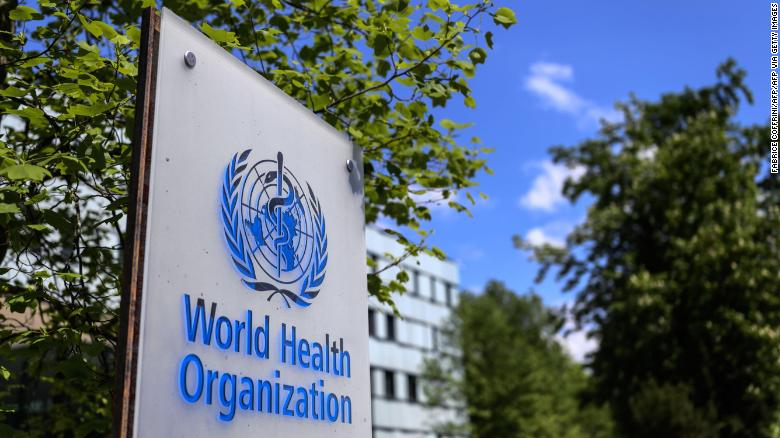
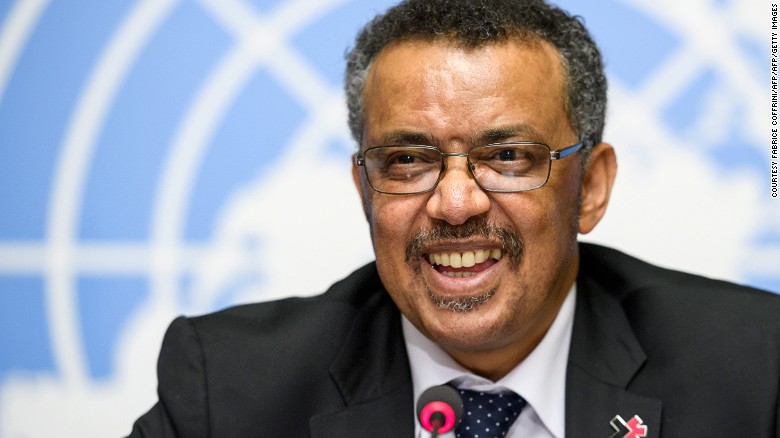
WHO leader is stuck between feuding China and US. It's a situation 'rock star' Tedros has spent his life preparing for

The WHO, headquartered in Geneva, has long needed more funding and reform -- and the virus presents an even greater challenge.

Tedros Adhanom Ghebreyesus was watching late-night television when he saw a hospital boss criticizing him and Ethiopia's Health Ministry, which he was leading at the time, for doing a terrible job. Instead of responding with a furious diatribe, as some political leaders might when watching their detractors on TV, he contacted the man, Dr. Kesete Admasu.

"Tedros called him in and said, well, if you have ideas and you're critical get in here and help us fix it, and made him Deputy Minister, which gives you a sense of his leadership style in bringing in the smartest and the best and empowering them," United States diplomat Mark Dybul, a professor at the Georgetown University Medical Center and co-director of the Center for Global Health Practice and Impact, told CNN.
"He took one of the worst ministries of health in the world, transformed it into one of the best, had to make very difficult political and health decisions and moves to make that happen," Dybul said.
Today, Tedros -- who is usually known by his first name, as is typical in Ethiopia -- is again facing harsh criticism as he tries to balance powerful interests and reform a troubled institution facing a monumental challenge. Some believe that if anyone can change the World Health Organization and help the world deal with the coronavirus pandemic, it's him.
"I think he's doing an incredible job," Peggy Clark, Executive Director of the Aspen Global Innovators Group who has worked closely with Tedros, told CNN. "I think that he is managing the situation as well as he can, even with the kind of ridiculous position that the US is taking at this time."
US President Donald Trump has regularly attacked WHO during the pandemic, blaming it for multiple failures and alluding to China's alleged influence at the organization as he moved to withdraw tens of millions in funding and, eventually, US membership.
Tedros has mostly reacted to these onslaughts with equanimity, but earlier this month condemned a "lack of leadership" in fighting the pandemic and made an emotional plea for global unity.
And when US Secretary of State Mike Pompeo claimed the Director-General had been "bought" by China, Tedros pushed back harder, calling the comments "untrue and unacceptable."
Tedros said that what "should matter to the entire international community is saving lives," adding that WHO would not be distracted.

'Rock star in the health world'

It is this single-minded determination that has characterized Tedros's rise to global fame, with the WHO Director-General known for his passion and drive, say observers.
In a speech before he was voted in for a five-year term in May 2017, Tedros said that when he was seven, his younger brother died "from one of the many child killers in Africa," Science Magazine reported. Tedros said that could easily have been him, and it was "pure luck" that he was now on stage running for a global leadership position. He said he was committed to reducing inequality and ensuring universal health coverage because he had grown up "knowing survival to adulthood cannot be taken for granted, and refusing to accept that people should die because they are poor."
His path soon became clear. As a child living in Eritrea, then a region of Ethiopia, the WHO filtered into his consciousness, Tedros said in a speech last year. "I remember walking through the streets of Asmara with my mother as a small boy, and seeing posters about a disease called smallpox. I remember hearing about an organization called the World Health Organization that was ridding the world of this terrifying disease, one vaccination at a time."
After gaining a biology degree from the University of Asmara in 1986, he began working for Ethiopia's Ministry of Health and studied in Denmark, which opened his eyes to the value of universal healthcare. In 1992, he received a WHO scholarship for a Masters degree at the London School of Hygiene and Tropical Medicine, before completing a PhD in community health at the University of Nottingham in 2000.
His thesis on malaria in the Tigray Region, where he grew up, was "outstanding" and "innovative," his former supervisor wrote in a letter to The Lancet medical journal supporting his bid for the WHO job. "A lasting memory of that collaboration was Tedros' innate ability to mobilize and inspire communities towards better health," wrote Peter Byass.
Tedros became head of the Tigray Regional Health Bureau and spent a year as a minister of state before serving as health minister from 2005 to 2012. "There were really only a handful of ministers of health, globally, who were really doing exceptional work in the developing world, and one was Minister Tedros," said Clark.
He found fame for "showing the way to a new era in world health," in the words of former USAID Administrator Ariel Pablos-Mendez, particularly through his bold vision to hire 38,000 young, female community health workers in every village in the country to deliver basic family planning, child health and malaria care.
His work helped to reduce child mortality by two-thirds, HIV infections by 90%, malaria mortality by 75% and tuberculosis mortality by 64%, according to his WHO application.
"Tedros became kind of a superstar. He was a rock star in the health world, and everybody loved him, not only because he was really so charismatic and brilliant but also because as a man, he really was setting up for family and children and women; it was very unusual," said Clark.
Clark believes Tedros's health worker program made a profound difference to a poor country, and he announced similar priorities around universal healthcare, women and children and health emergencies on taking office at WHO.
Many leaders in developing countries were dependent on wooing donors, said Clark,"but Tedros was so revered and beloved, he could literally walk into a room with donors and walk out with a multimillion-dollar check."
Teshome Gebre, then the Carter Center's Ethiopia representative for health programs, visited Tedros with his US bosses in 2006 to solicit help with tackling neglected tropical diseases. In a remarkable turnaround, Tedros instead persuaded them to donate $35 million to his malaria program, arguing that this was more urgent, life-saving work aimed at impoverished, marginalized people.
"They were extremely impressed with the way he really presented his arguments, his business case was so compelling," Teshome told CNN.
"This is for me one of the most memorable experiences that I have ever had with Dr. Tedros. I think I can say in my lifetime, I have never seen this kind of completely unexpected outcome."

The diplomat

Tedros's ascension to leading WHO is groundbreaking on several fronts. He is not only its first African Director-General but also the first non-physician to lead the global health agency.
He has strong support from the continent, where South Africa in particular faces a battle to contain the virus.
On April 8, Tedros said he had been receiving death threats, abuse and racist comments, but brushed them off. "I'm proud of being black," he said. "I don't give a damn."
The former Ethiopian government minister has many influential friends and supporters.
He said when the whole black community or Africa was insulted "then I don't tolerate it, then I say, people are crossing the line."
His stint as Ethiopia's Minister of Foreign Affairs between 2012 and 2016 saw him refine his diplomatic skills, persuading 193 countries to commit to financing the Sustainable Development Goals under the Addis Ababa Action Agenda.
He forged a friendship with former US president Bill Clinton through the Clinton HIV/AIDS Initiative, he has backing from tech tycoon Bill Gates, and he is on close terms with leaders including French President Emmanuel Macron and South Africa's Cyril Ramaphosa.
Stars including Lady Gaga, Jimmy Fallon and John Legend have also rallied around the WHO.
But some doubt Tedros precisely because of his diplomatic aptitude.
There were concerns when he was running for WHO leadership over his connection to an authoritarian government, one that Teshome concedes was "not very democratic."
Georgetown University professor Lawrence Gostin, a supporter of Tedros's WHO leadership rival David Nabarro, told CNN he was worried at the time because of Ethiopia's "abysmal human rights record."
Gostin -- director of the O'Neill Institute for National and Global Health Law, now a WHO Collaborating Center -- had reservations over alleged cover-ups of cholera outbreaks in Ethiopia, which Tedros denies.
Teshome agrees Tedros was "not transparent enough," but observed that "if he does otherwise, he will be fired from his position."
Gostin now speaks with Tedros regularly and calls him an "extraordinarily good" leader, and "one of the strongest director-generals in recent memory."
Tedros inherited what The Lancet called a "bruised and apologetic" WHO after its poor response to the 2013-2016 Ebola epidemic in West Africa. The organization was bureaucratic, politicized, and underfunded and reform was desperately needed.
Tedros's success in containing the Ebola epidemic in the Democratic Republic of the Congo (DRC) was widely praised. "Unlike most director-generals, he leads from the front," said Gostin. "He was on the ground, and probably, in harm's way."
WHO spokeswoman Margaret Harris was in the DRC at the time, and recalls Tedros genuinely participating on those visits, talking to local people and taking selfies with anyone who asked. When a public health emergency was declared, Tedros called in from the DRC, said Gostin.
"I give him a lot of credit for putting everything on the line. He's a very passionate man, he cares a lot and I think it shows. You can absolutely feel the sting of his wrath, and I have, but you can also hear the compassion."
Gostin recalls accidentally sending Tedros a text meant for his wife, saying he missed her. "'I love you too Larry, it's always good to hear from you," Tedros joked in reply.

The US-China issue

Many describe Tedros as humble. Teshome says Tedros is "not an authoritarian kind of guy," calling him "humorous, down to earth, very respectful to people."
But the Trump administration is not alone in its concerns about how Tedros deals with autocratic leaders.
In October 2017, Tedros picked Zimbabwe's then-president Robert Mugabe as a WHO goodwill ambassador -- quickly reversing the decision following an outcry.
Critics have questioned whether WHO is independent enough, pointing to Tedros's effusive praise of China's pandemic response and recirculation of China's statements that there was "no clear evidence" of human-to-human transmission of the coronavirus on January 14.
Gostin doesn't believe WHO knew China was being misleading, but says it could have responded better.
"I would have said, this is what the Chinese government is informing us about this outbreak and we have no way of independently verifying it," said Gostin.
Tedros, he added, believes that "it's better to use quiet diplomacy behind the scenes rather than criticize the government publicly."
Tedros has not been as full of praise for the effective pandemic response of Taiwan, a territory that China has successfully blocked from WHO membership, said Gostin. "Politics are at play. There's no doubt about it," he said.
But he acknowledges that Tedros did avoid antagonizing the Chinese government.
"He probably does read strongmen leaders like [Chinese President] Xi Jinping well, because if he publicly criticized China, it might have pushed China to be less cooperative and less transparent, and defensive. And he was trying to coax them from inside. And more than coax, he was actually quite firm with the Chinese government early on behind closed doors -- but it was at a cost to the reputation of the WHO."
The agency's image also suffered when it did not advise against travel to China. Tedros said at the time: "Such restrictions can have the effect of increasing fear and stigma, with little public health benefit."

WHO the world deserves

The truth is that WHO's power is limited. Unlike other epidemics, coronavirus has ravaged wealthy and poor countries alike, and leaders started taking independent action early in closing borders or enforcing measures without recourse to WHO.
"The world has the WHO it deserves. And the reason I say that is because it funds the WHO pitifully, about the size of one large US hospital; WHO has no control over two thirds of its budget, and no organization can succeed that way ... when anything goes wrong, they don't get political backing, they get blamed," said Gostin.
WHO's public messaging has at times felt confused. Concerned about low-income countries and a lack of personal protective equipment, it didn't recommend universal mask use early on. WHO delayed in declaring coronavirus a public health emergency even though there is no international standard for what a pandemic is. "It hurt them politically," Gostin said. "But it did not change the trajectory of the pandemic one iota."
However, despite the devastation of the virus and serious charges laid against WHO, Tedros has become a household name and a leading figure on the world stage.
The 55-year-old father of five is now a familiar face at regular news conferences, doling out warnings and vital guidance for the world. His at times emotional statements that there will be "no return to the old normal" and that this is the "worst global health emergency ever" are likely to appear in history books.
Dybul says Tedros has rapidly reoriented WHO from its headquarters in Geneva, Switzerland, by placing staff in countries where health problems are, much as he did in Ethiopia, making the WHO able to respond rapidly to Ebola and the coronavirus. "He learns extremely well, and very quickly. He's incredibly smart, and he adapts," said Dybul.
He said claims WHO should have spoken sooner on asymptomatic cases, for example, were unfounded as there was only limited evidence. "They do rapidly sift through data; he's keeping in a very technically sound strong leadership role, which is not easy to do during the middle of a global crisis," said Dybul.
"He was able to mobilize the availability of test kits, so that countries could have them available rapidly. He put together the network for vaccines, that is a global network for vaccine trials, which only WHO can do ... they're providing daily important technical support to countries so that they can put in place the test trace and quarantine approaches."
Had the US accepted the test kits from WHO, Dybul believes it could be in a very different position.
The dispute between the US and China is of course complex, but Tedros is trying to get on with the job as the future of the world hangs in the balance. The future of WHO is also at stake. How the agency fares in helping to distribute vaccines, a mission that first piqued Tedros's interest in childhood, will be crucial. It is a challenge that demands much of an organization with little real power.
    The US election could decide whether the WHO will lose its biggest donor, or becomes stronger and empowered thanks to funding and political support from a change of government.
    At the center of the chaos is a man whose life has been leading to this moment: Tedros.

    Cultural genocide? What China is doing in Tibet today The alleged human rights abuses in Tibet are further souring U.S.-China relations

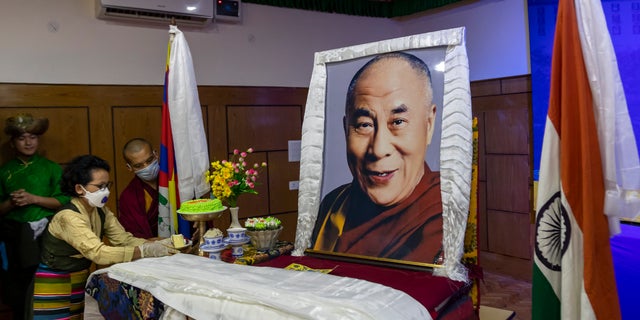
    An exile Tibetan offers a piece of cake to a portrait of her spiritual leader the Dalai Lama to mark her leader's 85th birthday in Dharmsala, India, Monday, July 6, 2020. (AP Photo/Ashwini Bhatia)

    While much of the international community has focused on abuses against the Uighur Muslims in the Chinese province of Xingang, the human rights horrors against Buddhists in Tibet – a decades-long conflict -- have dropped from the limelight.

    "Tibet is one of the worst human rights crises in the world today. More than 150 Tibetans have self-immolated since 2009, lighting their own bodies on fire to protest China's oppression," Bhuchung K. Tsering, vice president of the International Campaign for Tibet, told Fox News.

    "Tibetan schools are forced to teach students in Chinese as the primary language rather than Tibetan. And just recently, Chinese authorities ordered Tibetans to remove their beautiful prayer flags from villages and hilltops. Living under the repressive rule of the Chinese Communist Party, Tibetans have virtually no freedom of religion, freedom of speech, or any of the other basic freedoms that no government has the right to take away," Tsering explained.

    U.S. watchdog Freedom House lists Tibet as the second-least-free country in the world, behind only Syria.

    Concerns over the future of Tibet flared further this week after the Chinese government announced it was shuttering the U.S. Chengdu Consulate, which served the Tibet and other Tibet-populated surrounding regions. The retaliatory move came just days after Washington ordered the Chinese consulate in Houston closed over espionage concerns.

    However, foreign policy analysts underscore that closing the Chengdu location was a way to further remove the U.S. from monitoring alleged abuses in Tibet.

    Nestled in the southwest crevice of China, Tibet also borders Bhutan, Burma, Nepal and India. Its legal status is also subject to debate – Tibetans claim their country is independent, while the Chinese Communist Party (CCP) of the People's Republic of China (PRC) claims it belongs to them.

    Human rights activists widely claim a multitude of international law violations in the historic, mountainous terrain.

    According to Amnesty International's most recent China report, "the human rights situation continued to be marked by a systematic crackdown on dissent," and that Tibetan areas were especially subject to "repression conducted under the guise of 'anti-separatism' or 'counter-terrorism.'"

    In its 2019 Human Rights Situation report, the India-based Tibetan Centre for Human Rights and Democracy (TCHRD) claimed that Beijing was using an extensive amount of surveillance technology  to "suppress Tibetans and instill fear," and "violate the right to freedom of expression and privacy of journalists, bloggers, and human rights defenders."

    Others call the CCP's iron-fist "cultural genocide," as the Dalai Lama framed it in 2008.

    And even though China's constitution prohibits the state, public organizations and individuals from forcing religion on citizens, the U.S. claims there is anything but religious freedom – especially when it comes to Tibet. The vast majority of ethnic Tibetans practice Buddhism; however, some across the Tibetan Plateau engage in the pre-Buddhist religion of Bon. Small segments also practice Islam, Catholicism or Protestantism.

    A State Department report last month stressed that government "regulations control all aspects of Tibetan Buddhism, including religious venues, groups, personnel and schools," and that some in the Tibet Autonomous Region (TAR) and other Tibetan areas have been subject to "forced disappearances, arrests, torture, physical abuse, including sexual abuse, and prolonged detentions without trial of individuals due to their religious practices."

    "Former detainees reported being beaten until they lost consciousness and being shocked with electric batons. There were reports that monks and nuns were forced to wear military clothing and undergo political indoctrination in detention centers," the report stated. "The government continued to restrict the size of Buddhist monasteries and other institutions and to implement a campaign begun in 2016 to evict monks and nuns from monasteries and prohibit them from practicing elsewhere."

    Chinese authorities have evicted between 6,000 and 17,000 Tibetan and Han Chinese monks and nuns from Larung Gar and Yachen Gar Tibetan Buddhist Institutes, the report said. Children also were restricted from many traditional religious festivals and from receiving religious education.

    The veil of repression and the potential for punishment has, exiled Tibetans say, created such anxiety that many refuse to even utter the name of the Dalai Lama, the Tibetan Buddhist spiritual and political leader.

    "From an economic perspective, the CCP wants to extract resources, including water and minerals, to sustain other parts of China," surmised Cleo Paskal, non-resident senior fellow for the Indo-Pacific at the Foundation for Defense of Democracies (FDD). "From a strategic perspective, it is moving in major infrastructure, military hardware, and troops to advance its territorial claims on its neighbors, including India."

    Early in the 20th century, Tibet – under the 13th and previous Dalai Lama – had its own currency, national flag, military, passports and diplomats. It remained neutral throughout the Second World War, but in 1950, the newly established communist regime in China under Mao Zedong invaded the land parcel, rich in natural resources and critical in its geography bordering India. The CCP claims Tibet has historically been – and remains – China, while Tibetans cling to their seeds of independence.

    Marion Smith, executive director of the Victims of Communism Memorial Foundation (VOC), said, "The CCP has become much more clever at silencing voices in the West who dare to raise awareness about Tibet, especially in Hollywood—just ask Richard Gere."

    The American Hollywood star joined the board of directors at the International Campaign for Tibet in 1992 and passionately called for a boycott of the 2008 Beijing Olympic Games. He claimed in a 2017 interview with the Hollywood Reporter that he was dropped from a number of blockbuster movies because China doesn't like him, and that studio films struggle get financing with his name attached.

    Brad Pitt was also once banned from China for having starred in the 1997 hit "Seven Years in Tibet" – although he visited the PRC in more recent years.

    However, Chinese officials routinely note that over the past four decades, billions have been poured into Tibet to successfully lift it out of poverty, improve human rights and education, and invest in repairs to preserve Tibetan culture.

    Despite its disappearance from international diplomacy, Tibet is re-emerging in the widening rift between Washington and Beijing. Weeks before the consulate shutdown, Secretary of State Mike Pompeo warned that international access to the "tightly controlled" TAR was a matter of regional and environmental security, and banned from the U.S. several Chinese authorities who have barred that admittance.
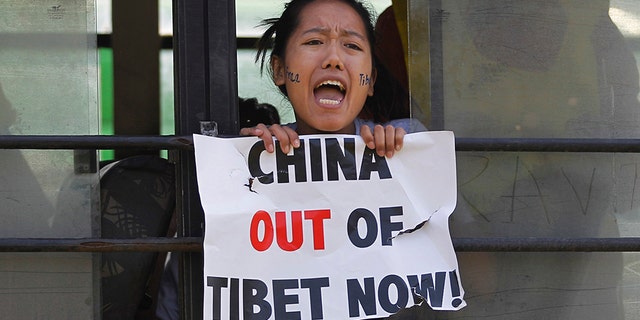
    In this March 10, 2015 photo, a Tibetan exile shouts slogans against China after being detained inside a police bus during a protest in New Delhi, India. (AP Photo/Altaf Qadri, File)

    In response, China's foreign ministry announced similar sanctions and urged the U.S. to "stop interfering in China's internal affairs."

    That demand remains to be seen.

    "What Congress needs to do now is pass the Tibetan Policy and Support Act. This bill will dramatically upgrade U.S. support for Tibetans, including by sanctioning any Chinese officials who try to interfere in the succession of the Dalai Lama," Tsering added. "This represents not only a grave violation of the rights of Tibetan Buddhists but also a threat to religious freedom around the globe."

    Taiwan could become the next flashpoint in the global tech war

    Intel wants to help US officials boost chipmaking on American soil

    The world is becoming increasingly dependent on a Taiwanese company for the most advanced semiconductors, after a stumble by rival Intel. But TSMC is trying to pull off a high-wire act by keeping both China and the United States happy at a time of rapidly escalating geopolitical tensions.

    There are only three companies that can manufacture super-advanced chips in the world: Taiwan Semiconductor Manufacturing Company (TSMC), California-based Intel and South Korea's Samsung. State-of-the-art chipmaking is rare and specialized because it's incredibly expensive to keep competing at the highest level.
    This week, TSMC (TSM) shares soared to new heights in Taiwan after Intel (INTC) warned it was behind schedule on manufacturing 7 nanometer chips, and may outsource production of them. Advanced chips can store and process more information. A smaller nanometer size means a more advanced chip.
    TSMC is the most likely candidate the US firm could turn to for help. Samsung (SSNLF) is producing 7 nanometer chips, but its manufacturing business is small relative to TSMC. It also mostly makes memory chips, while Intel needs help manufacturing advanced processing chips.
    Intel's setback probably won't spell its doom. The company has led the semiconductor industry for years and will likely get to manufacturing 7 nanometer at commercial levels "within fairly short order," according to Bret Swanson, visiting fellow at the American Enterprise Institute, a Washington-based think tank.
    But TSMC's successes right now -— and its position as the leading global supplier of chips — make it an enormously important company at a critical time. The United States and China are locked in a battle over who can more rapidly develop the technologies of the future, and both countries have partnerships with TSMC to supply them with the chips they need to power advanced technology such as artificial intelligence, 5G and cloud computing.

    TSMC hedges against tensions with the United States, but risks angering China

    The company is also spending big money to keep up those relationships. TSMC announced earlier this year that it is building a $12 billion manufacturing facility in Arizona that will be able to produce 5 nanometer chips by 2024. The announcement was a win for the Trump administration, which wants to have more advanced chip making capabilities in the United States, to secure supply chains for chips used in military or sensitive civilian applications.
    But the fact that TSMC is helping the US shore up its chipmaking capabilities could upset China. TSMC has invested billions of dollars in manufacturing plants in mainland China. Should Beijing retaliate against TSMC and Taiwan, that would at the very least throw markets into turmoil.
    "There has been concern in Taiwan about the potential for Beijing to nationalize TSMC fabs [plants that fabricate chips] in Nanjing and Shanghai," said Paul Triolo, head of global tech policy at Eurasia Group.
    While China has never controlled Taiwan, the Communist government regards the self-governing island as an integral part of its territory. China bristles whenever the United States has diplomatic engagements with Taiwan. Officially, Washington only has diplomatic relations with Beijing.
    Taking over TSMC's mainland China plants, which are wholly owned, is highly unlikely, Triolo said. It "would be a major escalation and a huge blow to the business community. It is not clear what this would buy for Beijing other than major negative downsides," he added.
    What China could do, is try to persuade TSMC to build a high-end plant on the mainland. The current TSMC plants in Nanjing and Shanghai operate less advanced technology. The company's most advanced fabs are in Taiwan, and Arizona would be the first large-scale overseas plant, according to Counterpoint Research.
    "Beijing could argue that if TSMC is willing to [build] advanced fab in Arizona, it should be willing to do the same in China," Triolo said.
    Washington's long-standing pressure campaign against Huawei underscores just how badly China needs to reduce its independence on foreign chipmakers.
    The latest US sanctions announced in May cut the Chinese telecommunications maker off from TSMC. Even though TSMC is a Taiwanese company, it relies on American tech to manufacture chips. The US Commerce Department said TSMC and other chip makers that use US technology would now have to apply for a license to export products to Huawei and its chip subsidiary HiSilicon. Those applications would very likely be denied, given Washington wants to keep Huawei gear out of global 5G networks.
    Aside from geopolitics, there's also geography. Taiwan is the world's top exporter of semiconductors, and the global supply chain needs more chip making capabilities spread out around the world.
    TSMC is the world's largest contract manufacturer of chips. Companies like Apple (AAPL)Amazon (AMZN AMAZON)Qualcomm (QCOM)and Nvidia (NVDA)can design advanced chips, but they don't have TSMC's costly fabrication manufacturing capabilities to build them. They are "fabless" chip makers.
    Although Intel can design and fabricate its own semiconductors, it can only turn to TSMC when it falls behind on cutting-edge chips.
    The concentration of so much advanced semiconductor manufacturing capacity on a tiny island just off the coast of mainland China has always been a supply chain worry, according to Swanson, of the American Enterprise Institute. "What if there's a tsunami in Taiwan?" he said.
    That again puts TSMC in a very strong position. "The West probably would like to help protect Taiwan not just geopolitically, but because of this technical prowess and technical capacity there," Swanson said.

    China is far behind when it comes to chipmaking

    Taiwan has shared its technical know-how with China. Over the years, hundreds of thousands of Taiwanese engineers have gone to the mainland to help develop China's domestic semiconductor industry, which Swanson notes has "made huge strides in the last two decades."
    Despite huge domestic support, semiconductors remain a key technology bottleneck for China.
    Semiconductor Manufacturing International Corporation (SMIC), the country's largest chipmaker, remains stuck anywhere from three to five years behind industry leaders Intel, Samsung and TSMC, according to Triolo, of Eurasia Group.
    SMIC is currently manufacturing 10 nanometer chips, while top players are already producing 7 nanometer chips, and racing to transition to 5 nanometer and eventually 3 nanometer chips.
    To make 7 nanometer chips, however, companies need access to an extreme ultraviolet (EUV) lithography machine. Such machines are capable of producing the complex patterns on cutting edge chips. They are also very difficult to operate, which is why Intel is having problems making 7 nanometer chips for commercial production, according to Triolo.
      The problem for SMIC is the United States is pressuring the Netherlands to block the sale of EUV equipment to SMIC by Dutch company ASML, Triolo said. The technology is designed by ASML, but includes substantial amounts of US intellectual property.
      The geopolitical situation could change. But given the time it takes to master EUV, any major delay would push SMIC's commercial entry into today's most advanced chips past 2023, Triolo said, and by then, industry leaders will be far ahead.

        China downgrades its Chengdu J-20 'stealth' fighter to 4th Generation but claims IAF Rafales no match for it

        China downgrades its Chengdu J-20 'stealth' fighter to 4th Generation but claims IAF Rafales no match for it
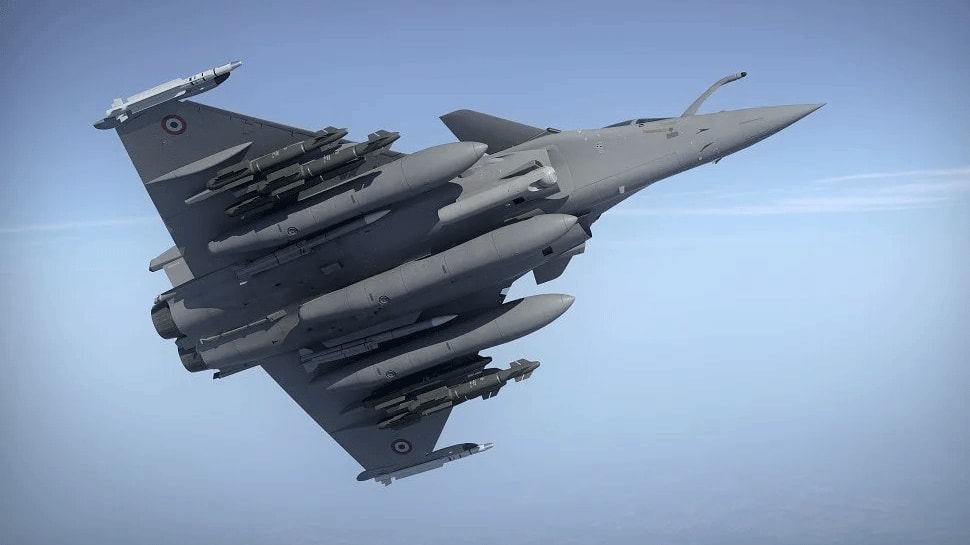
        Rafale, the 4.5 Generation fighter in the armoury of the Indian Air Force (IAF), has changed the aerial warfare dynamics with both Pakistan and China lagging far behind the superior technology and weapons package of the French-made combat jet. 

        Rafale, the 4.5 Generation fighter in the armoury of the Indian Air Force (IAF), has changed the aerial warfare dynamics with both Pakistan and China lagging far behind the superior technology and weapons package of the French-made combat jet. 

        China claims People’s Liberation Army Air Force (PLAAF) Chengdu J-20 is a 5th Generation Stealth fighter and superior to the Rafale but now a Global Times article which tries to find faults with the French-made jets has instead downgraded the J-20 to a 4th Generation combat aircraft.

        With IAF 17 Squadron Golden Arrows at the Ambala Air Force Station now flying five Rafales which landed on Wednesday (July 29, 2020), Chinese security experts have raised doubts if the French fighters can match their country’s J-20 fighters which they have been claiming have stealth.

        A Global Times article quoted Chinese military expert Zhang Xuefeng as claiming that while Rafales are superior to Sukhoi Su-30 MKIs in some combat performance areas but are basically a "3rd Generation" aircraft. Zhang Xuefeng went on to claim that Rafales are only about one-fourth of a generation more advanced that Su-30MKIs and hence "does not yield a significant qualitative change".

        "Thanks to its AESA radar, advanced weapons and limited stealth technologies, the Rafale is comparable to other third-plus generation fighter jets used by other countries, but it will find it very difficult to confront a stealth-capable fourth-generation fighter jet," the article stated.

        As the Global Times article mentions that the J-20 is a 4th Generation fighter, it cannot possess stealth technology. On the other hand, Rafale is a 4.5 Generation jet with a design ensuring a reduced radar cross-section (RCS) and infrared signature to evade enemy radars. IAF Su-30MKIs are 4th Generation and Global Times article now puts China's so-called most advanced jet in direct competition with India's Sukhois.

        In military aviation, 4th Generation aircraft do not have stealth capabilities and IAF Sukhoi Su-30 MKIs have been able to track the J-20s. In May 2018, Sukhoi Su-30MKIs on a sortie in Northeast India used their radars to see and track PLAAF J-20 fighters flying over Tibet.

        Even former IAF Air Chief Marshal BS Dhanoa (retd), who played a key role in the Rafale deal and whose initials BS are used as part of the tail number on the jets, had categorically pointed out that Rafale "is a game-changer, and the Chinese J-20 does not even come close".


        What Will Happen if the Coronavirus Vaccine Fails? A vaccine could provide a way to end the pandemic, but with no prospect of natural herd immunity we could well be facing the threat of COVID-19 for a long time to come. by Sarah Pitt

          There are  over 175  COVID-19 vaccines in development. Almost all government strategies for dealing with the coronavirus pandemic are base...