#Sponsored

Monday, April 13, 2020

Xi Jing Ping: Prepare for effects of world's woes

As nation advances, pressures expected from global economy, pandemic spread
China should fully prepare to deal with changes from the external environment for quite a long time given the continued spread of COVID-19 globally and the downward pressure facing the world economy, Xi Jinping, general secretary of the Communist Party of China Central Committee, said on Wednesday.
While China is making further progress in pandemic control with acceleration in economic and social recovery, the country is still faced with growing pressure from imported infections and new challenges in resuming work and production, he said, urging that worst-case scenarios should be kept in mind.
Xi made the remarks while delivering a speech at a meeting of the Standing Committee of the Political Bureau of the CPC Central Committee.
The meeting, the ninth of its kind since the start of the outbreak, analyzed the COVID-19 situation and economic performance at home and abroad, made new arrangements in the implementation of regular pandemic prevention and control measures and fully advanced work resumption, according to a statement released after the meeting.
Xi urged efforts to hasten the comprehensive recovery in work and life, solve difficulties and problems during the process and limit the damage caused by the pandemic to a minimum while adhering to regular prevention measures.
More targeted and effective pandemic control measures should be adopted in a timely way to guard against imported infections or a rebound in domestic infections, he said.
In Hubei province and Wuhan, efforts should continue to focus on saving patients in critical condition, Xi said, and control measures in communities should be further improved to guarantee safety.
Local authorities, especially in provinces bordering Hubei, should strengthen communication and sharing of information and boost coordination on prevention measures to ensure consistency in personnel controls and mutual recognition of health codes, he said.
Xi also instructed that consistent effort be made in controlling the pandemic in Beijing and paying close attention to asymptomatic carriers, saying any possible loophole should be closed.
Meeting participants decided that pandemic control measures in coastal and border ports will be strengthened and border cities will be guaranteed greater support in pandemic control personnel and materials, the statement said.
Noting that China is faced with increasing difficulties in economic development, the meeting instructed local Party committees and governments to have a greater sense of urgency in creating the conditions for work and production resumption by all means while improving pandemic prevention measures according to their local conditions.
Greater support should be provided to industries facing difficulties as well as small and medium-sized enterprises, it said, while calling for efforts to facilitate normal business in daily life service industries, expand consumption by residents and speed up the building of investment projects.
China has ample grain reserves and is fully capable of guaranteeing the country's supply of grains and staple agricultural produce, the participants said.
The meeting required strengthened monitoring and supervision of domestic grain market prices and consistent effort in production and distribution of foods such as pork, fruit and vegetables to ensure the basic stability of market supply and prices.
It was decided that a minimum standard of living for disadvantaged people will be further guaranteed and people in difficulties caused by the pandemic or due to infection will be covered by subsidies.
People in regions severely hit by the pandemic will be provided with temporary living allowances and unemployment insurance will be expanded to better guarantee the basic living of the unemployed, the meeting said.
Participants also underlined the importance of identifying all kinds of potential safety dangers, improve contingency plans and enhance rapid response capabilities to protect lives and property.

Xinese Virus: How One Ruthless Man Triggered the World’s Worst Healthcare Crisis in Decades Chinese virus? Perhaps, but let's be more precise - it has come out of chairman Xi's China.By Michael Petraeus

President Donald Trump is not the one to beat around the bush so, when the spokesman of the Chinese foreign ministry (no less) started peddling a conspiracy theory that US Army could have brought the virus to Wuhan during the war games last year, he was quick to respond, labeling the disease after its birthplace – China.
As usual, whenever the US President opens his mouth, there was widespread meltdown, drama, protests and – also quite typical – accusations of racism (!?).

Somehow nobody really did that when the accusations were thrown in the opposite direction. So, is it permissible for administration of one country to peddle unsubstantiated conspiracy theories and yet totally unacceptable for the other to respond with a term that is at least based on factual reality of where the disease originated?

President Trump isn’t really wrong here, but perhaps the term “Chinese” is a little too broad. Because the problem hasn’t erupted specifically because of China or Chinese people as a nation.

 No, the Covid-19 outbreak happened due to a broken authoritarian system steering the PRC today – one that was designed and ruthlessly built up by one man – Xi Jinping.

Right now Beijing is busy pushing a global PR campaign to salvage its image. It is donating supplies to other countries, sending doctors around the globe, parading its good will and eagerness to help.

Let’s not forget, however, that current shortages of face masks or other equipment are a direct consequence of China effectively shutting down for two months, cutting deliveries to the rest of the world that chose to rely on it.

Most of the wholesale stockpiles in Europe have been depleted for weeks. Buying a surgical mask was practically impossible in the first week of February, when prices erupted by several hundred percent, as global panic buying began – long before the virus was even considered a threat to the Old Continent. Whenever asked about products the distributors could only shrug and reply that they have no idea when anything arrives because China is not delivering.

 Therefore, even if foreign governments wanted to prepare for the worst, they largely couldn’t because the main source hoarded everything for itself, leaving the rest out in the cold.

Of course, one could excuse every single government for being primarily preoccupied with the well-being of its own citizens in a healthcare crisis – but it also shows that Chinese solidarity is only on display when Beijing can afford it quite effortlessly.

Crackdown… on the media
Before Chinese authorities acknowledged there is a problem they cracked down not on the spreading disease but on the people who warned and reported about it – like the now effectively martyred doctor Li Wenliang, who couldn’t have predicted that he had little over a month left to live when he raised the issue of a SARS-like disease spreading in Wuhan.

Summoned by the police for allegedly spreading misinformation he and others were silenced and communist censors got to work to purge the Chinese internet of alarmist reports, ahead of the upcoming Chinese New Year – disrupting which could be very costly economically (they must have thought).

Sadly, doctor Li contracted the disease and later died on February 7 at a young age of just 33.

 With hundreds of cases detected – an avalanche Beijing could no longer ignore – Wuhan went into lockdown on Jan. 23rd, two days before the Chinese New Year and after about 5 million of its residents already left for the holiday, spreading the disease inside and outside of the country.

It was only then when the party started addressing the issue instead of trying to silence its coverage. And yes, Chinese authoritarianism did show its merits when it mobilized to build temporary hospitals for thousands of patients or was able to enact a lockdown of cities and entire provinces up and down the country in an ambitious bid to break the chain of transmission.

But it would be foolish to forget that it’s the same authoritarianism that created the problem in the first place – and it has certainly gotten worse under chairman Xi.

Down with Dengism
Deng Xiaoping was the architect of modern China and his experiences with Mao (both personal and political) led him to believe that while strong, central power is required to maintain stability (especially in a country as big as China), handing all the power to one man can easily result in instability and chaos.

And so the reforms of the 1980s (including a new constitution) dealt away with the position of the Chairman of the Party, reinstated presidency in its stead and limited the terms in office to two consecutive five year periods.

Deng also moved away from violent purges of political opponents that country experienced under Mao, allowing more discord and discussion, understanding that nobody has all the right answers. He himself never held the highest office, although remained in control as the most influential figure until retiring in 1993.

As a result the system he created was more party- than person-centric. Subsequent presidents were merely leaders of the CCP, technocrats-in-chief, leading the country and then passing the baton to the next person in line after their 10-year term is up. Such were the presidencies of Jiang Zemin and, especially, Hu Jintao – when China experienced great economic prosperity, successfully hosted Olympics in 2008 and appeared to be growing more humane, even if still governed in an authoritarian style.

 Sadly, upon his rise to power Xi Jinping made it quite clear his presidency would not be one of continuity of this system.

His ambition was – and remains – to elevate himself as the central figure of China. Through his political reforms and questionable anti-corruption campaigns, which saw hundreds of party officials – including some of the top brass – jailed and purged from public life, he left no space for debate.

 Deng’s idea of collective-leadership is dead and Maoist personality cult is back in full swing.

Along with Xi’s opponents gone are the presidential term limits – paving the way for him to hold power (like all true dictators) until he dies. His “thought” has been incorporated into the constitution and even forced onto universities, what prompted protests at Fudan University in Shanghai last year.

In 21st century China it’s Xi Jinping’s way – or the highway (to put it mildly). Of course the consequences of such concentration of power are obvious and observed in all overly authoritarian states in history.

 If discord is discouraged (or worse) and absolute, unquestioning loyalty is the prerequisite to a successful life in business or politics, how many people are going to risk their neck telling the truth?

That’s how millions of officials are forced to be both dumb and numb, since the price of making risky – but often necessary – decisions has been made exorbitantly high.

Yes, there remain a few bold souls like doctor Li or Ren Zhiqiang, the mercurial property developer and outspoken critic of Xi Jinping – who has now mysteriously vanished after his latest tirade criticizing the handling of Covid-19 outbreak and calling Xi Jinping a “clown” – and has been uncontactable since March 12, prompting grave worry of his friends and family.

But few others will risk their livelihoods to upset the party leadership – so they won’t report issues or report them inaccurately, trying to avoid responsibility or the leadership’s wrath. And leadership itself is primarily concerned about appearances and protecting itself – ahead of protecting the people.

Perhaps with someone like Hu Jintao in charge the response would have been different. Perhaps the whistleblowers would be more eager to come forward. Perhaps the local party officials would be more decisive and outspoken. When he faced the SARS outbreak early into his presidency, the silencing of the health crisis and mishandling it led not only to dismissals of party officials but also to reforms that extended healthcare coverage for Chinese citizens.

With Xi Jinping, however, we’re back to old Maoist painting of the lawns ahead of the leader’s visit. Though today, thanks to the internet and social media, manipulative campaigns like the one tried in Wuhan, to thank visiting president, are rejected by the people (in a rare shows of public disobedience).

 Even the Chinese, therefore, appear to understand that while the government ultimately acted and suppressed the outbreak, it was also its tardy response and suppression of information that led to it spiraling almost out of control, leading to massive national lockdowns – which certainly will exact a heavy toll on the Chinese economy and livelihoods of its citizens.

Cold War Governance in the 21st Century
Quite ironically, perhaps, what would have been a largely local issue in the divided, underdeveloped world of the past, today has become a global pandemic affecting nearly every person on the planet.

 Blind, incompetent totalitarianism of Mao Zedong kept itself isolated from the rest of the world but the modern hybrid cooked up by Xi Jinping is a threat to us all, because it marries all the sins of the old system with globalization that China is now a critical part of.

As a result, whatever happens on the Chinese mainland may have serious consequences everywhere else.

I have often praised Chinese technocratic authoritarianism for its many achievements – elevating hundreds of millions of people out of dire poverty, swift infrastructural investments in roads, rail, air travel and sea shipping (that would take decades in Europe or America), its ability to retain internal security and stability, allowing people to go on about their lives without imminent threats of harm coming from crime or terrorism.

 But what we see today no longer has much to do with technocracy. Competences, facts and science have taken a back seat in Chinese politics, being replaced by unwavering support for the supreme leader, leading China to resemble, in some aspects, North Korea more than any developed state in the world.

For all its technological competences, China has failed to apply them to decision making in the moment of greatest danger. In fact, it has failed to apply them far earlier, to ensure proper sanitary standards which would have prevented this and other outbreaks.

Beyond the veneer of modern advances its governance appears to be heading in the opposite direction. Concentration of power around one man has neutered the administration and rendered it useless in the face of a serious crisis.

 China is a country with first world technology and third world laws.

In a lot of ways it is a reflection of its increasingly self-absorbed political class. Huge projects that allow decision makers to show off – highways, railways, airports, harbors or the military, or the entire Road and Belt Initiative – receive investment and coverage. But the invisible fabric of laws and regulations is still a tangled mess, a Capitalist-Marxist-Leninist chimera.

Of course with a top-down dictatorship nobody really cares about the laws since no checks and balances are put in place anyway and anything can be overruled by the decision of the supreme leadership which has entrenched itself even more under Xi Jinping. Which is why there was little to stop the outbreak as everybody kept looking at Beijing for answers.

 As a result thousands of people around the world will die and lives of billions will be affected. Many will suffer, lose jobs – or their loved ones.

All because of one man and his unwarranted ambitions.

Indo-lence: How Indonesia is Becoming a Global Threat in the Covid-19 Outbreak You can't deal with a problem you are unable to trace.by Michael Petraeus


As the novel coronavirus began spreading around the world in the past two months, most of the attention was focused on China, where it originated and infected tens of thousands of people, mainly in the city of Wuhan.
For weeks it has remained mainly a problem within China, with limited cases reported beyond its borders. As time went by, however, countries around the world started reporting a rapidly growing number of infections. South Korea, Italy, Iran exploded in the past two weeks, with over 7000 cases each as of today. France, Germany and Spain have pierced 1000 and the numbers are growing everywhere around. The virus finally reached Africa and South America – and is now present on all inhabited continents.

But the outbreak started in Asia affecting China and its neighbors first and foremost. And yet, for weeks the biggest country in Southeast Asia – Indonesia – had failed to report a single case. What should normally be considered a good thing, in this particular case is very worrying – not only to its inhabitants but to all of us.

Ignorance Isn’t Always Bliss
While everybody was panicking, Indonesian leaders appeared to have been rather cheerful. The country’s health minister exclaimed that it was god’s intervention and response to Indonesian prayers that spared the country – surely not something you want to hear from a person responsible for national healthcare.

 If a nation relies on prayers for good health of its inhabitants surely we may question whether it belongs in this century at all.

Naturally, one could quip that Indonesia, being a democracy after all, gets only as good leaders as its people elect. The problem is, however, that their mind-boggling incompetence threatens everybody in the immediate neighborhood – as well as many far away.

In a globalized world people travel by the millions every single day. Nearly every inhabited place on our planet is reachable within 24 hours, thanks to jet airliners criss-crossing the skies without rest.

Being a tropical nation of many picturesque wonders of nature, islands and beaches, Indonesia is a major tourist destination, attracting visitors from all over the world – particularly during the winter months in the northern Hemisphere, when Europeans and Asians alike descend on the place seeking warm weather and sun.

Hundreds of thousands of Chinese visitors came to Indonesia during the past few months – surely not all of them in good health, since the outbreak really started in late November last year.

 For a country this big and this popular not to record a single case of the novel coronavirus while it was being spotted and tracked everywhere around, has always looked to be a result of incompetence rather than divine intervention.

Today, as the first ones have been identified this week, along with several past deaths only now attributed to Covid-19 the question remains – how many have not been spotted in the many weeks prior and have wandered around the country’s packed, dense, huge cities and tourist resorts? How many other people have they managed to infect in the meanwhile? And how many of these cases were misdiagnosed or simply ignored, leading to further infections that are yet to be traced?

And the scale of the risk is gigantic.

 Jakarta alone is the world’s second largest city by metropolitan area population (behind Tokyo), with 34,000,000 inhabitants.

The country’s other major urban centres aren’t exactly small either, with Surabaya touching 10 million and Bandung following closely behind. These are cities with -populations greater than many countries – yet lacking sophisticated healthcare services and most certainly in ability to screen all the possible Covid-19 cases.
When the number of patients in Wuhan – the epicentre of the disease – began to rise, Chinese authorities sealed the city and the entire province off, and later proceeded to do the same with other parts of the country. Hundreds of millions of people abandoned restaurants and cinemas, and wore surgical masks both to protect themselves and each other, to restrict the spread of the virus.

In the meanwhile, as it kept landing in new countries, Indonesian authorities didn’t even acknowledge there is – or may be – a serious problem.

 But ignorance isn’t always bliss and viral infections do not go away simply because you choose to turn your head away. They will still spread. And as they do they may reach a point beyond which they become impossible to put out.

Vigilance exhibited early – one of its best examples being Singapore – allows to contain the disease, isolate the confirmed cases and quarantine everybody identified as a possible contact. But it’s not really possible if you’ve been ignoring the threat for many weeks until it has grown beyond control.

Indonesia is poor, but not as poor as to be completely marginalized or have its population isolated from the world by lack of access and financial means to travel (like Africa). It is an ascending developing country, closely connected to its ASEAN neighbors as well as countries further afield, bridging Asian Far East, Oceania and Europe. It’s not a place tourists avoid but one they flock to. And a home to a quarter of a billion people, supplying millions of travelers to the world.

 Jakarta’s Soekarno–Hatta International Airport is among the Top 20 busiest on the globe. With over 65 million passengers traveling through it goes head to head with international aviation hub of Singapore at Changi.

For comparison, the busiest airport in Africa, O.R. Tambo International in Johannesburg, handles little over 20 million passengers – and most of the rest don’t even come close. In fact, Indonesia’s primary tourist destination – Bali – handles over 24 million travelers per year – more than any African airport.

But it’s not only the number of passengers traveling through Indonesia that is worrying – it’s also the immense intensity with which it is connected with its neighbors.

 The international route between Jakarta and Singapore is the 3rd busiest in the world, with over 27,000 flights a year. The connection to Kuala Lumpur in Malaysia, comes in fifth, with nearly 20,000 flights. That is 50 to 70 flights a day, every day, every year. Millions of passengers pouring in and out of the country whose health minister believes prayers are a better protection that modern technology and medicine.

Singapore to the rescue?
Perhaps some comfort can be found in that it is the little city-state of Singapore that is the region’s primary international air hub that distributes traffic around it. The wealthy island has been praised left and right for its determined, organized response to the epidemic, which – despite a number of cases reported early on – has managed to keep their incidence from exploding – unlike what we are witnessing now in South Korea, Iran, Italy, Germany or France.

As long as the screening at Changi Airport remains tight, there’s a good chance that infected passengers can be spotted and brought under quarantine before they manage to pass the disease to hundreds more.

That said, unlike with other countries – from which Singapore restricted travel quickly and prudently (China, South Korea or Iran) – similar measures will not be possible with Indonesia. With dozens of flights every single day, innumerable business links and thousands of Indonesians working in Singapore, it seems simply not possible to close the border to everybody who visited Indonesia in the previous two weeks.

And because authorities in Jakarta have been so abysmally lazy to address the threat, their failures also prevented others from responding adequately, leaving the doors wide open for the disease to spread.

Damage Is Done
Sadly, regardless of how much we scoff at Indonesian handling of the issue, most of the damage has likely already been done. Their failure to react gave the virus precious weeks it needs to spread and incubate.

The country’s strategic position between Europe, Asia and Australia, as well as its huge population and a broad diaspora, coupled with lack of competent (or swift) response, have all created highly dangerous conditions for the contagion to spread far and wide.

 The crux of the problem is this – Indonesia is developed and connected well enough to expose millions in and out of the country to the virus and yet not developed enough to respond to it. Not rich enough to tackle the problem properly and not poor enough to be isolated.

Because of that we can only hope that, indeed, as it was reported earlier, the virus does not spread as quickly in hot, humid weather and that alone will slow or stop it. Unfortunately, with outbreaks in Italy and Iran (countries significantly warmer at this time of the year than many other) these assumptions have already been questioned.

Ironically, then, when it comes to Indonesia, prayers may be our best hope after all.

New Water Deal with Singapore is Entirely Possible – if Malaysia Changes its Tone. And Prime Minister. There are no contracts beyond renegotiation - but your offer has to be good. And genuine. By Michael Petraeus

New Straits times fired off two pieces in the past few days, again stirring the situation in bilateral relations between Malaysia and Singapore. First, the newspaper published a report from a talk about the water deals binding both countries, organized at University Kebangsaan Malaysia and then followed up with a leader next day, which was an all-out anti-Singapore offensive, blaming the city-state for stonewalling the requests for a price review and damaging relations between the two countries.
Anybody who wrote this has got some cheek, so let’s remind the ignorant and reckless author of that hit piece about a few facts.
Singapore Has Always Been Willing to Talk
Let’s deal with the most frequently repeated accusation – that Singapore doesn’t want to discuss the water deals. Well, perhaps this selective amnesia explains why the country is so poorly managed, if people in charge of it forget very simple facts from not so distant past.

Firstly, Singapore has another water agreement that it signed in 1990 – which is a supplement to the deal that expires in 2061 – and led to the construction of Linggiu Dam in Johor, benefiting people on both sides of the border. Under this agreement Singapore pays for the water it purchased in accordance to a formula rather than fixed price.
Secondly, both countries already sat down to negotiate new conditions of water supply from Malaysia mere 20 years ago. In the aftermath of the 1997 crisis, when it looked like Malaysia may be needing financial support, neighbors entered negotiations over a number of different issues – including the price of water supplied to Singapore.

 Over subsequent five years, between 1998 and 2003 Mahathir and his administration kept changing its demands – raising prices, firing off hostile comments, making and retracting controversial statements about the two countries – anything but constructive negotiation.

Malaysian proposals for the new price were quite random – starting at 30 sen and reaching over 6RM per 1000 gallons at one point (over 200 fold increase).

All this time Singapore has not only agreed to certain proposals (at 30 or 45 sen – which would be 10x to 15x higher than the current price) but was also willing to bear the costs of infrastructural investment in Malaysia to further enhance the water supply – water, let’s remember, that otherwise is freely discharged into the sea.

 It was due to incessant Malaysian uncooperativeness – time-wasting that lasted five years – that the talks had ultimately broken down and no amendments to the deals were made.

All that Singapore wanted is to extend guarantees of supply beyond current agreements. It agreed to higher prices, it offered investments that would increase water output in Johor (today badly needed in the state which faces water shortages) but Malaysia was clearly not interested in any deal, changing its conditions from one meeting of the two parties to another – until there was no reason to meet again.

 To accuse Singapore of unwillingness to discuss, review or change the conditions of the water deals is a Goebbelsian lie.

What, incidentally, shows how low journalistic standards are in NST.
Malaysia is Not Seeking Discussion But Extortion
I have to say I burst out laughing when I read the following quote by the “international law expert”, Associate Professor Salawati Mat Basir:

 “What bothers me more is the lack sense of gratitude from our neighbour for all that Malaysia has done for them.” / SALAWATI MAT BASIR

And it’s not an isolated opinion – you keep hearing it all the time, how Singapore should be grateful for what Malaysia is providing it or that somehow without Malaysia the city would not exist or be so successful.

A-ha-ha-ha!

 Let’s get something straight – Singapore is independent because it was KICKED OUT of the federation and the water deals were signed to make sure it can stay out.

The reason was rooted in borderline racist attempts to ensure Malay dominance over the multi-ethnic society – which so far has only produced a corrupt ruling class and widespread cronyism, in a country that started the 1980s on par with South Korea. We can all see where both countries are today.

In subsequent decades Singapore had borne the cost of building, maintaining and expanding infrastructure that allowed it to draw water which would freely flow into the sea. Ironically, through that it helped Johor to secure greater supply for itself – in the general absence of interest of Malaysian authorities, whose negligence has led the country on the brink of acute water shortages – and sometimes beyond it, like in 1998 or more recently in 2014 (which I experienced myself in KL at the time).

 If anybody it’s the millions of Malaysians in the south of the country who have a lot to be grateful for to Singapore, which has provided what their own politicians have failed to provide – and even supplies Johor with cheap, treated water that the local authorities sell to Malaysians at a significant profit.

Most of the country is so badly and incompetently managed that despite lying on the equator and being generously watered down from the skies, it still struggles to secure sufficient water supply – not to mention quality, since drinking from the tap anywhere in Malaysia is generally not advisable.

But the statement about how Singapore should somehow be grateful to Malaysia is doubly egregious when you consider what Mahathir’s government has done to its neighbor in the past two years:

Violated territorial waters of the city-state.
Paralyzed Seletar airport’s operations after ILS system was installed to enhance safety – mainly of Malaysian airlines.
Launched a dispute over airspace control, even though it’s been arranged so that Changi airport can continue safe operations.
Froze the High-Speed Rail link project in breach of earlier agreements.
Keeps delaying and throws new obstacles against the RTS mass transit link to Johor.
Went as far as to restrict exports of food ahead of the Chinese New Year in 2019.
Oh yeah, and revived the idiotic “crooked bridge” idea – that would cost billions, even as its leaders go around crying how the country so, so poor right now <sob>.

 As I wrote last year, under new government Malaysia engaged in “parang diplomacy”, behaving like a thug, trying to bully it’s diminutive neighbor.

And its representatives have the cheek to talk about gratitude.

 With such a tone how can anybody treat Malaysian requests for a review of the water deals seriously?
Of course there’s a better reason to ignore them – because Malaysia doesn’t want them either. Just like 20 years ago when Mahathir had a good chance to increase the price by 10 or maybe even 20 times – but was so uncooperative that the talks broke down.

 It’s not about the money, it’s not about water, it’s about spiting Singapore.

Regardless of how you interpret what the agreement stipulates – i.e. whether the agreement allowed for a review only in 1987 or simply at any time beyond it, it still requires both sides to agree. And can you blame Singapore for its reluctance given its past experiences? Last time it wasted five long years on a Malaysian wayang – and now the person who led it then is back in power. What can the outcome really be?

 Singapore does not want to negotiate not because it doesn’t see value in it or that such a deal could not be beneficial to both sides – but because Malaysian behavior is totally unacceptable and its leadership is entirely untrustworthy.

And, given its current performance, even Malaysians themselves would agree with this judgment. So how can anybody expect a foreign country to trust the authorities that even the locals don’t?

I’m pretty sure Singapore would be happy to negotiate new water deals with Malaysia. After all, even with its stated goal of self-sufficiency, it simply makes economic and political sense to keep other options – especially as cheap as drawing low-cost water from a river nearby – open.
It also makes sense for two neighbors – both dwarfed by far more populous countries in the ASEAN and by rising China – to cooperate rather than fight. Unfortunately, none of it is going to happen until Malaysia can defeat its insecurities.

 The core of the problem is that Malaysian leaders have an acute inferiority complex.

After the split in 1965 they and their predecessors have inherited a fairly large, fertile country, abundant in natural resources (metals, forests, oil), rich fauna and flora and millions of people – and yet they were left behind by little Singapore that had nothing.

 Malaysia is like a big brother who kicked his smaller sibling out of the house, keeping the family wealth to himself – and then proceeded to squander it, while the youngster has become far richer and more successful on his own. And now the culprit is back claiming the victimized relative owes him something. Fortunately, however, the tables have already turned.

Mahathir had over 20 years to negotiate new or renegotiate old water deals. And Singapore has always been willing – in the 80s, in the 90s and early 2000s. 1987 deadline lapsed, Linggiu dam was built, five years were wasted before the old fox stepped down in 2003. Today he’s back and so is his rhetoric, that is not going to bring any progress.

So, if Malaysia genuinely wants to talk, it has to speak in a different language, come up with a good offer and be willing to see it through.
None of it is likely to happen under current leadership, however. So, as I wrote in late 2018, before there’s any chance for progress, Mahathir must step down.

We Need to Stop Trying to Replicate the Life We Had Attempting to translate your old social habits to Zoom or FaceTime is like going vegetarian and proceeding to glumly eat a diet of just tofurkey. By ASHLEY FETTERS

People engage in activities together, surrounded by screens and images of meat.
The best part of any social gathering is the haphazard array of smaller, more intimate gatherings into which it inevitably breaks down. Just ask Shakespeare, or F. Scott Fitzgerald, or Edith Wharton. Romeo and Juliet meet during a stolen moment in the middle of a masquerade ball. Nick Carraway inadvertently befriends Jay Gatsby at a party when he’s off to the side, gossiping about Gatsby. The love affair between Newland Archer and Countess Ellen Olenska begins when the pair share a private giggle during a dinner, just out of earshot of the other guests.
I’ve been thinking wistfully about side conversations a lot the past few weeks. Like many others who are sheltering in place to curb the spread of COVID-19, I’ve participated in a number of Zoom happy hours of late. As friends trickle into the videoconference, one by one they demand to know how the friend who lives abroad is doing, you know, under the circumstances; how the friend whose wedding has been postponed is doing, how the friend who works in a hospital is doing. Each of the aforementioned friends then has to respond, while those of us who have been on the call from the start hear their responses for a second, third, fourth time. Eventually, lagging internet connections and the subsequent chaos of people talking simultaneously (“Sorry, you go!” “No, you go!”) force us all into a weird pattern of monologuing one after another. At this point, I always find myself desperately wishing I could discreetly ask another participant to “go get a refill,” or subtly invite them to break away and catch up in a quieter and less chaotic conversation of our own. (Sure, we could start a side chat on another platform or text each other, but it’s not the same.)
Some three or four weeks into virtual social interactions being essentially the only social interactions outside the home for most people, many of us have tried to go about our usual rituals, just online—and found the results a little underwhelming. The life we live now is not conducive to birthday dinners or bar flirtations or run-ins with friends who live down the block. It is small, slow, intimate; every encounter requires planning ahead. Of course trying to jam the happy, sprawling commotion of a night out into a row of little boxes on a laptop screen (itself jammed into the little box that is your home) is jarring. So it seems time to abandon efforts to replicate our old social life in online spaces—and instead adapt our interactions to our new normal. What if, instead, we leaned into the smallness, the slowness, the intimacy? What would our social life look like then?
Obviously, some aspects of prepandemic life can’t be re-created or replaced. In person, humans can sync up to one another through gaze and body language—which is impossible over phone or text, and difficult over video chat. Melissa Mazmanian, an associate informatics professor at UC Irvine, recently had to switch from in-person to Zoom interviews for a research project, “and some of them just don’t work as well,” she said. “I can’t read [subjects’] body language and help them feel comfortable in the way that I can when I’m there.” Nicole Ellison, who teaches at the School of Information at the University of Michigan, noted to me that in addition to messing with body-language clues, many teleconference hangouts require a lot of planning—which can throw off the vibe for friends who otherwise usually hang out on a spur-of-the-moment basis.
But perhaps most important, videochat happy hours fail to measure up to real-life happy hours because we keep comparing them with real-life happy hours, expecting that they will satisfy the same desire with the same efficacy. I told Ellison I found it annoying that I sometimes feel like I need to raise my hand before speaking while I drink beers remotely with my friends, and she replied that this was probably annoying only because I’d imported the expectation of not having to raise my hand from meatspace. Trying to translate your old social habits to Zoom or FaceTime is like going vegetarian and proceeding to glumly eat a diet of just tofurkey, rather than cooking varied, creative, and flavorful meals with fruits and vegetables. The challenge, then, of adapting to an all-virtual social life may lie in reorienting our interactions around the strengths of the platforms where we can be together.
It’s no small task to fully reinvent social life itself from your home, but with any luck, the new ways of spending time together that people discover will succeed in making this period of isolation a little less isolating. Of course, a satisfying all-virtual social life will look different for everyone. For some, this time will present an opportunity to put more thought and energy into individual relationships and deep one-on-one conversations, which translate well to platforms like Zoom or FaceTime. Others who find themselves longing for a friend-group hang or a team dinner might have to get a little more creative.
Some activities groups of friends did together before quarantine are easy to replicate on virtual formats. For example, Ellison told me that her book-club meetings, during which participants are used to taking turns speaking, have translated quite naturally to Zoom. (My own much less dignified version: I recently discovered that certain drinking games I used to play with my college friends—especially those involving a deck of cards that’s handled by only one dealer—can be played perfectly well over videochat.)
Some people have already devised new, surprising ways to enjoy one another’s company remotely with the tools at hand. I was recently invited to participate in a virtual reading of Shakespeare, for example, by some friends who weren’t previously in the habit of getting together to read classic plays. My colleague Julie Beck wrote about a group of friends who hosted a PowerPoint party, in which they took turns presenting amusing (or amusingly self-serious) slide presentations on topics of their choice. For that kind of event, Zoom’s screen-share feature handily facilitates an activity that might actually be harder to pull off in the physical world. Meanwhile, the browser extension Netflix Party—which lets friends sync up movies and TV on Netflix and chat as they watch—saw a surge in search-engine interest in late March, around the time that many shelter-in-place protocols went into effect. Ellison predicted we may soon see people inventing ways to signal that they’re up for an aimless break-room- or bar-style chat, perhaps by signing in to a teleconferencing app, sharing the link with friends, and seeing who pops in.
The runaway success of the online Nintendo Switch game Animal Crossing also speaks to the appeal of unfamiliar virtual spaces. In Animal Crossing, players can interact with other online players rather than just the characters created by the game, and players who are friends in the physical world can link up in the game and host one another virtually on their “islands.” Crucially, in spaces like this, the norms and communication patterns of face-to-face interaction don’t exist. “We’re not necessarily expecting [a setting like Animal Crossing] to be the real world, and maybe that’s partly why it works,” Ellison said. She added that she wouldn’t be surprised if virtual-reality experiences also become more popular for much the same reason: They can offer people the ability to roam around and interact in unstructured ways, but with just enough novelty to avoid unfavorable comparisons with face-to-face interactions.
Much of what’s clunky and grating about Zoom happy hours and their ilk is that many people use the still-unfamiliar tech in clunky, grating ways. A lot of Ellison’s friends, she told me, are technology researchers—so they’ve had more exposure to teleconferencing than a good chunk of the population, and know without being told to mute themselves when someone else is talking, and to sit with the light in front of them to avoid showing up on-screen as a spooky silhouette. She expects that most people who have just recently migrated their work to teleconferencing will catch on to subtle, unspoken rules like these pretty quickly: “Norms and practices will evolve over time,” she said. “I promise you—we’ll get better at it.”
I can’t in good faith suggest that hanging out remotely will be an adequate replacement for time spent physically together, even if and when we develop better virtual social skills. Even those of us who succeed in adapting our social life to platforms like FaceTime will still undoubtedly long for the delicious, crackling chemistry of actual face time. But in this moment, it’s worth remembering that the options we have can be nourishing, too—and even satisfying, if we get creative enough. I suspect we’ll figure that out when we stop trying to pretend the tofurkey tastes just as good.

The Pandemic Exposes India’s Apathy Toward Migrant Workers More than half a million people have left India’s cities since the lockdown was announced. By Patralekha Chatterjee


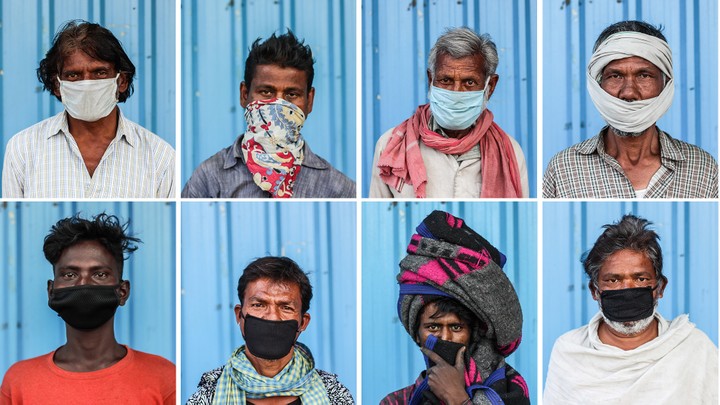
The defining images of India’s three-week lockdown may be of migrant workers, with bags perched on their heads and children in their arms, walking down highways in a desperate attempt to return to their villages hundreds of miles away.
India, a country of more than 1.3 billion people, is not among the worst affected by the pandemic. Not yet, anyway. The total number of confirmed COVID-19 cases has crossed 7,000, with more than 200 deaths.
But the virus is exposing once again India’s deep economic divide, and the government’s apathy toward the workers who power the country’s growth.
In the middle-class South Delhi neighborhood where I live, we’re preoccupied with inconvenience. No one likes to be cooped up at home for days on end. No eating out, no visiting one another; masks must be worn when you go to the grocer or the bakery. With few cars on the road, some of my neighbors have noted one silver lining: The sky is clear and blue, something we rarely see in one of the most polluted cities in the world.
A few miles away, in parts of the Indian capital where many migrant workers live, the lockdown is more than an inconvenience.
Prime Minister Narendra Modi ordered the lockdown with less than four hours’ notice. “Forget what it is like stepping out of the house for 21 days. Stay at home and only stay at home,” he said. He mentioned nothing specific about the daily-wage earners—mostly migrant workers—whose income, in an instant, disappeared.
Migrant laborers are among the most vulnerable parts of the “informal sector,” which make up 80 percent of India’s workforce. The country’s infrastructure is built on the backs of these workers. They construct malls, multiplexes, hospitals, apartment blocks, hotels. They work as factory hands, delivery boys, loaders, cooks, painters, rickshaw pullers. They stand the whole day by the side of the road selling fruits and vegetables and tea and flowers.
They often come to cities to look for work, because they cannot make a living in their village. They are rarely part of a trade union and typically work without any contract or benefits. Most earn cash, and do not leave a paper trail. They are also disproportionately from historically marginalized groups, referred to, in the country’s official lexicon, as “scheduled castes” (those at the bottom of Hinduism’s hierarchy of castes) and tribal groups. Nationally, these two groups make up about 25 percent of the population. India’s constitution, adopted in 1950, guarantees them equality of opportunity, reserved positions in educational institutions, government jobs, seats in Parliament and in the state assemblies. In practice, however, they often face discrimination and prejudice.
The night Modi instituted the lockdown, migrant workers started leaving Delhi, Mumbai, Bangalore, Chennai, Kolkata, and just about every other city to which the economic opportunities had drawn them in the first place. They knew they could not afford to stay in the city if they had no income. In their village, they had family, wouldn’t have to pay rent, and were more likely to get something to eat. All buses, trains, and taxis had been stopped, so they had no transportation. News reports said workers were stranded in railway stations. Some tried to surreptitiously flee in container trucks carrying essential commodities, but they were intercepted.
So the people started walking, first in a trickle and then in a flood. By the next evening, a shocked nation saw images of thousands walking down highways. More than half a million people have left India’s cities. At least 20 have died while trying to make it home.
This mass movement surprised authorities. Clearly, no policy maker had planned for such a reaction, and no detailed contingency plans seemed to be in place. Officials issued frantic orders to seal interstate borders and for people to maintain their distance from others so that the virus could not spread. They said that those on the move should quarantine for 14 days. Yet how could they?
The government asked voluntary organizations to help, and when soup kitchens and shelters were set up, they were soon packed with people. A few state governments provided buses for the migrant workers, but so many needed a ride that the lines were half a mile long.   
Migrant workers never seem to be much of a consideration for politicians. This episode is only one of many examples of that fact. These workers, despite their numbers, have no political clout. Many are registered to vote in their village. But when election day comes, they are usually in the city where they work and unable to cast a ballot.
Statistically, they are almost invisible. Because they consistently move between villages and cities, and among work sites, capturing their number is difficult. The federal government’s 2017 economic survey said, “If the share of migrants in the workforce is estimated to be even 20 percent, the size of the migrant workforce can be estimated to be over 100 million.”
India has welfare measures for people below the poverty line, but migrant workers rarely have access to them. Chinmay Tumbe, a professor at the Indian Institute of Management Ahmedabad and the author of India Moving: A History of Migration, points out that welfare services are often only available in one’s place of birth.
Partha Mukhopadhyay and Mukta Naik, who work for the Centre for Policy Research, one of India’s leading think tanks, wrote in a commentary piece in The Indian Express:
Field studies have consistently claimed short-term labour mobility in India was significant. The past week has seen emphatic validation of these claims as highways across the country have been pedestrianised. In its callous haste, the Union government, when it announced the lockdown, did not think through how migrants, caught unawares, at the wrong place, at the wrong time, would respond. Now they know.
A lockdown, however necessary, was always going to be unbearably difficult for those without a social and economic cushion. And now some states are opting to extend the quarantine. On Friday, some migrant workers in western India protested in the streets as they demanded a salary and approval to return to their villages. This crisis will only worsen as they alternate between the fear of catching the virus and the fear of zero income. Sanjoy Mondol, a 22 year-old Bengali migrant construction worker, now in a shelter in the outskirts of Gaya, in Bihar, eastern India, told me over a crackling telephone line that his elderly parents call him several times a day to find out how he is doing. His young wife is expecting a baby. "We are being fed. But I have no work and have run out of money,” he said. “I can't even send any money home. Somehow, if I could get back  to my village in Bengal, I would be happy. I could do some small thing, maybe sell vegetables. Be with my wife, my parents. I can't bear to hear them weep, each time they call me. Please get me home."
Meanwhile, India’s winter crop is ready for harvest, but farmers cannot find laborers to take it to market. Essential supplies are finally reaching city warehouses, but there is no one to unload the trucks. The migrant workers cannot get back to work, because there is no public transport.
No one really knows whether COVID-19 has entered the rural parts of the country where nearly 70 percent of Indians live. There are reports of neighbors shunning migrants once they arrive home, because they fear they carry the virus. And a shocking photo surfaced of migrant workers and their children in a small town being sprayed with bleach meant to sanitize buses.
For the workers who stayed in the cities, the same uncertainty exists. Shashi Rani, who came to Delhi to find employment, has not gone back to her village. She still sells garlands in front of my neighborhood temple. The temple is under lockdown; a few devout people bought flowers from her for the recent Hindu religious festival Navratri. Otherwise, she has hardly any customers. She worries about how she will sustain herself. The Delhi government’s mobile food vans offer some help. But she does not think the owner of the shanty where she lives will agree to defer her rent, despite a government directive to that effect.
The local governments in Delhi and in some other states have set up shelters for migrant workers who can’t work and could not get back home. Nonprofits are also trying to help. But India is a patchwork quilt; not every state is equally equipped.
Jan Sahas, an Indian nonprofit, recently conducted a survey, “Voices of the Invisible Citizens,” about the impact of the lockdown on migrant workers. They interviewed 3,196 migrant construction workers from northern and central India. The results paint a dismal picture: “62 percent of workers did not have any information about emergency welfare measures provided by the government and 37 percent did not know how to access the existing schemes.”
The new coronavirus has given migrants a sudden visibility in the national discourse. But the acuteness of their plight today is a result of the fact that India ignored them during normal times.

The Timeless Lessons of Easter Are More Timely Than Ever This year, Passover and Holy Week overlap, and the lessons of the two holidays apply to both believers and unbelievers alike. By Philip Yancey

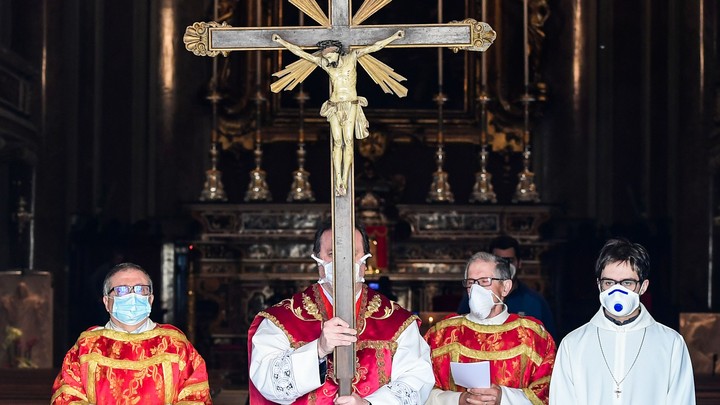
Parish priest wearing a face mask.
On wednesday and Thursday nights, when Jews gathered in some virtual way for the seder feast, they asked, “How is this night different from all other nights?” Christians would do well to reflect similarly. The Jewish celebration of Passover and the Christian celebration of Holy Week overlap this year. Both recall dark nights from long ago when desperate people of faith gathered to face a scary future. Both, however, are now overshadowed by a global threat from a virus that respects neither religion nor geography. What lessons might we take away today, under this very different threat?
Passover commemorates a time when not one but 10 plagues were unleashed, on a nation that had enslaved the Israelites. According to the Book of Exodus, God said, “I have indeed seen the misery of my people in Egypt … So I have come down to rescue them.” Thus began a power contest between Moses’s God and the Egyptians’ many gods. The plagues culminated in a final affliction that would take the lives of every firstborn son in Egypt.
On that night of blood and death, the Israelites huddled in their homes, listening to the loud sounds of grief but protected by the marks on their doorposts that caused the plague to “pass over” their own homes. After more divine intervention, the Israelites escaped at last and began their march to the promised land. That image, of slaves walking free, has inspired liberation movements throughout history, most notably the American civil-rights movement.
Over the next 40 years, God acted as a kind of divine nanny, directing the group’s every move, supplying food and water, dispensing the Ten Commandments. Yet, rather than expressing gratitude, the Israelites responded like spoiled children, by grumbling and plotting insurrections. Instead of cooperating as a true community, they soon splintered into factions, blaming their leaders and demanding more miracles. The Israelites finally made it to the promised land, although a journey that should have taken a few weeks dragged on for four decades, as God waited for the generation of complainers and rule-breakers to die out.
Passover celebrates that first night of liberation, when courage overcame fear and beleaguered people joined together in unity—a good thing to remember in a year when a virus forces social isolation. “There’s no way to replace having Passover with your parents, your grandparents, your friends and loved ones,” Rabbi Yaacov Behrman from Brooklyn told a journalist recently. Shelter-in-place orders will keep seders in 2020 from being inclusive group events. Yet, he added, “these prayers are what unite us, right now and through many generations. The times we are living in will bring these prayers alive while we reflect on what is happening all around us.”

riters of the gospels portray Jesus as recapitulating the experience of his forebears, including a flight to Egypt and a 40-day temptation in the wilderness. Some compatriots welcomed him as a leader like Moses, one who could deliver them from another oppressive regime, the Roman empire. Instead, of course, he met an early death.
All four Gospels set Jesus’s crucifixion during Passover in Jerusalem—yet another historical echo—and all four record a final meal with the disciples. In John’s detailed account, Jesus spells out his own fate that awaits him, though his followers seem uncomprehending. He is turning the mission over to them. “As I have loved you, so you must love one another,” he says. To underscore the point, he takes on the role of a servant and, despite their protests, washes their feet.
Then comes Easter Sunday, the day that changes everything—eventually. With surprising transparency, the Gospels record that initially the disciples refused to believe the rumors of resurrection. Unlike scheming conspirators, or gullible simpletons, they reacted as any rational person would: with incredulity. Dead bodies in a sealed tomb don’t suddenly reappear, alive, a few days later. One by one, Jesus convinced the disciples otherwise.
As if in a daze, some of them headed home, to resume their old profession of fishing. And when they saw Jesus one last time, they asked if he was now planning to restore the kingdom to Israel. They were still unable to grasp what he had told them, that his death would inaugurate a new kind of kingdom, not tribal or ethnic, but one without borders, a spiritual kingdom that would spread to the outermost parts of the Earth.
Seven weeks passed between Easter and Pentecost, when the disciples finally understood their mission. Suddenly, “with a sound like the blowing of a violent wind,” the spirit of God descended, transforming the cowering disciples into bold and courageous messengers. The kingdom had come, though not just to Israelites: to Parthians, Medes, Romans, Cretans, Arabs, and many others, as the Book of Acts details.
“The kingdom of God is within you,” Jesus had told them, a concept they comprehended at last.
Jews and christians share the belief that humans are God’s image-bearers, with the mission of mirroring God’s own qualities of mercy, compassion, and steadfast love. At Passover, Jews relive a time when they were slaves, a reminder to care for the needy and disenfranchised. They are encouraged to invite the less fortunate and those who live alone to the seder feast, a tradition made impossible this year by coronavirus restrictions.
For Christians, Holy Week focuses on a God-man who makes a willing sacrifice and then charges others with emulating his example of selfless love. Against all odds, in the three centuries after Jesus’s death, Christianity grew from a tiny subset of Judaism to become the official religion of the Roman empire. The sociologist Rodney Stark argues that Christians’ response to suffering helped fuel the expansion of the faith. When diseases such as smallpox and the bubonic plague hit Roman villages and the locals fled, Christians stayed behind to nurse not only their own families but also those of their pagan neighbors. When Romans abandoned their unwanted babies by the roadside, Christians adopted them.
After Christians became a majority in Rome and all of Europe, however, a kind of amnesia set in about Jesus’s message of nonviolence. Under Christendom, some of Jesus’s followers became persecutors rather than the persecuted, and waged wars of religion in the name of the “Prince of Peace.” Tragically, their spiritual ancestors, the Jews, made an easy target.
The lessons of Passover and Holy Week apply to believers and unbelievers alike, as a tiny virus has humbled us all. When we gather digitally in search of human contact, we do so with a new understanding of how vulnerably connected we are; the novel coronavirus that has spread around the world provides the proof. We will defeat the malady only by putting aside our divisions and working together as a global community, united against a common threat. Real victories are won not with the sword, but through service and care for one another.
The governor of Colorado, where I live, gives regular updates on the COVID-19 outbreak, in press conferences marked by honesty and good sense. Jared Polis is the first Jew to hold the title, and I was recently surprised to hear him quote a passage from the New Testament, 1 Corinthians 13. “And now these three remain,” said the governor, “faith, hope and love.” He described the faith we have in the scientists working on vaccines and cures, and in the health-care workers tending the sick. Next he reported on some reasons for hope, as social distancing finally shows results in our state.
“But the greatest of these is love,” he concluded. A challenge like COVID-19 can be met only if we all join together in a display of willing sacrifice and selfless love. Something worth pondering in a year when Passover and Holy Week overlap.

What Will Happen if the Coronavirus Vaccine Fails? A vaccine could provide a way to end the pandemic, but with no prospect of natural herd immunity we could well be facing the threat of COVID-19 for a long time to come. by Sarah Pitt

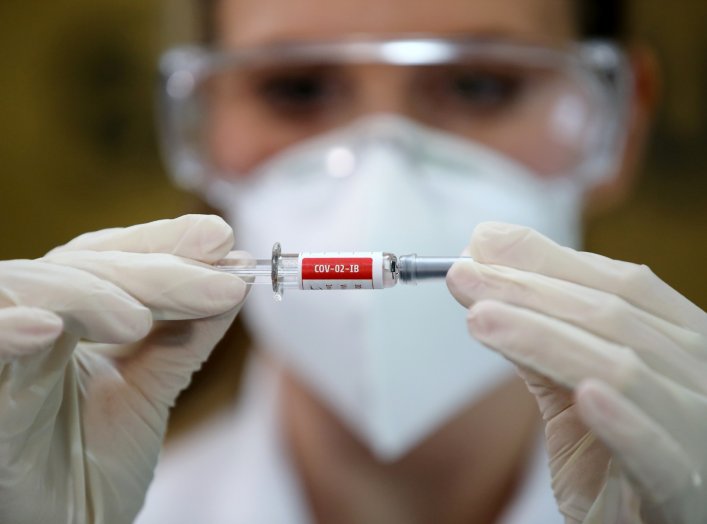
  There are  over 175  COVID-19 vaccines in development. Almost all government strategies for dealing with the coronavirus pandemic are base...