#Sponsored

Thursday, April 16, 2020

What Italy’s ‘Patient One’ Teaches Us Controlling the pandemic will require reshaping family life in much of the world. by RACHEL DONADIO

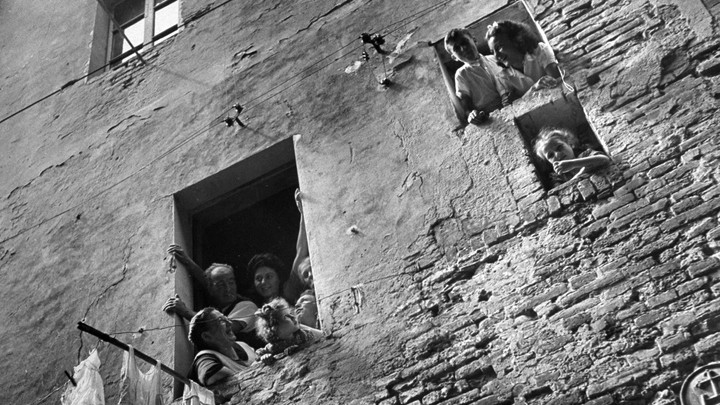
A family looks outside the window of their apartment in Siena, Italy.
The first person diagnosed with COVID-19 in Italy was a healthy 38-year-old who arrived at his local emergency room in Codogno, south of Milan, with flu-like symptoms. His condition quickly worsened, and doctors had the foresight to test him for the coronavirus. On February 20, his results came back positive. Within days, Codogno and other nearby towns in the region of Lombardy were on lockdown, and within weeks so was the entire country.
Patient One—for privacy reasons, we know just his first name, Mattia—spent weeks on a ventilator before he could breathe on his own again, and was released from the hospital only on March 22. In Italy, Mattia is most often portrayed as a success story, a story of resilience, in a country where more than 21,000 people have died from the coronavirus and some good news is needed. “Mattia teaches us that you can also recover from serious illness,” Raffaele Bruno, the head of infectious diseases at the San Matteo Hospital in Pavia, where Mattia was treated, told me.
But his story is also in some ways unsettling. While Mattia was still in the hospital, his father died of COVID-19, and his wife, nearly eight months pregnant, tested positive as well, though she eventually recovered. Mattia turned out to be a “super-spreader” who infected scores of others, including in his amateur soccer league, and at the hospital where he was diagnosed. His is a cautionary tale of asymptomatic contagion and the unpreparedness of hospitals. In an audio message after his release, Mattia urged his fellow Italians to stay inside, and said he was lucky to have been treated in the early days of the outbreak, before Lombardy started running low on ventilators. (Officials believe Italy’s Patient Zero, the first person to have brought COVID-19 to the country, is likely a German who traveled to northern Italy around January 25. I use the terms Patient One and Patient Zero cautiously: They’re important concepts in epidemiology, but morally complex—outbreaks have multiple causes, and we don’t want to stigmatize the infected.)
I see something else in Mattia’s experience—a story of pathos, in which life and death, pain and resilience are intertwined. Italy is a place of intricate family and community ties. Two and three generations often live in the same city, the same neighborhood, or even the same apartment building. People commute by train to other cities for work, while keeping their residence, and their family, in their hometowns, where a network of relatives can help raise their children. Without the extensive state-supported childcare of France and other European countries, many Italian grandparents are the primary babysitters, allowing parents to work and keep the gears of the economy turning. These ties are strong in Italy, where reliance on the family is typically greater than on the state.
They are also part of what put the country, with the second-oldest population in the world, after Japan, at such mortal risk, as contagion spread among relatives. It’s a pattern that is now being repeated around the world—especially in countries and cultures where large extended families are the rule, not the exception, and in lower-income communities in which people live in close quarters, where social distancing is fine in theory but nearly impossible in practice. All this bears a strange irony—in the recognition that for those of us able to look after ourselves, being alone, away from other humans, from our kin, is probably safer than being together. Controlling the pandemic will reshape family life for a long time to come.
Bruno told me that knowing whether Mattia infected his own father, or any of his other relatives, is “impossible.” Still, the sense of guilt that particular possibility might involve—or the generalized survivor guilt of weathering the pandemic when other family members or friends don’t—is something that will likely grow. “There’s a strong sense of shame and guilt that’s been underestimated,” David Lazzari, the president of Italy’s National Council of Psychologists, told me. “It often compels people to hide their symptoms, because maybe they’re afraid of identifying themselves as a carrier of the virus and then as someone who infects others.” Imagine, he continued, how people will live in the aftermath “with the idea that they infected half the town.” A lot of post-traumatic stress will ensue, he said. Now the pain is more immediate: a sense of powerlessness. Mourning without funerals. And being separated from the people we love. “We need to show our closeness, but from a distance,” Lazzari said.
For weeks now, I’ve been thinking about Patient One, from my apartment in Paris, where I live alone. All of us living far away from loved ones, especially older and more vulnerable relatives, have had to think long and hard about how best to offer support. Our immediate instinct is to want to gather together, to show closeness. Yet that is now the worst thing we could possibly do. Governments in France and Israel, where generations of families also tend to live in close proximity, have ordered older people to stay home, and told grandchildren to steer clear. In Germany, some health experts have suggested that children not see their grandparents until well into the fall, or even after Christmas. In Britain, where the government has told citizens to save lives by staying home, a cabinet minister was criticized for visiting his own parents.
Showing closeness from a distance requires overturning our most basic understanding of human contact and connection. But we have to stay distant, no matter how anathema that is to our world view. At least that’s what I like to tell myself, half a world away from my family in the United States. Weeks ago, the State Department raised its global travel advisory to its highest level—“Do Not Travel,” the ranking typically assigned to war zones—and began issuing warnings for American citizens to “arrange for immediate return to the United States unless they are prepared to remain abroad for an indefinite period.” But where was home? And how long was an indefinite period?
One of my closest friends in Paris, who is also American, gamed it out: If you went back to the U.S., he reasoned, you’d have to self-quarantine for two weeks when you got there. And if someone you loved were dying, you couldn’t actually be with them anyway. I had been reading L’Eco di Bergamo, the paper of a province north of Milan, with its 10 daily pages of square-inch-size obituaries, in which many of the dead were remembered as loving grandparents. I already understood, well before the reality set in in the United States, that when you die of COVID-19, you die alone. This truth was nearly impossible to bear.
I stayed in Paris—my life is here, my work is here, and I’m grateful my apartment has an unobstructed view of the sky. I called my parents and told them not to leave the house, not even to go to the grocery store. At the time, there were three presumptive COVID-19 cases in the state where they live. Doesn’t matter, I told them. The day before Mattia was diagnosed, Italy had no known cases. I called other relatives in the U.S., who were already hunkering down in their respective cities.
My solitude is not unendurable. I may be on my own here, but I’m in daily contact with friends and family around the world. We compare notes on lockdown measures. Some confide that they’re struggling—depressed, anxious, sometimes furious with their partners and children, worried about their unstable finances, angry at the world. I wish I could do something, at least babysit; instead, I listen. Everyone is scared. Has there ever been another moment when so many of us shared the same forebodings at the same time? I’m familiar with grief and existential powerlessness. I’ve wrestled, and tried to make peace, with loss. I’ve also worked from home, remotely, for years, and know how misunderstandings can be amplified with distance, and how hard reading the room is when there is no room.
We need to show our closeness, but from a distance. On a new weekly Zoom call with my entire extended family, a cousin recalled that my adored Great Aunt Natalie once shared with him her childhood memories of people walking around in masks during the 1918 flu pandemic. Aunt Nat had wanted to be a newspaper reporter but after high school, she wound up working as a stenographer and selling classified ads for the Cleveland Press to support her widowed mother and her two sisters during the Great Depression. How strange that the youngest generation in my family will also have childhood memories of adults wearing masks.
I think again of Mattia, the infector who survived. So much pathos and trauma, but also joy. Last week his wife gave birth to their daughter, Giulia. What kind of world will she inherit? I see my niece and nephew on screens. Sometimes I cannot even bear to call, because afterward, I miss their fierce faces and remember the feeling of their little warm bodies when we’d curl up together on the sofa to read books. This is now the price we pay for maintaining a safe distance, never knowing whether a physical visit might be a comfort or a threat. Everyone is so close but so impossibly far.

America’s Fault Lines Are Showing Not everyone can just work from home. by CAROLINE MIMBS NYCE

America’s fault lines are showing. As my colleague Joe Pinsker put it last week, there are really two pandemics:
One will be disruptive and frightening to its victims, but thanks to their existing advantages and lucky near misses with the virus, they will likely emerge from it relatively stable—physically, psychologically, and financially. The other pandemic, though, will devastate those who survive it, leaving lasting scars and altering life courses.
Where you end up depends on “a morbid mix of a sort of demographic predestination—shaped strongly by inequality—and purely random chance.”
Across the U.S., this outbreak is already exposing stark race, class, and gender divides—and threatening to exacerbate them.

CLASS

Not everyone can just work from home: Data suggest that benefit lies disproportionately with high-income Americans. And while the wealthy hunker down, essential workers remain at cash registers, fearful for their own health.
Plagues, counterintuitively, can be good for workers, my colleague Olga Khazan reports. One study of 15 major pandemics in history found that they increased wages afterward. Experts anticipate a turn toward populism post-outbreak, but whether it will be the Bernie Sanders or Donald Trump variety is unclear.

RACE

We now know for sure: The data show major racial disparities in COVID-19 cases. And yet too many politicians and commentators—relying only on anecdotal evidence—are engaging in victim blaming, Ibram X. Kendi argues.
“What if black people have been taking the coronavirus more seriously than white people for weeks, as the survey data suggest? What if despite all that, black people are still being infected and dying at higher rates from COVID-19?”

GENDER

No nurseries, no schools, no babysitters. As child care moves into the home, many families may fall back into a 1950s parenting model.
“With the schools closed, many fathers will undoubtedly step up, but that won’t be universal,” Helen Lewis wrote last month. “Some women’s lifetime earnings will never recover.”
One question, answered: The world is a scary place, outbreaks and otherwise. How do you raise a resilient child in 2020? Kate Julian, a senior editor and the mother of two children under 10, takes a long look in our latest magazine cover story:
To protect children from physical harm, we buy car seats, we childproof, we teach them to swim, we hover. How, though, do you inoculate a child against future anguish? For that matter, what do you do if your child seems overwhelmed by life in the here and now?
What to read if … you just want practical advice:
Tonight’s Atlantic-approved quarantine activity:
Dip your toe into video-game utopia. The best-selling game Animal Crossing is subtly subversive, our technology writer Ian Bogost argues.

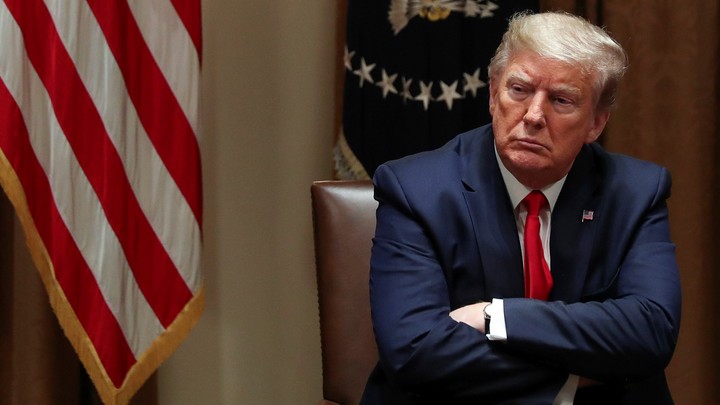
The WHO Defunding Move Isn’t What It Seems Trump is yet again attempting to distract the public from his own failures. by Graeme Wood

Donald Trump

President Donald Trump announced yesterday evening that he will withdraw funding for the World Health Organization, on the grounds that it helped China cover up the origin and extent of its coronavirus outbreak. The United States pays for the largest fraction (in recent years, about 17 percent) of the WHO’s budget. The WHO, in turn, funds the COVID-19 responses of dozens of countries around the planet, some of which are extremely vulnerable to the disease.
At about this point in the analysis, the expected move might be to explain why hobbling the WHO is unwise—how doing so will make us all less healthy and less safe; how it will be remembered as a moment when the U.S. chose to hasten its decline as a superpower; how funding the WHO gives the U.S. power over the group, and China will step in to seize the control the U.S. has ceded.
All these points are true—but only a sucker would focus on them. Defunding the WHO (or at least threatening to do so) is yet another instance of Trump’s signature move, one that I described just weeks ago, when he insisted on calling SARS-CoV-2 “the Chinese virus,” and for a few days journalists and social-media scolds obediently modified their criticisms to fit his latest outrage. The move is simple. When Trump is ensnared in controversy, when he is being asked straightforward, damning questions and his inquisitors do not stop asking them, he says or does something outrageous to change the subject. It works every time. It is working now.
At some point, it is hard not to admire his ability to deploy this move, transparently, over and over, and have it serve its purpose. It is like watching Kareem Abdul-Jabbar’s skyhook, or Lionel Messi’s nimble dribbling; everyone has seen him do it hundreds and hundreds of times and has had ample time to practice a defense against it. But the execution is perfect, and as his opponents helplessly watch the points rack up, they should acknowledge that they are in the presence of rare talent.
The trick, as with the “Chinese virus,” is to choose a plausible enemy, one whose misdeeds are not only undeniable but vital to acknowledge. It is, of course, true that COVID-19 originated in China, and anyone who suggests otherwise should not be trusted. As for the WHO, its errors were serious and unforced. Its delegation to Wuhan helped China underplay the severity of the outbreak, costing the rest of the world precious weeks. It denied that COVID-19 was contagious among humans as late as January 14, in an infamous tweet. At that point, when the disease may have already been spreading silently in the United States, people who trusted the WHO for medical advice would reasonably have believed that they were safe as long as they skipped the bat carpaccio. Then Bruce Aylward, a senior WHO official, appeared to suffer a neurological glitch on television when the presenter uttered the word Taiwan, a term forbidden by mainland China. Aylward had led the WHO delegation to Wuhan in February, and his aphasic reply to the presenter’s question suggested not only that the WHO had understated the outbreak and overpraised China’s response, but that the delegation had been brainwashed during its stay. These are all good reasons to criticize the WHO.
But to weigh these reasons, good and bad—the WHO’s sins against its virtues—is to go back to playing the sucker’s game, and to have an excellent view of Abdul-Jabbar’s armpit as the basketball hurtles overhead toward the hoop. Cutting off money to the WHO is not about policy. It is misdirection: Look here, not there, because you are calling attention to something you are not welcome to see.
The crisis in the United States has passed the point where literally everyone in the country feels personally affected—grieving for the dead or dying; in fear of poverty or hunger; robbed of beloved cultural figures; or just stuck at home. The question Are you better off than you were four years ago? is a sick joke, and Trump knows that it is going to be at his expense, electorally speaking. Naturally, he responds with the tactic that has served him well before: Swap a question with an answer that damns him for one with a complicated, controversial answer that tends to damn someone, anyone, else. Watch CBS’s Paula Reid at Monday’s press conference, asking the first question: “What did you do with the month of February?” Why don’t we have extensive testing capabilities, and why are hospitals still scrambling for the gear and equipment they need to protect health-care workers and save patients?
Trump, caught having completely bungled the only issue anyone will remember him for, will do anything to escape prosecutorial inquiries like these. He will be pleased, instead, to field complaints about his treatment of the WHO. The tactic he is using is one that has fooled too many people, too many times. We should hope, along with the WHO, that we won’t get fooled again.

Trump’s Backwards Federalism Could Actually Work Even if the president can’t mandate the states to reopen their economies, he can still do plenty to force that outcome. by Jane Chong

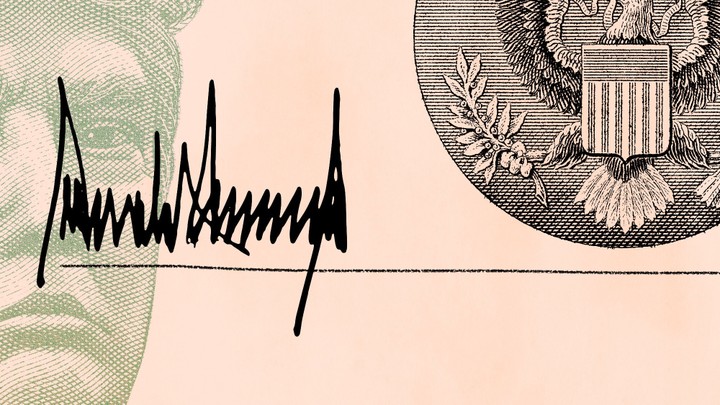
An illustration of Trump and his signature with the U.S. government seal
Things unraveled the usual way.
Earlier this week, President Donald Trump tweeted that whether to “open up the states” and restart the economy “is the decision of the President,” not state governors. He doubled down on his position at an afternoon White House news conference, where he added that, as president, he has “total” authority on the subject. Fact-checkers and legal experts rushed to repudiate the claim, citing, as usual, both the Constitution and Trump’s own prior statements. Trump lacks the legal authority to override the safety measures put in place by the states, they pointed out, and his tweets are inconsistent with his own insistence earlier this month that it’s up to state governors whether to impose the lockdowns in the first place.
The commentators aren’t wrong. But the interesting question is not really whether Trump has constitutional footing to forcibly compel states and municipalities to rescind the lockdown orders, but why he is inclined to assert that the decision to do so lies with him. And the even more interesting question is what powers Trump could, within his constitutional bounds, invoke to get businesses back open and Americans back on the streets.
Trump’s claim that he can unilaterally restart the economy is legally hard to square with his decision not to issue national lockdown guidance and to place the onus for such decisions on state governors. But politically, the two positions can be reconciled. An administration attuned to the latest public-health data on the coronavirus threat might be expected to move decisively toward a lockdown and to exhibit caution and incrementalism in advising rollbacks. Call it the London Breed model, for the San Francisco mayor now being lauded for declaring a citywide emergency and banning large gatherings back in February, in the face of intense political flak and well before most of the rest of the country’s leaders took action. An administration that views the risks and rewards of its response primarily through unemployment figures, however, might be expected to take the opposite tack—that is, hesitate to recommend widespread lockdown measures for fear of being blamed for the financial fallout and then seek a conspicuous role in easing those measures in the hopes of reaping the political upside that comes with an economic rebound. This is the Trump model.
Whatever Trump’s political calculus in claiming authority over the decision to reopen the country, his ability to follow up with substantive action is significant, though bounded. Trump cannot force governors and mayors nationwide to rescind their shelter-in-place orders, but he has other options for shaping the public’s perception of and ability to seek reprieve from the coronavirus threat, as well as the states’ capacity to manage the threat.
He could appeal directly to the public and convince Americans that it’s time to get back to work, thereby creating pressure for states and cities to loosen existing restrictions and surely affecting policy on the ground in Republican-led states such as Florida, whose governor resisted action for weeks and explicitly looked to the White House for instruction before finally issuing his stay-at-home order. Trump could mandate a shift in the federal government’s messaging—that includes not only the president’s own coronavirus guidelines but also Centers for Disease Control and Prevention guidance relied on by states, the general public, schools, businesses, health-care providers, and first responders. His agencies could continue to calibrate the many rules and interpretations they are charged with issuing to implement the programs and initiatives laid out in Congress’s stimulus bill, affecting matters as fundamental as which employees can take sick leave and for how long, and businesses’ incentive to retain rather than lay off workers. And Trump has great discretion in the ongoing disbursement of relief funds and allocation of national resources to the states.
For two very different camps, those anxious about what Trump might do and those eager to defend him for not doing enough, the temptation is to fixate on the outer limits of the president’s powers—such as Trump’s inability to forcibly impose or lift lockdown measures—while giving short shrift to the many courses of action well within the executive branch’s purview. This kind of lopsided thinking is evident even among proponents of expansive executive power. For instance, the legal scholar John Yoo recently argued that the states bear the brunt of the responsibility for responding to the pandemic, because only they have the authority, and manpower, to forcibly restrict the physical movements of the citizenry, and that the federal government’s authority is confined to “truly national problems.” That position extrapolates too much from the bare fact that quarantine powers lie with the states, and overlooks all the ways and all the stages at which the federal government has been uniquely positioned to effectuate—or stymie—a coordinated response to an unfolding international health crisis.
The bottom line is that the president’s powers are immense, and particularly so in the midst of an emergency whose outcome so clearly hinges on the country’s ability to get on the same page about which sacrifices are necessary and for how long. Trump has indicated his intention to reopen the economy, and soon. There is plenty he could do to make good on that intention, including over the recommendations of his own medical experts, and not much comfort to be derived from what he can’t.

The Pre-pandemic Universe Was the Fiction What the coronavirus outbreak reveals is not the unreality of our present moment, but the illusions it shatters. by CHARLES YU


Years ago, I started writing a short story, the premise of which was this: All the clocks in the world stop working, at once. Not time itself, just the convention of time. Life freezes in place. The protagonist, who works in a Midtown Manhattan high-rise, takes the elevator down to the lobby and walks out onto the street to find the world on pause, its social rhythms and commercial activity suspended. In the air is a growing feeling of incipient chaos. I got about midway through page 3 and stopped. I didn’t know what it meant.
One word I’ve been hearing a lot lately is unreal. Mostly, I hear it from my own mouth, because I haven’t left the house in a month, but also I hear it from friends on Zoom or Skype, and from the news on TV or online. Unreal, or its variations: not realsurrealthis can’t be real.
Of course, the global catastrophe unfolding is nothing but real. Stock-market convulsions have destroyed, in a matter of days, nest eggs built over decades. More than 16 million people in the United States applied for unemployment over just three weeks. The case count and death toll grow with each refresh of the page.
And yet some part of me still doesn’t want to accept that these calamities are really happening. Not really. What does it mean to say that this doesn’t feel real? The feeling seems to derive from the assumption that life before the pandemic, “normal” life, was real. That we have departed from it into strange territory.
But what if it’s exactly the other way around?
What the current crisis and our responses to it, both individual and institutional, have reminded us of is not the unreality of the pandemic, but the illusions shattered by it:
The grand, shared illusion that we are separate from nature.
That life on Earth is generally stable, not precarious.
That, despite what we know from the historical and geological and biological record, human civilization—thanks to advancements in science and medicine and social and governmental structures—exists inside a bubble, protected from the kind of cataclysmic event we are currently experiencing.
What I’ve learned in the past few weeks is that this supposed technological bubble was just that: a thin layer that popped easily.
The stronger bubble, the one that persists, is the psychological one. Even as our stark new reality becomes clear, it remains hard to accept that “normal” was the fiction. It will take some time to let go of the long-held, seldom-questioned assumptions of everyday life: that tomorrow will look like yesterday, next year like the last.
These assumptions are a luxury. For me, they are a cross product of my intersecting privileges: born in the United States, to professional parents, at a point in history where my life has proceeded, for the most part, through a series of economic booms without major socio- or geopolitical upheavals. Or at least with upheavals far enough removed so as to allow me to feel physically and mentally insulated. Living with these assumptions for so long has created a kind of expectancy as to how things tend to go, that my life has to make some kind of sense.
But what if it doesn’t? Quantum mechanics might provide a useful, if rough, analogy. At a fundamental level, physical reality defies our most basic intuitions about causality and locality, which is to say about time and space. Our senses and perceptions evolved to evade tigers and catch food, not to understand the properties of photons and subatomic particles. Despite more than 100 years of effort by the world’s leading physicists and philosophers, the quantum realm remains incomprehensibly bizarre. As it turns out, science fiction cannot invent anything weirder than the brute reality of the universe itself. The fact that we cannot comprehend it is a form of environmental mismatch.
We may face a similar type of conceptual difficulty in grappling with a pandemic. Our brains may not be naturally suited to dealing with problems of this scale or nature. Even our language, our concepts, are inapt tools, artifacts of our previous reality. Unprecedentedhistoric, we proclaim, with each new, grim milestone. As if precedent and history have bearing on a virus that seeks only to maximize copies of itself.
Perhaps most revealing is how we say the damage, the fallout, and the speed at which things are happening feel unimaginable, a word telling both in its rightness and wrongness. We “imagine” this kind of disaster all the time, in our dystopian-novel trilogies, our bingeable streaming miniseries. And most famously, in our summer popcorn global-disaster blockbusters, a well-worn genre that derives its pleasure and dread from the same source: literally imagining the worst. We enter dark, cool theaters in the middle of July, portals to other universes in which various doomsday scenarios play out. But here’s the key: We’re always behind a scrim of safety, a barrier between what we think of as possible and impossible. We watch these movies as tourists in an alternate reality, knowing that our round trip lasts two and a half hours, and then we will be home, safe in the real—and boring—world.
And of course, novel, we call it, but SARS-CoV-2 has been around in some form for thousands of years or more. It is novel only to us, Homo sapiens, the one species that imagines its survival, its success, as the central narrative of the story of this planet. A story with a beginning and middle and end. A story that has structure and rules. A story that means something.
In the current chapter of this story, there are ostensible villains: some members of the Trump administration (including the president himself) and officials at the state level who have been reckless or incompetent or self-interested or shortsighted or all of the above. There are heroes as well: certain governors and mayors, science advisers and health-care professionals, individuals who, in a time of uncertainty, have performed with courage, duty, expertise, and sacrifice.
But the reality is, zooming out to the largest scale, fighting the pandemic effectively requires us to take actions that go against our instincts, our intuitions, the things we evolved to be good at. Cooperation—farsighted, strategic, collaborative action—is required to defeat an adversary that relies on our physical cohesion. We can find meaning in how we fight it, but relying on our old illusions, assuming that we, as humans, will prevail, is dangerous. Life, for us and the virus, is about genes propagating themselves. No amount of magical thinking or bluster or can-do attitude can change that fact.
As we hear reports of peak deaths and curves flattening, the quiet wonderings about when life will return to normal will get louder every day. As the whispers grow, it will be important to remember: Things don’t have to be resolved in a way that works out all right for us, or for our economy, for any particular systems or ways of living. Things aren’t necessarily going to be okay in a reasonable timeframe just because we want them to. To think otherwise is to succumb to the fiction, a sheltered, resource-rich mindset (presumably not shared by the billions of people who have long lived in volatile conditions and are thus under no such illusions).
Five hundred years ago, Copernicus re-centered the universe away from us, outward. The COVID-19 outbreak is a reminder: The world isn’t for us; we are part of it. We’re not the protagonists of this movie; there is no movie. After all the suffering and wreckage have subsided, one good thing for our long-term viability will be to have changed our ways of thinking. To have regained a humility.
I say humility because, as it turns out, unimaginable says more about the limits of our imagination than about reality itself. What we really mean when we say that this pandemic feels “unimaginable” is that we had not imagined it. Just as imagination can mislead us, though, it will be imagination—scientific, civic, moral—that helps us find new ways of doing things, helps remind us of how far we have to go as a species. How little we still understand about our place in this world—terrifying and awful at the moment—but also how much we still get to discover. How fragile and rare our ordered structures are, our fictions, and how precious. How next time, we might rebuild them, stronger.

How the Coronavirus Could Create a New Working Class Experts predict the outbreak will lead to a rise in populism. But will workers turn their rage toward corporate CEOs, or middle-class “elites”? by Olga Khazan


A plastic bag and a black leather handbag six feet apart
Late last month, a photo circulated of delivery drivers crowding around Carbone, a Michelin-starred Greenwich Village restaurant, waiting to pick up $32 rigatoni and bring it to people who were safely ensconced in their apartment. A police officer, attempting to spread out the crowd, reportedly said, “I know you guys are just out here trying to make money. I personally don’t give a shit!” The poor got socially close, it seems, so that the rich could socially distance.
The past few weeks have exposed just how much a person’s risk of infection hinges on class. Though people of all incomes are at risk of being laid off, those who can work from home are at least less likely to get sick. The low-income workers who do still have jobs, meanwhile, are likely to be stuck in close quarters with other humans. For example, grocery-store clerks face some of the greatest exposure to the coronavirus, aside from health-care workers. “Essential” businesses—grocery stores, pharmacies—are about the only places Americans are still permitted to go, and their cashiers stand less than an arm’s length from hundreds of people a day.
My inboxes have filled up with outcries from workers at big-box retailers, grocery stores, and shipping giants who say their companies are not protecting them. They say people are being sent into work despite having been in contact with people infected with the virus. They say the company promised to pay for their quarantine leave, but the payment has been delayed for weeks and they are running out of money. Or the company denied their medical leave because they don’t have proof of a nearly impossible-to-get COVID-19 test. Or the company doesn’t offer paid medical leave at all, and they’re wondering how they’ll pay for gas once they recover from the disease.
Masks are in short supply nationwide, and some managers have resisted allowing workers to wear them, fearing it will disrupt the appearance of normalcy. Some companies have rolled out “hazard pay” for employees, but in many cases it amounts to about $2 more an hour. The Amazon employees I’ve spoken with largely work fewer than 30 hours a week, and the company does not provide them with health insurance. One Walmart employee used up all his attendance “points” while sick with the virus, and was fired upon his return to work. (Walmart did not comment on his situation for my story.) At least 41 grocery-store workers have already died from the virus. “I make $14.60 an hour and don’t qualify for health care yet,” one grocery-store employee in New Mexico wrote to me. 
“I am freaked out.”

Meanwhile, many white-collar workers have no “points” system. Many such jobs offer as much paid time off as an employee and her manager agree to—a concept far beyond even the most generous policies at grocery stores. Many PR specialists, programmers, and other white-collar workers are doing their exact same job, except from the comfort of their home. Some are at risk of being laid off. But for the most part, they are not putting their lives in danger, except by choice.
Wealthier people also have fewer underlying health conditions that exacerbate COVID-19. And they are more likely to be practicing social distancing effectively, according to Gallup. Perhaps this is because they don’t need to leave the house as much for their livelihood: Gallup also found that 71 percent of people making more than $180,000 can work from home during the pandemic, compared with just 41 percent of those making less than $24,000. According to a recent analysis by The New York Times, the well-off are staying home the most, especially during the workweek, and they also began practicing social distancing earlier than low-income workers did.
“Self-isolation is an economic luxury,” says Justin Gest, a public-policy professor at George Mason University and the author of The New Minority. For those working-class people who do still have jobs, “it probably requires a physical presence somewhere that exposes them to the virus.”
At the same time, it isn’t as if grocery workers can simply stop coming to work. More self-checkouts could be used and more contact-free deliveries could be made, but someone has to get the Cheerios off the truck and onto the shelves. We are, through this virus, seeing who the truly “essential” workers are. It’s not the people who get paid to write tweets all day, but the people who keep the tweeters in chickpeas and Halo Top.
Epidemics and other natural disasters tend to both illuminate and reinforce existing schisms. “The division in our society between those of us who can keep our jobs and work from home and others who are losing their jobs or confronting the dangers of the virus … I think there’s a real chance that it could become more intense,” says Peter Hall, a government professor at Harvard.
Some service workers have taken to Twitter and private messaging groups to lament the fact that while they’re getting coughed on by strangers, their corporate bosses have retreated to their summer houses. AmazonInstacart, and Whole Foods workers have already gone on strike to protest their working conditions. This in itself is fairly extraordinary, because American workers rarely strike. In 2017, there were just seven major work stoppages. In a particularly Gilded Age twist, Amazon’s lawyer described one of the walkout leaders, Christian Smalls, as “not smart or articulate” in a leaked memo obtained by Vice News.
To find out how these rifts might escalate, I spoke with 15 experts on the sociology and politics of class. When the dust settles, there’s of course a chance that low-income workers might end up just as powerless as they were before. But history offers a precedent for plagues being, perversely, good for workers. Collective anger at low wages and poor working protections can produce lasting social change, and people tend to be more supportive of government benefits during periods of high unemployment. One study that looked at 15 major pandemics found that they increased wages for three decades afterward. The Plague of Justinian, in 541, led to worker incomes doubling. After the Black Death demolished Europe in the 1300s, textile workers in northern France received three raises in a year. Old rules were upended: Workers started wearing red, a color previously associated with nobility.
The U.S. has long been the sole holdout among rich nations when it comes to paid sick leave and other job protections. Now that some workers are getting these benefits for the coronavirus, they might be hard for businesses to claw back. If your boss let you stay home with pay when you had COVID-19, is he really going to make you come in when you have the flu? “Is this going to be an inflection point where Americans begin to realize that we need government, we need each other, we need social solidarity, we are not all cowboys, who knew?” said Joan Williams, a law professor at UC Hastings and the author of White Working Class.
Many experts said one likely result of this outbreak will be an increase in populist sentiment. But it is not yet clear whether it will be leftist populism, in the style of Senator Bernie Sanders, or conservative populism, in the style of President Donald Trump. Leftist populism will likely emphasize the common struggle of the laid off, the low-paid, and the workers derided by their bosses as expendable. Meanwhile, “right populism will ask white working-class people to be in race solidarity with rich white Americans,” Betsy Leondar-Wright, a sociologist at Lasell University, said. It will perhaps lead to the scapegoating of Chinese people and other foreigners.
Which path we go down depends, first, on whom workers brand as the “elites.” Will it be the corporate CEOs who have put them in that position, or the middle-class account coordinators who have had envious quarantines by comparison? If workers’ ire is aimed at companies, they may be forced to change corporate policies accordingly. But if America’s working class decides the enemy is the professional class—the $50,000-a-year Bushwick bloggers—we may see more misplaced bitterness toward “elites” who really aren’t.
A few months from now, the path we take will also depend on whether voters ultimately blame Trump for the pandemic and the ensuing economic collapse, and on whether Democrats are able to create a coherent narrative out of the calls for better worker protections. And in a year, it will depend on how severe the death toll turns out to be among service workers, and how well they’re able to organize in response. But if past epidemics are a guide, the workers may win out in the end.
There’s also cause, of course, to think that blue-collar life won’t be any better after the pandemic ends. In addition to being bad for workers’ health, the pandemic might well be bad for workers’ rights. After all, right-leaning populists have a political party; left-leaning populists do not. Liberal Democrats—Sanders and Elizabeth Warren—were trounced in the Democratic primary. Trump, meanwhile, is still the president.
As the election draws near, he could start to inflame tensions by claiming that the pandemic is the fault of foreigners or elites in big cities, which have so far been hit harder by the virus. Outsiders make convenient fall guys for pandemics; the Black Death led to massacres of Jews across Europe. People in some pockets of the country might not see mass deaths from COVID-19, but they would still feel the economic devastation—the layoffs, the closed businesses—convulse their town. That could become a source of resentment, said Amy Chua, a professor at Yale Law School and the author of Political Tribes. The whole thing could seem like a hoax, blown out of proportion by liberal health wonks. If merely simmering cultural tensions brought Trump to power, think what boiling ones could do.
Republicans and Democrats already see the pandemic very differently. A Pew Research Center poll conducted March 10 to 16 found that about 80 percent of people whose main source is Fox News thought that the media slightly or greatly exaggerated the risk of the pandemic. As my colleague McKay Coppins wrote, Democrats are generally taking social distancing more seriously than Republicans are, with the most ardent deniers defiantly cozying up to strangers just to own the libs. According to a recent Pew report, Democrats are more likely than Republicans to see the coronavirus as a “significant crisis.” A recent profile of the ironically named Wellsville, Kansas, in The Washington Post revealed a town that believes the virus was made up by the media to besmirch the president. In parts of the country that are less affected by the virus, more people could become Trump supporters. Trump’s approval rating is going up in part because some people think he’s doing a good job handling the pandemic.
Poor Americans don’t uniformly support greater government intervention on behalf of workers, and it’s not clear whether the pandemic is going to shift those hardened political fault lines. In the past few decades, many low-income whites have become allied with other whites, not with other poor people. “White workers with lower levels of education have fled in large numbers to the Republican Party and are increasingly voting based on their ethno-nationalist beliefs, not class solidarity,” Bart Bonikowski, a Harvard sociology professor, said.
There is always the risk that legislators, having witnessed a cohort of children get a decent-enough education through a combination of Zoom sessions, home-ec projects, and exhausted parents, might decide that public schools aren’t worth funding all that generously. (Though, after wrangling their own children while Skyping into meetings, Americans might also develop a new appreciation for child-care workers and teachers.)
Finally, organized labor has been gutted in recent decades, making any sustained workers’-rights movement seem like a long shot. Busy employees at big-box retailers spread across the country don’t have a centralized way to communicate or even much time to do so. They also have little in common with the health-care workers treating COVID-19 patients—other than that both groups are, for now, in harm’s way. “I just think it’s tough for that to become a movement,” Christopher Witko, a political-science professor at Penn State University, said. “Americans always say, This changes everything. But it never changes anything.”
Still, entrenched beliefs about poverty and wealth are already being shaken up. Americans have long revered the wealthy, believing that they earned their place atop the hierarchy. The argument, in some quarters, has been that people should simply work harder or get more education to escape “dead-end” jobs like those in warehouses or grocery stores. But today, those jobs are more crucial than middle management in white-collar firms. Disgust with the wealthy might reach an Occupy-level fever pitch, while we learn just how important the humble checker or delivery driver really is.
Such a change would be a return to a 1950s-style view of the working class, in which low-wage jobs conferred a sense of dignity. “You viewed yourself as the backbone, the heart and soul of America,” Gest said. No one is more essential than the person bringing you food at the end of a long, frightening week.
America’s poor have previously blamed themselves for their own poverty, Allison Pugh, a University of Virginia sociologist, said. But “it’s gonna be hard to blame yourself when your grandmother dies,” she said. “All of a sudden, it doesn’t feel like your fault anymore. And you’re gonna look up and be like, This is not okay.
Left-leaning populism hasn’t triumphed at the national level recently: Joe Biden just became the presumptive Democratic nominee after defeating Senator Sanders. But these types of worker protections have been a plank of the Democratic Party for years. In the future, a more social-democratic-type candidate might break through nationally—especially, Witko said, if it were a young, perhaps Hispanic candidate who spoke to a broad swath of voters. This crisis has revealed just how bad service workers have it, and afterward, their struggle might be hard to ignore.
A similar phenomenon happened when cholera struck Hamburg in 1892. The city, a large seaport in northern Germany, was then semiautonomous, and it was controlled by merchants who valued trade above all else. These businessmen did not consider public health to be a sound investment. Cholera is transmitted through tainted water, but unlike the rest of Germany, Hamburg’s authorities did not install a filtration system in the municipal water supply.
The local government in Hamburg at first played down the epidemic and resisted imposing a quarantine on the city. Much like President Trump in recent weeks, they seemed to be asking themselves, “Which interest do we put first, the economy, or peoples’ lives?” Richard Evans, author of Death in Hamburg, said. “By the time they got around to admitting it was there, it was too late.”
That August was unusually hot and dry; the city’s canals ran low. These were ideal conditions for Vibrio cholerae to creep into the water supply. Because the disease spread through human waste, people with their own bathrooms were less likely to contract it. Survivors recalled having servants scrub their houses and boil their water before they used it. The servants themselves could afford no such luxury. And much of the town’s poor population worked near the harbor, where the water was filthy and teeming with cholera bacteria. Within six weeks, up to 10,000 people had died, and the death rate among the poor was much higher than that among the rich. Through their labor, the poor sacrificed so the wealthy could survive.
That disparity seemed to galvanize the entire city. The following year, left-leaning Social Democrats won all three of Hamburg’s seats in the national Parliament. Later came an expansion of voting rights, housing reform, and, finally, the installment of a treatment system for the city’s water. Cholera killed thousands in Hamburg, but in its aftermath, the working class was given new life. In 2021, the American working class might seize their moment, too.

What Will Happen if the Coronavirus Vaccine Fails? A vaccine could provide a way to end the pandemic, but with no prospect of natural herd immunity we could well be facing the threat of COVID-19 for a long time to come. by Sarah Pitt

  There are  over 175  COVID-19 vaccines in development. Almost all government strategies for dealing with the coronavirus pandemic are base...